
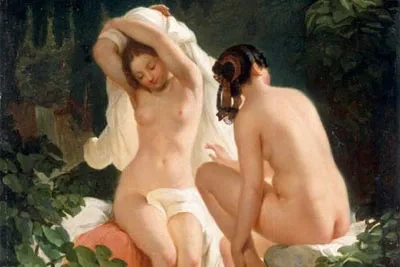
This summer, nude bathers can be encountered in Austrian Salzburg.
In the Italian medieval castle of Gradara, which in itself can be considered a work of art, paintings and drawings will tell you about 'stolen kisses' (it was in this castle that the tragic love story of Paolo and Francesca, described by Dante, unfolded). And if you happen to be in Scotland this summer, remember that a large 'Spanish' exhibition is currently running in Edinburgh.
Some types of art can also be encountered outdoors: on August 8, the Sand Sculpture Festival begins on the shores of Lake Constance in Swiss Rorschach. Winners will be announced on August 15. The sand sculptures, as organizers promise, will stand until mid-September. Admission to this exhibition is free.
More details about these and other events in Europe's cultural life in August are provided by Gazeta.Ru in the next issue of the review 'Exhibitions of Europe'.
AUSTRIA
Bathing Scenes, July 10 – November 1, Salzburg. The Salzburg Residence Gallery is famous for its unusual thematic exhibitions. This summer and autumn, the museum is showing a cultural exhibition dedicated to the depiction of bathing scenes in different eras. Ritual and pleasure, the symbolic rite of purification and eroticism, landscape and genre scenes – these are the aspects in which the ancient connection between man and the element of water is examined at the exhibition. Visitors will be able to see paintings by 60 artists, including Jan Brueghel the Elder, Albrecht Dürer, Andrea del Sarto, Francesco Solimena, Cornelis de Vos, Jean Antoine Watteau, Félix Vallotton, Claude Joseph Vernet, Maurice Denis, Wilhelm Busch, Paul Cézanne, Lovis Corinth, Otto Mueller, Herbert Boeckl, and other artists. //www.residenzgalerie.at
Retrospective Exhibition of Cy Twombly, until October 11, Vienna. The Museum of Modern Art (MUMOK) in Vienna is hosting a retrospective exhibition of one of the most popular American artists, Cy Twombly (born 1928). At the beginning of his career, Twombly was part of the group of popular American abstract expressionists, exhibited with Robert Rauschenberg and Jasper Johns, and in the mid-20th century the artist moved to Rome, where he still lives. In general, in Cy Twombly's life, private and public mythology boldly intertwine. His private myth is associated with his move to Europe and reclusive lifestyle – this is why facts such as the imposition of a fine on a French woman who kissed his painting, or the award to Twombly himself of the 'Golden Lion' at the Venice Biennale, or the fact that his works are actively bought for large sums of money, seem sensational. It is believed that the artist achieved such popularity through a deep study of ancient mythology and Mediterranean culture. It is these motifs in the artist's work that the Vienna exhibition is dedicated to, which will feature paintings, drawings, sculptures, collages and photographs by the artist, including the latest cycle of works created specifically for this exhibition. //www.mumok.at
GREAT BRITAIN
'The Discovery of Spain for British Collectors and Artists: from Goya to Picasso', July 18 – October 11, Edinburgh. The title of this exhibition, which recently opened at the National Gallery of Scotland as part of the Edinburgh International Festival, fully reflects both its content and composition. In the 19th century, British collectors and artists truly discovered Spanish painting; scholarly works devoted to the work of Velázquez and Goya appeared. The exhibition presents about 130 paintings, drawings, and prints by great Spanish artists from private and state collections (including works by El Greco, Goya, Velázquez, Zurbarán, Picasso), as well as works by British artists whose work in one way or another reflects the Spanish theme. Visitors will see paintings by Arthur Melville and David Wilkie with Spanish landscapes and genre scenes, works by John Everett Millais created under the influence of Velázquez's painting, paintings by Eric Gill, Augustus Edwin John, and Barbara Hepworth who participated in the exhibition 'Artists Against War and Fascism', which was a kind of response to the tragic events in Spain in the 1930s. The works of these artists are compared with paintings by Picasso created in the same period, including 'The Weeping Woman', painted in 1937. //www.nationalgalleries.org
Exhibition of Richard Long, until September 6, London. You can get acquainted with one of the popular trends of the second half of the 20th century – land art – at the exhibition of the contemporary English artist Richard Long (born 1945) at the Tate Britain gallery in London. Land art seeks to return art to nature, using deserted, 'wild' landscapes as both object and artistic material. Richard Long's first work in this style was created in 1967 – the artist trampled a straight line in a field, which became his own path, a 'walk nowhere'. In general, the idea of a walk lies at the heart of Richard Long's art: 'I began to work in the surrounding space, using natural materials – such as grass, water, stones, and this later transformed into the idea of creating sculpture by means of an ordinary walk. Thus, the walk as art provided me with a certain ideal that allowed me to explore the relationships between time, distance, geography, and measurement.' Naturally, the main exhibits at this exhibition will be photographs of Richard Long's landscape sculptures. //www.tate.org.uk
HUNGARY
Turner and Italy, July 15 – October 25, Budapest. The Museum of Fine Arts in Budapest recently opened a large thematic exhibition "Turner and Italy," which has already been shown in Ferrara and Edinburgh. Joseph Mallord William Turner's (1775–1851) fascination with Italy and Italian art began in his youth during his studies at the Royal Academy in London. "Dreams of Italy" is the title of the first part of the exhibition, which features old books about Italy, as well as engravings and paintings by Richard Earlom, William Woollett, Giovanni Battista Piranesi, and Claude Lorrain. The following seven parts present about 80 paintings, watercolors, and drawings by Turner himself from museums in Europe and the United States, related to his numerous travels in Italy. The works are arranged chronologically, allowing visitors to observe the evolution of the artist's style. //www.szepmuveszeti.hu
GERMANY
"Long Night of Museums," August 29, Berlin. This August, the annual "Long Night of Museums" event will take place in Berlin for the 25th time. From 6 PM to 2 AM, more than 100 museums and art galleries open their doors to guests. Visitors have the opportunity to see not only permanent exhibitions but also temporary ones. On this night, the city also hosts specially organized concerts, readings, music and theater performances, and special guided tours are prepared. As in previous years, buses will run on eight routes between museums, and traveling on them is included in the ticket price (?12), which allows entry to all museums and exhibitions. //www.lange-nacht-der-museen.de
Exhibition of Carl Gustav Carus, until September 20, Dresden. A large exhibition dedicated to the life and work of the German physician, philosopher, psychologist, and artist Carl Gustav Carus (1789–1869) recently opened in Dresden. He was a professor at the Saxon Medical-Surgical Academy, personal physician to the royal family, engaged in comparative anatomy and psychology, was elected president of the German Academy of Natural Scientists, and was passionate about philosophy and painting. He was friends with Goethe, the geographer and explorer A. Humboldt, and the painter C. D. Friedrich.
The versatility of Carl Gustav Carus's personality is fully reflected in the Dresden exhibition, which will present about two hundred of his landscapes, drawings, anatomical engravings, as well as Carus's anthropological collection, medical instruments, and books. In addition, visitors will be able to see 50 paintings by other artists, contemporaries of Carus, including Caspar David Friedrich, Johann Christian Dahl, David d'Angers, and Ernst Rietschel. The exhibition is divided into two parts and takes place in the Old Masters Picture Gallery (in the Semperbau) and in the Cabinet of Prints (in the Residenzschloss). Then the exhibition will move to Berlin. //www.skd-dresden.de
GREECE
"Rodchenko and Popova: Defining Constructivism," until September 20, Thessaloniki. This exhibition was hugely successful in February–May at London's Tate gallery, attracting over 100,000 visitors; in October it will move to Madrid, and now it can be seen at the Museum of Contemporary Art in Thessaloniki. The exhibition is dedicated to the evolution of the aesthetics of Russian Constructivism from 1917 to 1929: from abstract painting to typography and utilitarian art. Visitors will see about 350 works by Lyubov Popova (1889–1924) and Alexander Rodchenko (1891–1956), who in the 1920s became one of the leaders of "production art" – the radical wing of Constructivism, whose representatives tried to incorporate the factors of time and space into art to achieve a "synthesis of the plastic arts."
The exhibition will feature paintings, posters, photographs, theater set designs, book illustrations, and costumes. Visitors will see works by Lyubov Popova from the series "Painterly Architektonics" and "Spatial-Force Constructions," as well as Rodchenko's monochrome canvases from the 1921 exhibition "5x5=25," his photographs and film posters. //www.greekstatemuseum.com
DENMARK
"Masks: from Carpeaux to Picasso," August 7 – November 1, Copenhagen. This exhibition has already been shown in Paris (Musée d'Orsay) and Darmstadt (Mathildenhöhe), and at the beginning of August it opens again at the Ny Carlsberg Glyptotek in Copenhagen. Interest in the mask in the art of the late 19th and early 20th centuries is usually associated with the crisis of realism, the search for new universals in the depiction of man, and the emerging interest in primitive art and Japanese painting. Ritual, theatrical, and carnival masks became popular among writers, theater directors, sculptors, and artists. The Copenhagen exhibition brings together paintings, sculptures, and drawings by James Ensor, Edvard Munch, Félix Vallotton, Arnold Böcklin, Max Klinger, Paul Gauguin, and Pablo Picasso. //www.glyptoteket.dk
SPAIN
Exhibition of Maurice de Vlaminck, until October 18, Barcelona. The CaixaForum exhibition center in Barcelona recently opened an exhibition of the French artist Maurice de Vlaminck (1876–1958), whose life and work embody the successful career of a self-taught painter. Vlaminck turned to painting only in 1899, having previously been a cyclist, musician, and journalist. In 1905, Vlaminck participated in the Salon d'Automne and the Salon des Indépendants, and in 1907 his solo exhibition brought him fame.
The Barcelona exhibition presents works from the early period of 1900–1915 – a period of searching and finding his own style. The exhibition is arranged chronologically and by genre, clearly reflecting the evolution of the artist's painting (Impressionism – Fauvism – Cubism – Neo-Impressionism) and the influence of van Gogh and Cézanne on his work. In addition to Vlaminck's paintings, the exhibition will feature a collection of sculpture and ceramics assembled by the artist himself. //www.obrasocial.lacaixa.es
Exhibition of Kees van Dongen, until September 27, Barcelona. The organizers of the exhibition at the Barcelona Picasso Museum propose to take a fresh look at the work of French artist of Dutch origin Kees van Dongen (1877–1968) and his connection with the work of Pablo Picasso and Henri Matisse. In 1897, van Dongen moved to Paris, lived in Montmartre, and became a participant in the famous Salon des Indépendants, initially earning money by drawing for newspapers. Later he became one of the most prominent representatives of expressionist Fauvism, whose paintings were flashy, bright, and even shocking, full of an 'orgy of light, warmth, and color.' The exhibition will mainly feature van Dongen's female portraits, which became his favorite theme, a whole 'poem of the sensual world,' as well as illustrations and graphic works little known to the general public. //www.bcn.cat
ITALY
Exhibition of jewelry by Alberto Zorzi, July 29 – November 1, Florence. The Silver Museum in Palazzo Pitti will soon open a solo exhibition of contemporary jewelry designer Alberto Zorzi (born in 1958), belonging to the Paduan school of jewelers. Zorzi's early works are characterized by geometric design – his pieces are based on the simplest geometric shapes. The master's latest works are distinguished by the fact that he creates inexpensive jewelry from many thin plates, fastening them together into abstract forms. The most famous series made in this style is the 'City' series: the jewelry resembles a view of a city from above, from a very great height. The exhibition will feature not only Alberto Zorzi's jewelry from 1973–2009, but also his silver items, drawings, and sketches. //www.uffizi.firenze.it
'Stolen Kisses,' until November 2, Gradara. The medieval fortress of Gradara, completely restored in the last century, is located 25 km from Rimini and 13 km from Pesaro. The history of the fortress-city is connected with the names of Malatesta, Sforza, and della Rovere – families without which the history of Italy is unimaginable. But the main thing this fortress is famous for is, of course, the tragic story of the legendary forbidden love of Paolo and Francesca, killed in this castle by Francesca's husband and Paolo's brother, Giovanni. The castle recreates the setting of these events, which took place between 1285 and 1289, including Francesca's bedroom, where the bloody drama unfolded. In the 'Divine Comedy,' Dante immortalized their memory and their 'love, which compels the beloved to love.' The exhibition 'Stolen Kisses' tells several world-famous love stories known to us from literature, and then illustrated in painting of the 19th–20th centuries. These are the love stories of Paolo and Francesca, Lancelot and Guinevere, Tristan and Isolde, Romeo and Juliet. //www.bacirubatigradara.com
FINLAND
'Surrealists and Dadaists,' until September 22, Helsinki. The Art Museum of the Tennis Palace (Taidemuseo Tennispalatsi) is hosting an exhibition dedicated to the history of two avant-garde movements of the 20th century – Surrealism and Dadaism – and their influence on contemporary art. This history will be illustrated by masterpieces from the Israel Museum (Jerusalem). The exhibition features works by Hans Arp, Max Ernst, Francis Picabia, Marcel Duchamp, René Magritte, Yves Tanguy, Salvador Dalí, and other iconic artists, as well as Surrealist and Dadaist journals and manifestos, and photographs. As part of the 'Night of the Arts' event on August 21, from 11 am to 9 pm, admission to the museum and the exhibition will be free. //www.hel.fi
FRANCE
'Matisse – Marquet: Correspondence,' July 16 – November 2, Bordeaux. Perhaps fate itself brought together two artists of the Parisian Belle Époque – Henri Matisse (1869–1954) and Albert Marquet (1875–1947). Young provincial artists came to conquer Paris, studied together at the École des Beaux-Arts under Gustave Moreau, worked together on the decoration of the Grand Palais when they needed money, exhibited together at the Salon des Indépendants, and gained fame. Then fate parted them, but their friendly correspondence and discussion of issues in modern painting remained. This exhibition, which recently opened at the Musée des Beaux-Arts in the city of Bordeaux, Marquet's birthplace, is devoted precisely to this dialogue in the letters of the two artists. The artists' reflections on color, composition, subjects, genres, and contemporary trends in painting are illustrated, naturally, by their works – specially for this exhibition, more than 60 paintings and drawings have been gathered from museums and private collections. //www.bordeaux.fr
SWITZERLAND
Sand Sculpture Festival, August 8-15; until mid-September, Rorschach. The 11th International Sand Sculpture Festival (Internationalen Sandskulpturen Festival) will gather 10 professional teams of sculptors in the city of Rorschach on the shores of Lake Constance, who will have a week to create two-to-three-meter works of art from 200 tons of sand. The jury will evaluate the sculptors' work according to four criteria: technique, compliance with the given theme, originality of implementation, and artistic effect. Winners will be announced on August 15 and will receive three prizes and a People's Choice Award. By the way, during this week, it will be possible not only to observe the creation of sand sculptures but also to create your own sculpture in a special 'amateur zone.' The sand exhibition will last until mid-September, admission free. //www.sandskulpturen.ch