
The name Santa Claus first appeared in 1773. The first literary description of the image belongs to William Gilley, who published in 1821 the poem "Santeclaus". In 1823, seminary teacher Clement Clarke Moore composed the poem "Christmas on the Threshold, or The Visit of Santa Claus", in which he depicted Santa as a good elf, arriving on eight reindeer and entering the house through chimneys.
In 1862, Santa Claus first appeared on magazine covers. Cartoonist Thomas Nast drew him in black and white and settled Santa at the North Pole (he "moved" to Lapland in the 20th century). The red fur coat was bestowed upon the fairy-tale grandfather in 1885 by publisher Louis Prang, who brought to America the Victorian tradition of Christmas greeting cards made using color lithography. Thus Santa exchanged the furs in which Nast had dressed him for a solid bright red outfit.
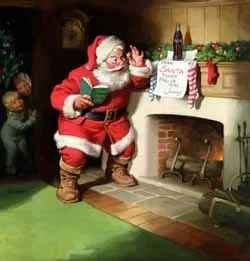
The current appearance of Santa Claus belongs to the brush of American artist Haddon Sundblom, who in 1931 drew a series of illustrations for Coca-Cola advertising. Sundblom's Santa is no longer Clement Moore's elf, but a giant.
Thus the image of Santa Claus appeared - an old man with gray hair, a neat beard and mustache, in a red jacket, pants and a pointed cap. A dark leather belt encircles a plump belly. Most often he has glasses on his nose and a smoking pipe in his mouth. He rides a reindeer sleigh and drops gifts into shoes and stockings left near the fireplace.
Santa Claus has colleagues in all countries of the world. In the Netherlands, Holland - it is Sinter Klaas (Sinterklaas, Sunderklass), who arrives by steamer accompanied by black servants and gives gifts.
In Finland and a number of Scandinavian countries, Joulupukki is popular (Joulupukki - forest man - Christmas goat - Christmas grandfather). The modern image and legend are largely taken from American Santa Claus. He is also an old man with gray hair, a neat beard and mustache in a red jacket with a dark leather belt, pants and a pointed cap. He must have glasses. According to legend, he lives on Mount Korvatunturi with his wife Muori (Maria) and gnomes. In ancient times, he would go from house to house at Christmas (caroling), treat obedient children and punish disobedient ones (for which he carried a switch). Subsequently, the educational aspect of the image was lost. In 1985, Santa Park and Joulupukki Village were opened in Finland, which are visited annually by 250,000 tourists.
In Karelia, Santa's colleague is Pakkaine (Morozets), who unlike most New Year characters is a very young man with a mischievous character. In Cyprus, the New Year character has the strangest name - Vasily, in Italy – Babbo Natale (Babbe Natale). Children believe that he, leaving his sleigh on the roof, enters the house through the chimney, where a little milk and sweets are kept for him "for reinforcement".
In the Czech Republic and Slovakia, on the eve of St. Nicholas Day, on the night of December 5 to 6, Mikuláš comes, outwardly similar to the Russian Ded Moroz: the same long fur coat, hat, staff with a spiral top. However, he brings gifts not in a bag, but in a backpack. And he is accompanied not by the Snow Maiden, but by an angel in snow-white clothes and a shaggy little devil. Mikuláš is always happy to give good and obedient children an orange, an apple, or some kind of candy (something tasty and edible!). But if a potato or a piece of coal is found in the "Christmas boot" of a hooligan or a slacker, it is definitely Mikuláš.
Czechs and Slovaks have another, the most modest New Year character in the world - it is Yezhishek (Yozhishek). While dropping gifts into children's homes, Yezhishek carefully makes sure no one sees him. Therefore, nothing is known about Yezhishek's appearance.
In Russian folklore, the image of Ded Moroz took shape over many centuries. Historians tend to believe that the prototype of our Ded Moroz was the East Slavic cold spirit Treskun, or, as he was also called, Studenets. More similar to our Ded Moroz is the character of ancient fairy tales Morozko, in later versions Moroz Ivanovich, Moroz Yolkich. He is the Spirit of winter, strict, sometimes evil, grumpy, but fair. He favors and rewards good people, and can freeze bad ones with his magic staff. By the 1880s, a certain character with a bag of gifts at the Christmas tree became established in the public consciousness. True, he was called differently: Svyatochny Starik, Rozhdestvensky Ded, or simply Yolochny Ded.
In literary treatment, Moroz Ivanovich appeared in 1840 in the collection "Grandfather Iriney's Children's Tales" by V. F. Odoevsky. This kind gray-haired old man rewards the Needlewoman for good work with a "handful of silver coins", and teaches the Lazy Girl a lesson by giving her an icicle instead of silver. In Nekrasov's poem "Red Nose Frost", the main character is evil, who likes to "freeze blood in veins and chill the brain in the head". In children's poetry of the late 19th century, Ded Moroz is a kind wizard. By the beginning of the 20th century, the image of Ded Moroz as a kind giver of Christmas trees and gifts was finally established. Traditionally, Ded Moroz is dressed in a long, ankle-length red fur coat trimmed with white fur. At first, his fur coat was blue (indicating the northern, cold origin of the character); in pre-revolutionary postcards, you can also find a white Ded Moroz. Now Ded Moroz most often comes in a red costume. His hat is semi-oval in the color of the fur coat. On the hands of the children's favorite are mittens. In one hand he holds a staff, and in the other – a bag of gifts.
In preparing the publication, materials from RIA Novosti were used.