
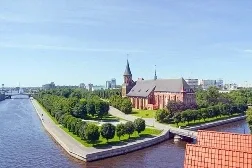
Russian exclave on the Baltic – pioneer of the compatriots' return program
The westernmost region of Russia, the so-called exclave, was chosen as the venue for the forum because the results here are better than in any other participating region: 6,162 people have already arrived. Vremya Novostey columnist Ivan SUKHOV spoke with returning compatriots and those who welcome them.
Russian Germany
At Kaliningrad's Khrabrovo Airport, there is ongoing renovation: it is visibly transforming from an ordinary provincial concrete box into a modern international hub. However, construction has its costs: in rooms that have already been clearly renovated, the ceiling leaks in places, causing plaster on the walls to bubble, and very homey plastic basins sit on the brand-new floor. When heading into the city, passengers at some point had to make their way through a whole bundle of wires, pipes, and hoses of various sizes, which had spilled out like an octopus into a narrow corridor.
The situation is roughly the same with the new road from the airport to Kaliningrad. There are two major road construction projects in the region – the so-called Baltic Ring, a section of which is supposed to connect the regional capital with its air gateway, and the international Via Hanseatica highway, which passes through the region from Germany and Poland onward to Lithuania, Latvia, and Estonia. On the section between the city and the airport, lighting masts with elegant lamps decorated with the old Königsberg coat of arms have already been installed. But cars and buses still have to wind along the old narrow road, only occasionally crossing the new highway – it is almost ready, but cannot be used yet. On one hand, all this construction creates inconveniences. On the other hand, it would be much sadder if everything simply remained as it was.
There is still plenty of this "as it was". Along the roadsides, ruins still appear – monuments to a war that ended almost 65 years ago. In small towns, one can find old German churches that have been touched neither by a restorer's hand nor by social changes since the war. They still house some kind of repair workshops or parking for agricultural machinery, and it may easily turn out that a lopsided, openwork bell tower signifies not the long-ago valor of an artilleryman, but deep postwar, perhaps quite recent, indifference of local residents and authorities. Old railway bridges, with modernist iron arches and thousands of rivets, are still reliable, but the paint has cracked and peeled, rust has spread.
In Kaliningrad itself, which was renovated and decorated for its 750th anniversary in 2005, the successes of builders and restorers are evident, but even there some very strange objects remain – for example, a section of a flyover over Moskovsky Prospekt designed several years ago, which ends in nowhere on both sides, or the House of Soviets, towering on the site of the former royal castle. The multi-story symbol of Soviet power was never completed before its collapse. The House of Soviets still stands empty and awaits a final decision on its fate.
German heritage is clearly visible at every step. Six and a half decades after the war, it is customary not to hinder it but to help it manifest. German architectural monuments are cleaned and restored; German residential buildings are in much higher demand on the real estate market than Soviet ones, and sometimes even higher than modern ones. The old monument to Friedrich Schiller, saved during the battles for the city by an unknown soldier or officer who scratched on the pedestal: "Don't shoot, he's a poet," looks with surprise as the outlines of the old city, which has changed from German to Russian but strives to preserve its German features, emerge and are renewed.
Continuity sometimes reaches the level of black humor. Next to the building of the former Land Court, now occupied by a technical university, stands a red-brick mansion that housed the police presidium in Prussian times and the Gestapo administration in Nazi times. The dark times are behind: now the mansion houses the directorate of the Federal Security Service for Kaliningrad Region.
Restaurants and pubs of Königsberg cultivate the image of a ruddy burgher washing down famous Königsberg Klopse – chopped meatballs with sauce – with beer. Local enthusiasts and their like-minded associates in Germany have resumed publication of the newspaper "Königsberger Allgemeine" – in two languages, for now once a month, but on 20 pages and in color.
Kaliningrad Region paradoxically acknowledges its German cultural roots, which are putting forth new shoots – without Germans. Through the ancient Brandenburg Gate in the second defensive ring of Königsberg, which claimed so many lives of Soviet and German soldiers during the battles for the city in April 1945, now lies a road to Mamonovo, not to Brandenburg. However, maps of the region with former German names are in demand not only among tourists.
The mixture of this strange nostalgia for German times, the touching shabbiness characteristic of either all of Russia or all of Eastern Europe, and modern Russian new builds creates a unique and, oddly enough, pleasant cocktail. The Baltic resorts of Kaliningrad, especially after the summer crowds recede and rain rustles through the pine needles, are a paradise for quiet relaxation.
Kaliningrad Region is the smallest of Russia's regions and the westernmost: even the new year arrives here last, an hour later than in Moscow. In addition, it has the densest network of roads. Now they speak of this with such pride as if it were the governor's administration's achievement. In reality, the reason is, of course, that this land was long part of Germany. The roads are narrow, one lane each way; secondary highways were already lined with ancient elms, which make them look like avenues.
When you drive along such a road at night, the dense foliage in the headlights turns into a continuous corridor with walls and a canopy rustling in the wind. It reminds you of a film about Stirlitz, or a living book by Remarque. And you become a little afraid for these mossy elms, which were planted back in the Weimar Republic, during the years of inflation and unemployment. What if during the current economic crisis someone decides to create social jobs for cutting down the avenues? Or will some security service decide that behind these trunks close to the road there may be a threat to the first persons of the region or the state.
Russian America
When in the summer of 2006, a decree by President Vladimir Putin launched a six-year state program for the resettlement of compatriots, the Kaliningrad Region immediately became one of 12 pilot regions ready to receive new residents. Now that there are almost two dozen participating regions, Kaliningrad maintains a steady lead – 6,162 people have already arrived here, about half of all returnees. Several thousand more applications submitted to Russian consular offices abroad are waiting their turn.
The Kaliningrad Region, with a population of just under a million, is one of the few Russian regions that experienced some growth between the censuses of 1989 and 2002. This was partly due to immigrants – from 1989 to 2002, 135,000 people arrived here. The last successful year from this perspective was 2002 – 5,000 people arrived. In 2003, there were only 3,000. One can assess in different ways whether many or few repatriates responded to Vladimir Putin’s call, but in the specific case of Kaliningrad, their arrival helped compensate for the decline in immigration rates.
22-year-old Stepan Sladkov, who moved a year ago together with his 68-year-old grandmother Valentina Vasilyevna from Uzbek Chirchik, believes that somewhere in Siberia it would be cold for them after Uzbekistan, and Kaliningrad is a promising region. It is hard to say what Stepan understands by prospects – his own economic success or opportunities related to the European environment. Which sooner or later will mean economic, and partly perhaps political, integration with Schengen Europe. But one way or another, Kaliningrad’s 6,000 people are more than in any other 'recipient' region.
People come here because of the mild climate, because of the proximity to Europe – to Warsaw, Berlin and Vilnius it is significantly closer than to Moscow. Because of economic opportunities: before the start of the 2008 crisis, the Kaliningrad Region was growing rapidly thanks to various assembly and licensed productions, producing everything from baby food to refrigerators, televisions and foreign cars. Now some of the production facilities are closed or reduced, but some have managed to survive.
In addition, the region is planning to start construction of the Baltic Nuclear Power Plant next year – 'peaceful atom' raises significant doubts among ecologists and supporters of the development of the recreational sector, but it should make the region energy independent and provide jobs first on the construction site, then in maintenance.
The nuclear power plant, as anywhere else on the globe, causes controversy. There are, for example, experts who believe that the excess electricity that will appear after the plant’s launch will have nowhere to be sold, since the surrounding Schengen countries may boycott the nuclear project. But there are other points of growth – first of all, the transport network, which needs to be built and improved, and agriculture, which, according to the regional minister for territorial development Mikhail Plyukhin, even during the crisis showed 9 percent growth.
Among other things, the Kaliningrad Region has a peculiar resettlement tradition. To the question of how the indigenous population receives repatriates and whether there is aggressive competition for jobs, the director of the Kaliningrad Region Resettlement Service, Andrei Zemchenkov, answers: 'There is no indigenous population here, everyone is a newcomer, so no problems arise.'
The Kaliningrad land with its thousand-year history is, of course, not the United States, created by newcomers practically in an open field and still considering immigration as one of the fundamental foundations of its existence. But this territory has always attracted people ready to start a new life from scratch in a new place and find a new homeland here. In the 12th–13th centuries, German knights and farmers took these lands from the pagan Prussians to sow grain and build castles and cities.
From the Prussians, however, only the name remained. Having existed for three centuries under the rule of the Teutonic Order, these lands were transformed by the last master Albrecht into the Duchy of Prussia, which by the beginning of the 18th century united with the Electorate of Brandenburg and another century and a half later became the core of a unified German state with its capital in Berlin.
In 1709, when all surrounding countries were engulfed in war, East Prussia experienced a terrible plague epidemic that wiped out a significant part of the population. Then King Frederick I announced that he was ready to accept settlers from any European country, who would be able to keep their religion, language and schools for their children, but would have to bear all Prussian duties except for some taxes. The new owners were partially exempted from taxes for the first years of settlement depending on their economic success.
The Crown allocated land and livestock for breeding, and those whose harvests were abundant and herds grew had their tax holidays extended. And those who did not show diligence were expelled back to where they came from. People came not only from the German principalities and kingdoms, but also from the farthest corners of Europe – mainly Protestants from regions where their conflicts with Catholics had not yet fully subsided: Presbyterians from Scotland, Huguenots from France, Lutherans and Calvinists from Austria and Holland. Considering that the plague of 1709 wiped out a very significant part of the population, it becomes clear that East Prussia was essentially recolonized.
The next wave came in 1946-1947. On October 21, 1944, Soviet advance units occupied the village of Nemmersdorf (now Mayakovskoye, Gusevsky District). They held it for only a day and retreated under threat of encirclement. On October 23, the Germans returned to Nemmersdorf and found murdered civilians (13 women, eight men, and five children), nearly everyone who had not been evacuated before the Soviet offensive. Naturally, Nemmersdorf immediately became a German Khatyn. When the Soviet army launched a general offensive on East Prussia, not only regular units but also the local population fought fiercely for every house until the last possible moment, let alone the Königsberg forts. After it became clear that the Soviet offensive could not be stopped, a mass exodus of residents began.
There was nowhere particularly to flee – Germany lay in ruins. According to some data, by the time of the German surrender, up to 300,000 Germans still remained in East Prussia. Initially, it was not planned to deport them to Germany, but it quickly became clear that there were practically no one wanting to stay. Therefore, in 1946, a decision was made to resettle the region, renamed Kaliningrad Oblast, with residents of the areas of Russia, Ukraine, and Belarus that had suffered most from the war, as well as the Bashkir and Tatar autonomous republics – apparently, in order to quickly level the cultural landscape.
Thus began the third colonization of the region. It had its costs – for example, the almost two-million head of horses instantly dwindled to nearly zero, and some towns that had been virtually untouched by war simply disappeared from the map. The appearance of those that remained changed dramatically, and not for the better. But ultimately, the region was once again, for the third time, populated by people for whom it became a new homeland.
Read the continuation of the article: STRATEGIC REPATRIATION