
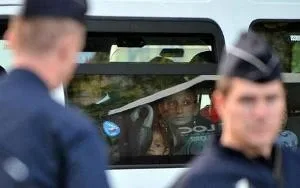
The deportation of Roma has become a European problem
French President Nicolas Sarkozy confirmed that, despite criticism, including from the European Union, he will not back down from curbing illegal Roma immigration. At the end of August, French Foreign Minister Bernard Kouchner mentioned the possibility of resigning due to "the damage done to the country's international reputation." However, at his meeting with the president, it was decided that the veteran human rights activist leaving the government "would be desertion."
Recently, this writer witnessed at Bucharest's Băneasa airport a young Romanian Roma, just deported from France, telling journalists that he "made a living there by begging, stealing, and generally whatever came his way." He promised to "return for sure," because "you can't get rich in Romania now."
According to official statistics, there are currently 1.5 million Roma in Romania, but unofficial figures are significantly higher. The leader of socialist Romania, Nicolae Ceaușescu, actively worked on their integration into society. He largely succeeded in ending the Roma's nomadic lifestyle by forcibly settling them in rural localities. After the Romanian revolution of 1989, two Roma political parties emerged, and their traditional hierarchy was legalized.
At that time, the Romanian Roma insisted that from then on they be called "Roma." The authorities agreed, but soon regretted it. After all, the name of Romania – in Romanian, România – was originally intended to emphasize the Latin origin of Romanians from Rome. And now a new semantic chain emerged: România – Roma – Gypsies.
The undesirable reputational consequences for Romania of this confusion became apparent after its accession to the European Union in 2007 and the immediate appearance of Roma "shantytowns" around cities, first in Italy and then in France. Nor did the attempt to introduce the ethnonym "Rrom" for Roma help – the innovation did not catch on, because the Romanian language has no double consonants.
The level of integration of Romanian Roma is evidenced by depressing figures – about 80% of Roma children do not attend school, and about a third of this ethnic group are illiterate. Honest Roma engage in traditional trades: among them are bricklayers, blacksmiths, tinsmiths, and scrap metal collectors.
The Roma criminal underworld is engaged in human trafficking, usury, outright banditry, but especially drug trafficking. Typically, large family clans are involved in this. However, there is no basis to claim that there are more criminals among Roma than among representatives of other ethnic groups in Romania – such statistics simply do not exist.
The European Union allocated €4 billion to Romania for the social integration of Roma. But these funds are practically unused; only €85 million have been spent. French President Nicolas Sarkozy sent a letter to the European Commission insisting that the funds allocated to Romania for Roma be used for their intended purpose and not sit idle. Incidentally, Paris, against the backdrop of the Roma deportation scandal, has already threatened that if Bucharest does not solve the problem of social integration of this category of its citizens, France will oppose Romania's entry into the Schengen area.
The Romanian authorities, in their defense, utter general words about the right of Roma to freedom of movement within the EU and that the French authorities are playing into the hands of racial discrimination. The Romanian Foreign Ministry stated that "citizens committing illegal acts in EU countries should be approached without stereotypes, especially ethnic ones," but "condemnation of ethnic groups, creating a negative image of any state or people, contradicts the spirit and principles of the European Union."
Head of Romanian diplomacy Teodor Baconschi expressed concern that in the conditions of the economic crisis, the deportation of Roma from France "will lead to a slide into populism and generate xenophobic reactions." He spoke in favor of direct dialogue between Romanian and French competent authorities, as well as coordination of efforts with the EU, because "the Roma problem is now also a problem of the European Union."
And such a dialogue has begun. Recently, two state secretaries of the Romanian Ministry of Internal Affairs held talks in Paris with the Minister of Internal Affairs, the Minister of Immigration, and the Secretary for European Affairs. The contact was reported at a press conference in Bucharest by Valentin Mocanu, the state secretary responsible for the Roma issue. According to his assessment, the blame lies entirely with local Romanian authorities who are not using European funds to employ Roma and educate their children in schools.
Mocanu reported reaching agreements with French colleagues on permanent dialogue, a joint action plan and its coordination with the EU, exchange of information on cases of criminal activity, including organized crime, of immigrants from Romania, and on increasing the representation of the Romanian Ministry of Internal Affairs in France from four to 14 people. Increasing the staff of a similar mission in Italy has already yielded good results.