
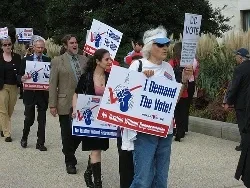
Traditionally, the last day for filing tax returns in the United States is observed in the Federal District of Columbia as a day of struggle for voting rights
Method 1 – Expansion
The essence of the method is as follows: the legal status of Washington does not change, but it gets the opportunity to send a full-fledged delegate to the House of Representatives (the lower house of Congress). This requires both houses of Congress to vote for this decision by a majority vote.
In January 2009, drafts of the corresponding law (called the DC Voting Rights Act) were introduced for consideration in the House of Representatives and the Senate. These texts are practically identical. They provide that the House of Representatives will not have 435 congressmen, but 437: one vote will be given to Washington, and the second – presumably a new electoral district in the state of Utah.
This scheme is extremely important for the bill to become law. The fact is that the vast majority of Washington residents support the Democratic Party. If the number of congressmen increased only due to Washington, it would create additional problems for the Republican Party, which would try to torpedo this bill. Therefore, the second seat in the House of Representatives is proposed to be given to residents of the state of Utah, which has a "Republican" reputation. However, Utah was added not only to maintain party balance. By law, the right to receive new seats in the House of Representatives is granted to states with the fastest growth in the number of voters – the U.S. Census Bureau makes corresponding assessments every 10 years after the nationwide census. According to the 2000 census results, Utah was recognized as such a state.
If this bill passes both the House of Representatives and the Senate, it will become law after being signed by the president. U.S. President Barack Obama previously promised to support this innovation.
In the spring of 2007, a similar bill was introduced to Congress. It was approved by the House of Representatives and a majority of senators, but Washington never got the coveted rights – the Republican minority in the Senate blocked the adoption of the law.
This option is likely supported by the majority of Washington residents. The largest public organization advocating for this project is called "DC Vote." Critics point out that if this law is passed, Washington will still be in a disadvantaged position because it will not have its own representatives in the Senate.
Method 2 – Annexation
The public organization "Committee for the Capital City" proposes an amendment to the U.S. Constitution that would abolish the Federal District of Columbia and allow the city of Washington to be annexed to the state of Maryland, on whose lands it originally was. In this case, the population of Maryland would increase significantly, and the state would be able to send one or even two additional congressmen to the House of Representatives. Accordingly, senators from Maryland would also defend Washington's interests. This idea first appeared as early as the beginning of the 19th century and has been periodically discussed since then.
The advantage of this option is that such an act has already happened in Washington's history. In 1846, the U.S. Congress agreed to return to the state of Virginia the southern part of the Federal District of Columbia – the city of Alexandria and its surroundings. The reason for this step was a combination of factors: on the one hand, Congress had no time to manage the district, leading to additional economic problems; on the other hand, the struggle for the liberation of black slaves and the associated political games played an important role. In addition, supporters of returning Washington to Maryland emphasize that during the first decade of the existence of the U.S. capital, its residents voted for congressmen and senators from Maryland. In the United States, where historical and legal precedents are always taken into account, this is a fairly serious argument.
In 2004, a corresponding bill (called the District of Columbia Voting Rights Restoration Act) was introduced in Congress, but it was not discussed and was not put to a vote. Opponents of this project point out that as a result of annexation to Maryland, Washington would lose its unique status and lose some federal subsidies.
Method 3 – Separation
The Statehood Green Party of the District of Columbia demands that the Federal District of Columbia be granted statehood. It declares that "until we become a state, Washington residents will be 'second-class' U.S. citizens."
The Statehood Party of the District of Columbia was founded in 1970, and in 1999 it merged with the Green Party of the District of Columbia, resulting in a party with a hard-to-pronounce and contradictory name.
The ideology of supporters of this option is based on the views of the civil rights movement of the 1960s. The party declares that the movement that managed to end racial segregation in the United States has not completed its work. If Washington gets statehood, it will be the first and only U.S. state where the overwhelming majority will be African Americans (currently they account for about 93% of the population of Washington city). It is proposed to keep the plots of land on which federal buildings stand – such as the White House and the Capitol – under federal jurisdiction, modeled after the Vatican.
Supporters of this decision emphasize that Washington can become a state if Congress passes a corresponding law – no constitutional amendment is needed (adopting an amendment is an extremely complicated matter, in particular because two-thirds of states must support it). Supporters of this crisis resolution option have an important argument in their favor – in 1949, the U.S. Supreme Court concluded that in some cases the district can have state rights – this verdict has never been challenged.
Proponents of this idea achieved their most notable success in 1978, when Congress passed a draft constitutional amendment to that effect. However, only 16 states ratified it, and as a result the amendment did not enter the final text of the U.S. Constitution. In 1982, a convention was held in Washington that adopted a draft constitution for the state of «New Columbia». However, the process stalled – in 1993, a draft of the corresponding law was discussed by Congress but did not receive the necessary number of votes.
Related materials:
The Last Colony of the USA
Based on materials from Washington ProFile