
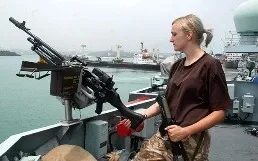
In recent years, the waters off Somalia have become the most dangerous for seafarers.
According to statistics from the International Maritime Bureau, in 2008 pirates captured 49 ships worldwide (18 in 2007), and another 46 vessels were fired upon. Overall, pirates used firearms 139 times (72 the previous year). 889 crew members were taken hostage, 32 wounded, 11 killed, and 29 missing. In total, 293 pirate attacks were recorded in 2008 (263 in 2007).
The largest share of the increase in pirate activity came from pirates operating in the waters off Somalia and the Gulf of Aden, accounting for 111 incidents. For the first time in maritime history, pirates captured a large tanker and a ship loaded with tanks. Somali pirates attacked all types of vessels, including those traveling at high speed. Moreover, pirates were much better trained and equipped than in previous years.
The second most dangerous location is the coast of Nigeria (40 incidents), while another 100 attacks by Nigerian pirates were not officially confirmed. Traditionally dangerous areas also include the waters off Bangladesh and Tanzania, but there pirates only attack ships at anchor. Meanwhile, pirate activity decreased in Indonesian waters (28 incidents in 2008, compared to 121 in 2003) and in the Malacca Strait (two incidents compared to seven in 2007).
However, these statistics only account for attacks that were officially reported by shipowners. Many researchers note that in fact, no more than 10–20% of piracy-related incidents are included in such reports. The reason is that ship and cargo owners often prefer to negotiate directly with pirates and pay them off. This is explained by the following reasons: first, they are not confident that authorities can solve the problem more effectively (given that the operating cost of a cargo ship is $10,000 or more per day—it is faster and cheaper to negotiate with pirates); second, reporting a pirate capture automatically increases insurance premiums: according to consulting firm BGN Risk, Somali pirates increased the insurance cost for a ship from $500 in 2007 to $20,000 in 2008. Additionally, insurers and counterparties may require equipping ships with more modern engines, passive defense systems, etc. Third, the affected shipowner company gains a negative image, and clients are wary of doing business with it.
Most sources analyzing the patterns of modern piracy offer the following classification of 21st-century sea robbers. The first group consists of ordinary criminals who carry out simple operations—for example, stealing something. The second category includes members of organized criminal groups who conduct complex operations and manage stolen goods intelligently (traditionally, such pirates are particularly numerous in Southeast Asia; some belong to Chinese triads). The third group consists of members of paramilitary organizations, sometimes with some official status: often these are armed groups led by warlords who need a steady income to maintain their power and control over a territory—this type makes up the majority of pirates in Somalia and Indonesia. Sometimes they even mimic actual patrol boats belonging to or resembling customs or navy vessels of the respective countries.
Most attacks occur at night when the minimum number of sailors is on watch and ship speeds are lower. The types of attacks also vary. In the first case, pirates simply board the ship, empty the ship's safe and crew's wallets, and then escape. The usual haul from such an operation is about $20,000.
The second type of attack involves stealing not only money but also cargo. In some cases, pirates simply transfer goods to their own vessels; sometimes this operation requires docking in a pirate harbor; sometimes the captured ship is brought to a port where the pirates have connections, and the cargo is sold to local buyers. The profitability of such operations is much higher; the value of cargo sold at discounted prices can reach several hundred thousand dollars.
In the third case, pirates detain the ship with its cargo, take the crew and passengers hostage, and then demand a ransom from the shipowner. Ransom amounts vary and are not disclosed, but there have been reports that they can reach several million dollars.
A fourth method was widespread in the 1990s, but due to stricter international ship registration rules, no such incidents have been reported in recent years. The method is as follows: pirates capture the ship, then kill the crew, forge the relevant documents, and re-register the vessel (until the late 1990s, temporary registration allowing a ship to fly the Panamanian or Honduran flag could be easily obtained at any Panamanian or Honduran consulate). The ship is then either sold or chartered to transport valuable cargo, after which it disappears without a trace.
In the 1960s and 1970s, there were attacks by pirates on coastal towns and villages in the Philippines, Sri Lanka, and Malaysia. In some cases, pirates killed or took hostage local police and even military units stationed in the town.
In addition, pirates are actively involved in operations to transport contraband, drugs, weapons, slaves, and actively cooperate with criminal communities. Theoretically, it is possible to assume that in the near future pirates and criminal structures will acquire not only surface but also underwater forces. Attempts to do this have already been recorded. Colombian drug traffickers in the late 1990s tried to build a submarine – intelligence services completely accidentally discovered a hangar where the submarine was being built. In the early 1990s, US intelligence services thwarted a deal to sell Soviet "baby" submarines to Latin American criminal groups.
A number of cases are known when pirate methods were also used by terrorists: thus the Palestine Liberation Front in 1985 captured the Italian cruise liner Achille Lauro in the Mediterranean Sea, and the Philippine organization Abu Sayyaf (by the way, its founder Abubakar Janjalani, like Bin Laden, fought against Soviet troops in Afghanistan) in 2004 killed more than 100 passengers on a captured ferry. In general, Abu Sayyaf made piracy one of the main sources of replenishing its budget.
It is extremely difficult to estimate the real losses to the global economy as a result of pirate actions. In 2006, the World Bank concluded that the annual damage from pirate activities is $10-20 billion.
See also material on the topic: TECHNOLOGY OF MARITIME ROBBERY
Based on materials from Washington ProFile.