
In one form or another, forced labor is used throughout the world and in virtually all countries, regardless of their economic system. Russia is no exception in this regard. According to experts, the problem of labor slavery in this country is inextricably linked to the influx of migrants from the former Soviet republics. Thus, in recent years, a rather alarming situation has developed in Russia. According to surveys conducted by specialists, coercion is an integral part of the ordinary labor experience of many foreigners coming to this state to earn money.
“At present, there are several reasons for the spread of slavery in Russia,” says Pavel Chikov, chairman of the Interregional Human Rights Association “AGORA” and candidate of legal sciences. “And first of all, it is the multimillion-strong army of illegal migrants. It is necessary to understand that this is a huge mass of labor that is not protected in any way. Naturally, a potential employer has a huge desire to take advantage of it. Unfortunately, neither law enforcement agencies, nor trade unions, nor the court, nor a criminal defense lawyer can protect them.” It is for this reason that reports of the use of slave labor by unscrupulous employers on their enterprises come with enviable regularity. Especially when it comes to fishing enterprises in the Far East.
At the end of November 2006, Pyotr Nekhoroshkov, deputy head of the “Center T” of the Main Directorate of the Ministry of Internal Affairs of the Russian Federation for the Far Eastern Federal District, officially told journalists at a briefing in Khabarovsk that a number of Far Eastern fishing companies hiring migrants are not fulfilling their obligations to them. “Recently, reports have been coming in especially often that slave labor is being used in the fishing industry.” According to him, fishing companies in Sakhalin and Primorye mainly use labor of Ukrainian citizens. “People sign contracts in which one of the main points is a high salary,” explained Pyotr Nekhoroshkov. “But when workers are brought to the Far East, their documents are taken away and, using physical force, they are forced to work for the fish harvesting and processing company, and they are not paid.” According to Nekhoroshkov, people do not have the opportunity to contact their relatives because they are constantly at sea. Of course, sometimes they go to semi-spontaneous docks where they replenish fuel and food supplies, but then they go back to fishing.
“This type of crime is new and appeared in our region not so long ago,” explains Larisa Shkil, head of the press service of the regional Main Directorate of the Ministry of Internal Affairs of Russia for the Far Eastern Federal District. “If earlier migrant labor was mainly characteristic of the intimate services market, now this problem has turned to us from another side – fishermen are hired, promising high salaries, and as a result they are left abandoned thousands of kilometers from home.” However, according to Shkil, fishing slavery has not yet become widespread, and law enforcement agencies, in turn, are taking all measures to prevent such crimes from becoming widespread. “Yes, this is a new type of crime,” the press service head continued. “But, as with the emergence of any other criminal activity, law enforcement agencies are doing everything to minimize such cases through regular inspections.”
“Special inspections and detection of such crimes are carried out by representatives of the operational-search unit specializing specifically in the fishing industry,” says Evgeniya Sokovishina, press secretary of the Economic Crimes Unit of the Primorsky Krai Internal Affairs Directorate. “As for residents of the region, as a rule, people are invited to work as sailors on ships, they sign fictitious contracts with them, and after the voyage ends, workers naturally do not receive the money they earned.” However, inspections on ships, according to Sokovishina, can only be carried out if a complaint from victims has been filed with the police. “People complain to each other that they were deceived, but they do not go to law enforcement officials,” she lamented. “Therefore, we constantly place advertisements in various media urging people not to be afraid to go to the police. The more such inspections there are, the greater the chance that law enforcement agencies will be able to stop the activities of exploiters.”
The regional Economic Crimes Unit admitted that the employers who have been detained are mostly charged under Article 156 of the Criminal Code of the Russian Federation (fraud). “There is no talk of the article ‘use of slave labor,’” explained Sokovishina. “In general, it is quite difficult to find the organizers (directors of such companies) because these enterprises are often illegally registered anywhere and under anyone.”
According to Pavel Chikov, a representative of the human rights organization “AGORA,” one does not have to go to the Far East for examples of the use of free labor. “Even in the capital, within the Moscow Ring Road, there are many places where migrants offer their labor, risking falling into slavery every day,” the human rights activist explained. “The articles of the Criminal Code of Russia on ‘human trafficking’ and ‘use of slave labor’ do not work in principle. Russia assumed the ban on slavery and the obligation to create conditions guaranteeing freedom from it when it joined the Council of Europe and ratified the Convention for the Protection of Human Rights and Fundamental Freedoms in 1998. But, alas, these obligations are usually not fulfilled in practice.”
As told to Strana.Ru by Yevgeny Artemov, head of the press service of the Department for Combating Organized Crime and Terrorism, the number of criminal cases initiated under Article 127 of the Criminal Code of the Russian Federation ("unlawful deprivation of liberty") in 2005 increased significantly compared to 2004. "If in 2004 eight such crimes were registered, then in 2005 there were already 20. Many of them have already been sentenced, while some are still pending in court." However, according to experts, even people uninitiated in this problem understand that the number of registered crimes in the same Far East differs significantly from what is actually happening.
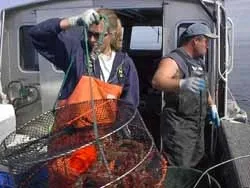
When it comes to fishing slavery in the Far Eastern region, this is far from the first such case. Earlier this year, it emerged that 25 Ukrainian fishermen who came to the Far East in 2005 looking for work and good pay found themselves in the position of prisoners on a vessel engaged in illegal crab fishing. "They were subjected to physical and psychological violence: their passports were taken away, they were forced to eat raw fish and allowed to sleep once every two days," Jean-Philippe Chauzy, a representative of the International Organization for Migration (IOM), told journalists at a press conference in Geneva at the time. "Moreover, they were forced to work 18 hours a day, were not paid wages for six to ten months, and were starved. They were saved by sheer chance." When the poaching vessel Pervorechensk was stopped and confiscated by Russian border guards off the coast of Sakhalin, they found half-dead fishermen locked in the hold along with the illegal catch.
The investigation established that all foreign citizens on the Pervorechensk ended up there accidentally, through deception. A whole scheme for supplying labor had been worked out. In major Ukrainian cities — Kiev, Odessa, Mariupol, Nikolaev, etc. — people signed labor contracts with intermediaries and employers, according to which they were hired on foreign vessels. The salary was also necessarily stipulated — in the range of $1,600. Under the terms of the contract, the sailors were obliged to arrive in Yuzhno-Sakhalinsk at their own expense. After that, they were taken to the Pervorechensk. As the freed sailors told, the management claimed that the vessel was operating legally and conducting legal crab fishing. But later people realized that they were being forced into poaching, stealing crabs in foreign waters. The caught crabs were placed in tanks with seawater, then the Pervorechensk would meet other vessels at sea, where the catch was reloaded and then transported to Japan. For their hard maritime labor, the 'slaves' did not receive a single penny, and rebels were starved and deprived of water.
"It is natural that slavery thrives in the 'gray' sectors of the economy with high profits and minimal costs — these are construction, agriculture, fishing and fish processing industries," explained Pavel Chikov. "It is precisely in these sectors that state control is minimal. People are usually attracted by the promise of big money. Their passports are taken away, citing the need for registration, and they are taken far from transport hubs. In the case of the Far East, they are taken out to sea, from where people cannot report that they are in trouble."
According to Chikov, it is impossible to protect the rights of these people from the outside. "High-quality operational work of the relevant services is needed, who know where and when there is a noticeable increase in employment of people in the 'gray' segment of the labor market. Human rights activists and law enforcement agencies can only start an investigation if there are facts of statements from the victims themselves. For them, this is associated with numerous costs, especially if they are illegal migrants. They can only protect themselves by creating informal associations reminiscent of trade unions."