
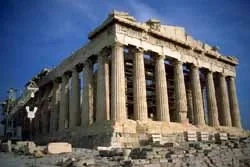
Acropolis of Athens (Greece) <\/strong><\/p>
"Acropolis" means "upper city" in Greek. The Acropolis of Athens is located on a mountain where, according to myths, a dispute took place between the god of the seas Poseidon and the goddess of wisdom Athena over the right to patronize the city, which at that time did not yet have a name. The citizens agreed to declare as their patron the one who would bring them a more valuable gift.<\/p>
Poseidon struck the rock with his trident and brought forth water, but it turned out to be salty and therefore unfit for drinking. Athena thrust her spear into the ground; it turned green and turned into an olive tree. Growing olives and producing olive oil became one of the main occupations of the citizens and brought prosperity to the city. Subsequently, in the courtyard of the sanctuary of the nymph Pandrosus on the Acropolis, the Athenians cherished as the apple of their eye a sacred olive tree—supposedly the very one that grew from the goddess's spear.<\/p>
Alhambra Citadel (Spain) <\/strong><\/p>
Alhambra is a distorted Arabic name meaning "Red Fortress." The citadel is built of reddish-pink brick on a mountain above Granada and is a monument of the period when a significant part of Spain was ruled by the Arabs.<\/p>
The sponsors of the construction of the Alhambra were the rulers of the Emirate of Granada, a state in the south of the Iberian Peninsula that arose after the Arab invasion of the European continent from North Africa. Construction began in the mid-13th century, and later expansions and alterations were carried out almost continuously.<\/p>
At the end of the 15th century, the Reconquista—the reconquest of the Iberian Peninsula from the Arabs by the Christian Spanish kingdoms—succeeded. Then a cross was raised over the Alhambra, and mosques were turned into Christian churches. Christian monarchs also came to love the Alhambra and began to remodel it to their taste, so that its interior decoration whimsically combines elements of various eras and artistic movements. From the outside, however, the fortress is perhaps the most striking example of medieval Arab architecture.<\/p>
Angkor Wat (Cambodia) <\/strong><\/p>
Angkor is a city in Cambodia that was the capital of the Khmer Empire from the 9th to the 15th century. Angkor Wat is a temple complex located among mountains, which, covering almost 2 square kilometers, is the largest religious structure in the world.<\/p>
Angkor Wat was built in the early 12th century by King Suryavarman II of the Khmer dynasty. The temple is 65 meters high, its walls are covered with the most intricate ornamentation, and its drainage system is considered a marvel of ancient engineering. The temple complex was originally dedicated to the god Vishnu, who in the Hindu divine triad is the preserver (Brahma is the creator, and Shiva the destroyer). In the 14th-15th centuries, Angkor Wat turned from a Hindu temple into a Buddhist one, which it remains to this day.<\/p>
Chichen Itza (Mexico) <\/strong><\/p>
Chichen Itza in the Mayan language means "well of the Itza people." In the 7th-10th centuries, Chichen Itza was one of the centers of Mayan culture. During this period, several grandiose temples in the form of stepped pyramids appeared there. Researchers have long noted that they are very similar to early Egyptian pyramids (which were also stepped) and to Babylonian religious structures—ziggurats. Some consider this coincidence not accidental and conclude that the ancient Maya communicated with the Egyptians and Babylonians.<\/p>
Already in the 20th century, traveler Thor Heyerdahl undertook a journey across the Atlantic Ocean on a papyrus boat, seeking to prove that the Egyptians could cross a vast expanse of water and meet the Maya. Others see in the similarity of the Pyramid of Giza and Chichen Itza evidence of the "common roots" of the Mayan and Egyptian civilizations, placing these "roots" in the legendary Atlantis.<\/p>
The Great Wall of China<\/strong><\/p>
The wall to protect against nomadic peoples living in the steppes north of China was begun by Emperor Qin Shi Huang in the 3rd century BC. This emperor is also famous for his burial site, which is guarded by an entire terracotta army.<\/p>
The wall stretches with gaps along the northern border of the Qin Empire and is now the main attraction of the world's most populous country. Chinese authorities are making truly titanic efforts to protect it from vandals. For this purpose, special patrols were even established—controlling 6,000 kilometers of the national heritage is not so easy. You can ascend the wall only in a few specially equipped places. It is also said that the Great Wall of China is the only man-made structure visible from space.<\/p>
Timbuktu (Mali) <\/strong><\/p>
The city's name means "well of Buktu" (so named, according to legend, after a woman who dug the first well at the site where the city later grew). The city was founded by the Saharan Tuareg tribes presumably in the 10th century. It was an important military and trade center of all the powerful empires of Black Africa—Ghana, Mali, Songhai.<\/p>
Timbuktu is located on the edge of the Sahara, on the border of Black Africa and Arab North Africa. Europeans and Arabs have long admired Timbuktu and spun legends about its wealth. Moreover, the city became a center of enlightenment thanks to the so-called "Sankore University," which is considered one of the oldest higher education institutions in the world. Here, Islamic and local pagan cultures were bizarrely mixed.<\/p>
Modern Timbuktu is perhaps the only city in the world that is so poor and yet has an international-class airport, where many tourists arrive. The population of Timbuktu today is just over 30,000 people.<\/p>
Petra (Jordan) <\/strong><\/p>
Petra is a city carved into the rock, the capital of the Nabatean state—an ancient Middle Eastern tribe, presumably Arab. In fact, aside from Petra, very little evidence remains that the Nabateans ever existed. Their state flourished from the 4th century BC until 106 AD, when Petra was captured by the Romans.<\/p>
Petra is located at an altitude of 850 m above sea level. Temples, dwellings, tombs, aqueduct, theater, the large temples of Al-Khazneh and Ad-Deir - almost everything in the city is carved into the rock. Petra and its founders, the Nabataeans, are repeatedly mentioned in the Bible.
Neuschwanstein Castle (Germany)
The name Neuschwanstein is associated with Lohengrin, the Swan Knight from Wagner's opera. This name was invented by the customer of the castle - Bavarian King Ludwig II of Wittelsbach, a great admirer and main patron of Wagner. The castle is located in an exceptionally picturesque area among lakes and mountains in southern Bavaria, near the border with Austria.
Built at the end of the 19th century, it, of course, had no defensive purpose, but was a whim of the eccentric and, as many believed, mad Ludwig II. At the same time, the spirit of romance and antiquity embodied in it made it a symbol of everything fairy-tale. In particular, it was Neuschwanstein that served as the prototype for the famous Sleeping Beauty Castle at Disneyland (Los Angeles). The image of this castle is placed on the logo of the Walt Disney Company.
Sydney Opera House (Australia)
The most famous building on the Green Continent is located on a cape in Sydney Harbour. To some it resembles a pile of shells, to others a ship sailing under full sails. The Sydney Opera House covers almost 2 hectares. The famous "shells" are tiled. There are over a billion tiles. The "shells" are designed so that the sea breeze blows right through them.
Out of 233 designs for the opera house submitted to a competition by architects from around the world in 1954-55, the project of the Dane Jørn Utzon was chosen. Construction began in 1959 and was completed in 1967. The interior decoration was finished in 1973. Utzon exceeded the budget by 140 times.
Roman Colosseum (Italy)
The word Colosseum is related to the concept of "colossal", which in turn derives from the Greek word "colossus" meaning "large statue". The amphitheater was founded in 75 AD by Emperor Vespasian of the Flavian dynasty. At that time, the Colosseum was called the "Flavian Amphitheatre". It was built by Jewish prisoners. The Colosseum could hold 50,000 people. Up to 6,000 people could fight simultaneously in the arena.
The Colosseum was a highly complex engineering structure. Beneath the arena there was a huge number of rooms of various purposes, ranging from chambers where gladiators were kept, cages for animals, to weapon stores. The arena could be flooded with water so that gladiators fought not on land, but as if at sea. According to legend, the acoustics in the Colosseum were such that the emperor could hear words spoken in a whisper at the farthest point of the arena from the imperial box.
Machu Picchu (Peru)
Although Machu Picchu is often called the "lost city of the Incas", its name literally translates to "old peak". The city is located in the Andes at an altitude of about 2,500 m above sea level. Machu Picchu was built in the first half of the 15th century and is considered a masterpiece of late Inca architecture.
The city existed for less than a century: in 1532-33 the great Inca Empire was conquered by about two hundred Spanish conquistadors led by Francisco Pizarro. There is a legend that at the moment when Pizarro entered Machu Picchu, all its inhabitants mysteriously disappeared.
St. Basil's Cathedral and Red Square (Russia)
The stone Kremlin in Moscow was built in the 14th century under Prince Dmitry Donskoy. In the 15th century, under Ivan III, it was rebuilt with the participation of Italian masters (Ivan's wife, a Byzantine princess, was raised in Italy, where Renaissance culture flourished at that time). Then the Kremlin became red stone, and the battlements on the walls took on the shape of "swallow's tails". The "tents" over the towers were added in the 17th century.
At the end of the 15th century, the posad east of the Kremlin burned down. In its place arose a large market square - Torg-na-Pozhare. A little further east, the second Moscow fortress after the Kremlin appeared - Kitay-gorod. In the 17th century, Torg-na-Pozhare began to be called Red Square.
In 1555, on the southern edge of the square, by order of Ivan the Terrible, they began to build the Cathedral of the Intercession on the Moat in honor of the capture of Kazan. Construction was completed in 1561. According to legend, after that, the terrible tsar ordered the architects Barma and Postnik, who supervised the construction, to be blinded so that they could not create such beauty for another sovereign.
Pyramid of Cheops in Giza (Egypt)
Pharaoh Khufu (in Greek Cheops) ruled Egypt from 2590 to 2568 BC. His grand tomb has the shape of a regular pyramid with a side of 230 meters (thus, the base area of the pyramid is almost 5.3 hectares) and a height of 146.7 meters (the top later collapsed by about 10 meters).
This pyramid is the largest among a considerable number of similar structures scattered along the Nile Valley. It is built from two and a half million limestone blocks weighing 2.5 tons each and was once faced with marble. The pyramid is strictly oriented to the cardinal points. Today, the pyramids of Giza are probably the most attractive tourist attraction in the world.
Easter Island statues (Chile)
When the Dutchman Roggeveen discovered a small island in the southeastern Pacific Ocean on Easter Sunday 1722, he was probably very surprised to find it inhabited. It remains to this day the most remote piece of land from other inhabited territories.
The local residents call the island Rapa Nui ("navel of the world"). Their legends say that once life flourished on the island. But then the palm forests partly died, partly were cut down, due to overpopulation a terrible famine occurred, and cannibalism spread on the island. Today the population of the island is about 2,000 inhabitants and cannibalism is no longer practiced.
Along the entire coastline of the island stand moai - 997 statues made of compressed volcanic ash, ranging from 4 to 10 meters in height and weighing from 20 to 90 tons, in the form of elongated heads with protruding chins and long ears. Some heads wear cylindrical "hats." All statues face away from the ocean, looking inland.
There are numerous theories about the origin, manufacturing technique, and transportation of the statues. Dating varies from the 4th to the 9th-10th centuries. Almost all scientists agree on one thing: the statues most likely depict ancestors, ancient chiefs who protect their descendants.
Statue of Liberty in New York (USA)
Frederic Auguste Bartholdi, the French sculptor who created the statue, named it La Liberte Eclairant Le Monde ("Liberty Enlightening the World"). In 1886, the statue was given to the United States to commemorate the centennial of the country's independence and was erected on an island at the mouth of the Hudson River in New York.
The height of the statue from the ground to the tip of the torch is 93 meters. Until it was closed for restoration in 2001, visitors could climb inside its head. Incidentally, Gustave Eiffel, the creator of the tower named after him, participated in designing the statue's internal structure.
Located at the entrance to New York Harbor, for decades the Statue of Liberty was the first thing immigrants saw when arriving in America by sea.
Christ the Redeemer Statue in Rio de Janeiro (Brazil)
The statue, 38 meters tall, is installed in the Tijuca Forest on the summit of Corcovado Mountain, which rises over 700 meters above Rio de Janeiro. Christ looks down upon the city and embraces it with outstretched arms. The statue was created on the initiative of local church authorities and opened in 1931. The project was designed by a Frenchman of Polish origin, Paul Landowski.
In October 2006, to commemorate the monument's 75th anniversary, a chapel was consecrated at its base, and now local residents can baptize their children and marry under the shadow of the statue, which is held in great esteem and affection.
Stonehenge in Amesbury (UK)
This structure was built by the earliest inhabitants of the British Isles in three stages between 3500 and 1100 BCE, although archaeologists have found traces of even older structures at the site. Thus, Stonehenge is a monument from the late Neolithic and early Bronze Age. Stonehenge consists of 82 megaliths (stones weighing five tons each), 30 stone blocks of 25 tons each, and 5 trilithons, the weight of which reaches 50 tons.
Ancient English monks—scholars and chroniclers—associated everything majestic and mysterious on the islands, including Stonehenge, with the names of King Arthur and the wizard Merlin. In the 17th century, it was suggested that Stonehenge was built by the Celts and linked to the Druidic cult. Modern scholars tend to believe that Stonehenge was as much a mystery to the Celts as it is to us.
The stones are arranged in an open circle. If you greet the dawn of the summer solstice among the stones, you will find that the first rays of the rising sun fall on the stone in the center precisely through the opening in the circle. To this day, no one can say exactly what this structure was built for.
Taj Mahal in Agra (India)
The Taj Mahal ("Crown of the Palace") is the title of Arjumand Banu, the beloved wife of Shah Jahan, the ruler of India from the Mughal dynasty who lived in the 17th century. The famous complex in Agra is the mausoleum of the emperor and his wife.
It is believed that the model for the Taj Mahal was Persian and Central Asian architecture, which flourished under Tamerlane and his descendants. The most likely author of the mausoleum's design is said to be the Persian Ustad Isa. Construction began in 1629 and lasted 22 years. The mausoleum is situated in the middle of a garden covering an area of over 300 square meters. From the gate to the tomb itself, a long narrow pool stretches through the garden. The tomb itself is a square with chamfered corners; inside the main chamber are cenotaphs (false burials), while the actual graves of Shah Jahan and Taj Mahal are located in a secret chamber. The walls of the mausoleum are faced with marble and inlaid with thousands of precious and semi-precious stones.
Kiyomizu-dera Temple in Kyoto (Japan)
The full name of the temple is "Otowasen Kiyomizudera," which translates to "Temple of Pure Water." Inside the temple complex is the 13-meter Otowa Waterfall, after which the temple is named. The temple belongs to the Buddhist Hosso school. It was founded in 798. The complex took its present form in the 17th century. Almost all of its structures are wooden.
Kiyomizu-dera is one of the most revered Japanese temples. It is located in Kyoto, which for a thousand years, starting from the 8th century, was the residence of Japanese emperors and the cultural center of Japan.
Hagia Sophia in Istanbul (Turkey)
The first and only Jewish temple simply called the Temple of Jerusalem was, according to legend, built by King Solomon. It was a grandiose structure. In 537, construction of the Hagia Sophia cathedral in Constantinople was completed. According to legend, the sponsor of the construction, Emperor Justinian, upon entering it, said: "Solomon, I have surpassed you!"
In plan, the temple is a cross. The height of the central dome is 55 m, its diameter is 33 m. In 1453, the Ottoman Turks of Sultan Mehmed II captured Constantinople. The crosses on the cathedral were replaced with crescents, minarets were added, and the frescoes were plastered over. Hagia Sophia became a mosque. According to legend, at the moment when the Turks burst into the cathedral, a service was underway. The priest standing before the altar simply disappeared, and when the cross is again raised over Hagia Sophia, he will reappear and finish the service interrupted by the conquerors.
In 1935, the founder of modern Turkey, President Kemal Atatürk, by his decree turned Hagia Sophia into a museum. The frescoes were cleaned from plaster (which, as it turned out, contributed to their excellent preservation) and now coexist with shields on which quotes from the Quran are written. In 2006, Muslim services were resumed in the temple.
Eiffel Tower in Paris (France)
The tower was designed by engineer Gustave Eiffel, who had previously participated in the creation of the Statue of Liberty. It was built from 1887 to 1889 and was used as an entrance arch at the 1889 World's Fair. The tower has a height of 300 meters (plus 22 meters of TV antenna). The total weight of the metal structures exceeds 7 thousand tons. Until the construction of the Empire State Building in New York in 1931, the Eiffel Tower was the tallest structure in the world.
According to a famous anecdote, the writer Guy de Maupassant hated the Eiffel Tower and thought it disfigured the appearance of Paris, but nevertheless preferred to dine in a restaurant on one of the tower's platforms. When asked why, he supposedly replied: "It's the only place in all of Paris where you can't see this terrible pile of iron."