
AUSTRIA
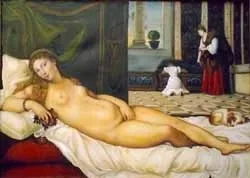
Exhibition "Late Titian", October 18 - January 6, Vienna. The Vienna Museum of Art History opens an exhibition based on the results of recent scientific research on the late work of Titian (1488-1576). It has been prepared in cooperation with the Venetian Gallerie dell'Accademia, and 60 works by the artist, created in the last 25 years of his life, are provided by various museums in Europe and the USA. The study of the style of Titian's late works is the main theme of the exhibition. Pallucchini once called the style of late Titian "magical impressionism," which abandons naturalism and classical ideals. His late manner is characterized by generalization and incompleteness, rejection of precise drawing, and mosaic-like brushwork (pittura di macchie). Expressiveness is based on subtle color transitions that seem to "melt" forms. Viewers are invited to explore the features of Titian's style using such paintings as "Nymph and Shepherd," "Tarquin and Lucretia," "St. Sebastian," "Danaë." Also presented at the exhibition is the artist's last unfinished painting, "Pietà" (1576). //www.khm.at
Church exhibition Gloria 2007, October 18-20, Dornbirn. This is the largest church exhibition in Europe, whose unusual format attracts more and more visitors. Magazines, books, church supplies, and of course antiques are of great interest not only to clergy. Equally curious at this trade fair are works by contemporary masters for churches. //www.messegloria.info
BELGIUM
Exhibition "British Vision", until January 13, Ghent. The main autumn event at the Museum of Fine Arts in Ghent will undoubtedly be a large retrospective exhibition of English painting, featuring works by major artists from the period 1750-1950. The exhibition explores the specifics of the British worldview, genre specificity, and features of the figurative system of English painting, reflected in changing trends over two centuries. The era of the "grand style" is represented by works of Hogarth and Gainsborough; neoclassicism and pre-Romanticism by paintings of Stubbs, Blake, and Fuseli; Romanticism by landscapes of Constable and Turner; Pre-Raphaelite painting by works of Millais, Rossetti, and Burne-Jones; early 20th-century avant-garde by works of Lewis, Bomberg, and Roberts; abstraction and Surrealism by paintings of Sutherland and Bacon; and Pop Art by works of Hockney and Jones. //www.mskgent.be
GREAT BRITAIN
Exhibition of works by Georg Baselitz, until December 9, London. A large retrospective exhibition of one of the most famous German neo-expressionist artists, Georg Baselitz (born 1938), recently opened at the Royal Academy of Arts in London. The exhibition consists of five parts, with works arranged in chronological order. Baselitz was first spoken of as a serious artist after his first scandalous exhibition in 1963 at Galerie M. Werner, and the series of paintings "New Types" created in 1965, which expressed an interest in Mannerism, cemented his reputation as a provocative artist. "Reality is the painting itself, not what is in the painting," the artist asserts, creating his famous "upside-down compositions." They became a sign of "liberation from the arbitrariness of subject and figuration" and made his name famous. Baselitz's sculptures, like his paintings, are built on inconsistencies and asymmetry. The exhibition features 60 paintings, as well as sculptures, engravings, and graphic works by the artist. //www.royalacademy.org.uk
Retrospective exhibition of Turner Prize winners, until January 6, London. The Turner Prize, an annual British award in contemporary art, has been awarded since 1984. It was established to encourage the development of contemporary art in Britain and to make it a subject of public discussion. This exhibition, which opens at Tate Britain, is a kind of "report" on the state of contemporary art over the last quarter century. It will feature works by winners and nominees shortlisted from 1984 to 2006. Visitors will be able to see works by Gilbert & George, Richard Deacon, Anish Kapoor, Tony Cragg, Richard Long, Lucian Freud, Damien Hirst, Antony Gormley, Chris Ofili, Grayson Perry, Simon Starling, and last year's winner Tomma Abts. In connection with the opening of this exhibition, works by nominees for the Turner Prize 2007 can be seen at Tate Liverpool from October 19 to January 13. //www.tate.org.uk
GERMANY
Exhibition of Max Klinger, October 12 - January 13, Hamburg. The main autumn event at the Hamburger Kunsthalle will be the exhibition "Love," prepared for the 150th anniversary of the birth of the famous German artist Max Klinger (1857-1920). The main theme of the exhibition - the influence of Klinger's work on 20th-century art - is revealed in six thematic sections and illustrated with paintings and graphics by Max Beckmann, Max Ernst, Paul Klee, Alfred Kubin, Edvard Munch. In total, the exhibition presents over 200 exhibits: paintings, sculptures, graphics. Visitors will be able to see Klinger's famous graphic series ("picture novels") "Love" and "Eve and the Future," about 60 paintings, including the famous "Blue Hour," and 12 polychrome sculptures. //www.hamburger-kunsthalle.de
SPAIN
Exhibition "Dürer and Lucas Cranach the Elder", through January 6, Madrid. The Madrid Museo Thyssen-Bornemisza will soon open an exhibition dedicated to the issues of the German Renaissance of the 15th to mid-16th centuries. The German Renaissance was the culmination of a spiritual (Lutheran reforms) and social crisis that lasted half a century and greatly changed medieval Germany. The exhibition examines the specific features of the German Renaissance, which lacked the coherence of the Italian one and developed over a short chronological period. The changing concept of the world and man, the search for style, subjects, heroes, and new techniques in German Renaissance painting are examined through the works of two artists of the "golden age" - Albrecht Dürer and Lucas Cranach the Elder. //www.museothyssen.org
Exhibition Be-Bomb, through January 7, Barcelona. A new, contemporary take on the artistic debates of American and European postwar art is reflected in the Be-Bomb exhibition at the Barcelona Museum of Contemporary Art (MACBA). The exhibition's main theme is revealed in its full title, "Transatlantic War of Images and All That Jazz. 1946-1956." The exhibition is structured as a dialogue-debate between American and French postwar art. It is believed that American art at that time achieved an undeniable superiority over French art. The tumultuous decade passed in heated debates and was marked by unprecedented creative activity. The symbol of the triumph of American painting is considered to be Abstract Expressionism ("action painting"), to which belonged Pollock, Gottlieb, de Kooning, Motherwell, Rothko, Barnett, Newman, Kline. The paintings of these authors are dialogically juxtaposed with works by French painters who sought themselves in lyrical abstraction (Wols, Hartung, Mathieu), "abstract nubism" (Riopelle, Ubac, Barre) or Art Brut (Dubuffet). The artistic debates of this decade will be illustrated with films, newspaper and radio materials, and fashion catalogs of the era. //www.macba.es
ITALY
International Boat Show Salone Nautico, through October 14, Genoa. The number of lovers of water tourism, yachting, and sports is growing, as are visitors to this boat show in Genoa. Last year, 300,000 people came to see new products from different countries. Salone Nautico will be open from morning until late evening, and visitors can expect various presentations and, of course, competitions – both boat and water scooter races. //www.navigarmedolce.it
Exhibition "Paul Gauguin. Myths and Dreams", through February 3, Rome. Over 150 paintings, drawings, sculptures, and ceramic works by Paul Gauguin (1848-1903) are presented at the main exhibition of the year at the Complesso del Vittoriano in Rome. The complex fate of the artist, embodied in his creative quest, is the main theme of this exhibition. The main motive of his life was "escape from civilization," which he accomplished by traveling to Peru, Martinique, and Oceania. The mystical-symbolic nature of his work is largely connected with cultural archetypes (myths) and archetypes of the unconscious (dreams), which allowed the artist at age 40 to develop his own original style, merging the rhythm of Egyptian reliefs, the wit of Italian primitives, the outlines of Japanese prints, and the synthetic qualities of color he discovered. "Where Do We Come From? What Are We? Where Are We Going?" is the title of Gauguin's "testament" painting, created shortly before his suicide attempt in 1898. It is these questions that visitors to the Roman exhibition will ponder. //www.romart.it
NETHERLANDS
Exhibition "Japanese Book Illustration of the 17th-20th Centuries", October 12 - January 6, Amsterdam. The serious fascination of Impressionist artists with Japanese art and the influence of Japanese prints on their work has long been known. So it is not surprising that the Van Gogh Museum in Amsterdam is opening a thematic exhibition of Japanese art. It will be all the more interesting for visitors to see the influence of "Japonism" on Van Gogh's own painting. The exhibition will feature book illustrations created by masters of Japanese painting from the 17th to 20th centuries - landscapes, flowers, animals, everyday scenes, ceremonies, and erotic scenes. A separate section of the exhibition is dedicated to the history of Japanese kimono design. //www3.vangoghmuseum.nl
FRANCE
Exhibition of Paintings by Jean-Honoré Fragonard, through January 13, Paris. Thanks to the Goncourt brothers, Jean-Honoré Fragonard (1732-1803) was turned in the mid-19th century exclusively into a "frivolous painter" and "cherub of erotic painting," although the legacy of the long-lived artist is richer and more diverse than this role. Simply put, from 1761 Fragonard refused academic honors, abandoned history painting, and created series of "cabinet pictures" on love and gallant subjects, landscapes, and "imaginary portraits." From 1774, Fragonard lost his popularity, and much of the painting from this 30-year period of his life has not survived. Only one thing is clear: Fragonard's style seriously changed; he was attracted to the language of allegory and elegy, themes of melancholy, passion, and eroticism reflected in the poetry of the era. The organizers of this exhibition, opening at the Musée Jacquemart-André in Paris, set out to reveal the complexity and ambiguity of Fragonard's work and to debunk the myth of the "frivolous painter." //www.musee-jacquemart-andre.com
International Contemporary Art Fair FIAC, October 18-22, Paris. FIAC is considered the most important date in the calendar of contemporary art exhibitions of the 20th and 21st centuries. This ambitious project will feature 180 art galleries from 25 countries, presenting paintings, drawings, sculptures, installations, video works, and photographs from their own collections. This year, the fair has two venues: the Grand Palais and the Cour Carrée of the Louvre. //www.fiacparis.com
SWITZERLAND
Exhibition 'History of Swiss Porcelain', until February 24, Zurich. It is not for nothing that porcelain is sometimes called 'white gold', and the story of revealing the Chinese recipe for making porcelain resembles an adventure novel with a thrilling intrigue. In the 18th century, porcelain factories opened one after another in Europe - first in Saxony, then in France. In 1764 such a factory appeared in Zurich, and in 1781 in Nyon. The exhibition recently opened at the Swiss National Museum is dedicated to the history of Swiss porcelain. It presents rare dinner sets, figurines and entire porcelain groups - these are traditional 18th century hunting scenes, gallant scenes and allegorical compositions. //www.musee-suisse.ch
Nyuta KUKUSHKINA.
Gazeta.Ru er="0">