
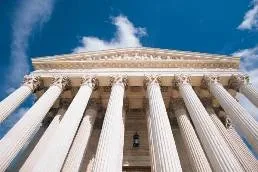
By irony of fate, residents of the American capital found themselves deprived of rights
The District of Columbia was created in 1790 specifically to establish the country's capital and house the highest federal authorities on its territory. The Founding Fathers of the United States feared that if one of the major cities belonging to a state acquired the rights of the capital, the rights of the other US states would be infringed, because local residents would exert too much influence on the activities of the highest authorities.
To create the district, two neighboring states – Maryland and Virginia – shared their territory. The new capital was named after the first president, George Washington. It became the District of Columbia in honor of Christopher Columbus, as the territory of North America was sometimes called in those times. It was a beautiful synonym, popular among romantic writers.
Like residents of the other 50 US states, Washington residents pay federal and local taxes, serve in the armed forces, serve on juries, and so on. However, Washingtonians do not have full-fledged representatives in both houses of the US Congress. De facto, there are representatives of Washington in both the House of Representatives and the Senate, but they do not have full status: in the House of Representatives, they can vote in committees and commissions, but not in general sessions (that is, they have a consultative vote); in the Senate, they only serve as observers. Paradoxically, a permanent resident of Washington who goes abroad can vote in Congressional elections – upon returning home, he loses this right. In 2000, the US Supreme Court confirmed that district residents do not have a constitutional right to have full-fledged representatives in the Senate and Congress, and that only Congress can change this law. It is important to note that residents of US dependent territories – American Samoa, Guam, Puerto Rico, and the Virgin Islands – also do not have the right to elect congressmen and senators. However, the "pill" is sweetened by the fact that they do not pay federal taxes.
Only in 1961 did district residents gain the right to participate in presidential elections (a special amendment to the US Constitution – the 23rd – was adopted for this purpose). At the same time, Washington received three votes in the Electoral College, which formally elects the US president.
Until 1974, Washingtonians also did not have the right to have an elected mayor and legislature. Until that time, all decisions concerning city affairs were made by officials appointed by Congress. Nevertheless, to this day, supreme authority in the District of Columbia belongs not to the municipality but to the US Congress. In particular, the Washington mayor's office does not have the ability to fully manage the city budget. In many cases, regulations adopted by the city legislature have been overturned by Congress, and various social programs have been closed or drastically modified. The Washington municipality does not have the right to tax federal authorities – this source of revenue is very important for other cities in the country. Congress's right to intervene in city life was suspended in 2001, but has not yet been officially revoked.
The article that establishes the boundaries and legal status of the district is part of the main text of the US Constitution (Article 1), which makes changing the legal status of the country's capital very problematic. Any arguments by supporters of changing the state of affairs run into equally serious arguments from their opponents. The essence of the dispute is quite fundamental: supporters of expanding the rights of Washington residents argue that the Constitution should be changed if it is outdated, while opponents declare that any changes could bury the entire US legal system. In addition, many experts doubt that Congress has the legal right to make such changes (this conclusion, in particular, was reached by the Congressional Research Service in 2007).
Polls periodically conducted in the United States show that supporters of granting Washingtonians the same rights as other citizens of the country outnumber opponents: for example, according to a Washington Post poll, 61% of US residents support this.
Furthermore, despite the inviolability of the Constitution, it has been de facto violated. Article 1, Section 8 of the US Constitution states that the size of the district is determined by a square with sides 10 miles (approximately 16 km) each, totaling 100 square miles (260 square km). However, the modern area of the district is 68.3 square miles (177 square km), with about 10% of that being water (in particular, the Potomac River).
It has become a tradition that April 15 of each year – the last day for filing tax returns in the US – is celebrated in the District of Columbia as a day of struggle for voting rights. In addition, all license plates of Washington residents are adorned with the inscription "Taxation Without Representation" – this phrase was one of the first slogans of the American Revolution, as a result of which the United States gained independence from Great Britain.
According to the US Department of Commerce, in 2007 the gross domestic product of the District of Columbia was $93.8 billion. For comparison, according to the World Bank, Hong Kong's GDP is estimated at $190 billion, and Bolivia's GDP at $11 billion. If Washington were a state, it would rank 35th out of 51 in this indicator. At the same time, in terms of per capita income, Washington would rank first in the US.
According to estimates by the Washington mayor's office, federal authorities account for 27% of the city's jobs. Only two companies among the 500 largest US firms (according to Fortune magazine) are based in the capital, the largest of which is Danaher.
Related materials:
Reform of the 'last colony'
Based on materials from Washington ProFile.