
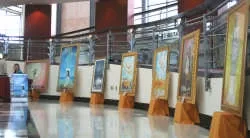
Some go to Europe to see famous landmarks. Others go shopping - to buy perfumes from the best French manufacturers or fashionable handbags from Italian designers. And only travelers who have the habit of visiting museums will, of course, pay attention to both the exhibition "Van Gogh and French Still Life" in Amsterdam and the June "Portrait of the Renaissance" in Madrid.
AUSTRIA
Exhibition "Following Sisi," until October 26, Vienna. The main summer exhibition of the Vienna Museum of Art History, after the successful Archimboldo exhibition, became a cultural exposition dedicated to the Austrian Empress Elisabeth (1837-1898), or Sisi, as her close ones called her. This exhibition presents carriages, travel and festive dresses of the empress, jewelry, fans, personal items, including such intimate accessories as silk stockings. A lover of travel and horse rides, this woman was distinguished by her striking beauty and good taste. Just as contemporaries were always interested in the happy and tragic details of Elisabeth's life and death, so, according to the organizers, our contemporaries are curious to briefly immerse themselves in the microcosm of one person. The exhibition also features portraits of Sisi and people close to her. //www.khm.at
Exhibition "Fantastic Realism," until September 14, Vienna. Half a century ago, the "Vienna School of Fantastic Realism" appeared in the artistic space of Austria – one of the most influential movements in painting of the second half of the 20th century, uniting artists such as Arik Brauer, Wolfgang Hutter, Ernst Fuchs, Rudolf Hausner, Anton Lehmden. These artists are oriented towards the art of the German Renaissance, they turn to mythological, occult-pagan, and biblical motifs, interpreting them unorthodoxly. Masters of this movement are characterized by searches for ways of artistic synthesis of ancient mysticism with modernity, grotesque and irony. The recently opened exhibition of fantastic realism at the Vienna Belvedere Gallery presents the best paintings of six artists of this movement, gathered from European museum and private collections. //www.belvedere.at
GREAT BRITAIN
Exhibition of Gustav Klimt, until August 31, Liverpool. A large retrospective exhibition of the Austrian artist Gustav Klimt (1862-1918), opened at the Tate art gallery, became one of the main events within the project "Liverpool - European Capital of Culture 2008." The work of Gustav Klimt reflects two trends in Austrian art of the late 19th - early 20th centuries: traditional historical painting and impressionism, close to French plein air painting. In addition, throughout his career, Klimt turns to symbolic paintings with many characters, monumental landscapes and portraits. The fact that the artist graduated from the School of Decorative Art certainly influenced his work. Already in Klimt's early works, the principle of asymmetry is formed, which gives his compositions a certain "Japanism," reflecting the spirit of the Vienna Secession. Klimt's role in this modernist movement is extremely important: from 1897 to 1905 he was the first president of the Secession. At the beginning of the 20th century, Gustav Klimt creates large decorative cycles. This art of two-dimensional planes, striving to unite painting and architecture, is Klimt's main contribution to the development of monumental painting. One of such works, "Beethoven Frieze," intended for the Secession building and executed on the occasion of the unveiling of Max Klinger's statue of Beethoven (1902), became the compositional center of the Liverpool exhibition. Gustav Klimt's works are presented at this exhibition in the context of the painting of his contemporaries, as well as design and architectural projects by Josef Hoffmann. //www.liverpool08.com
Summer Exhibition 2008, until August 17, London. The Summer Exhibition at the Royal Academy is one of the most large-scale and open events in the world of contemporary art, in which, by tradition, both renowned artists and newcomers participate. This year, the Summer Exhibition will be held for the 240th time, featuring about 1,500 works: painting, photography, sculpture, drawings and models. Most of them will be sold during the summer. The theme of Summer Exhibition 2008 is "man-made."
One of the main events of this exhibition is the "memorial gallery," featuring late works of the famous representative of the London school, artist-intellectual R. B. China (1932-2007). //www.royalacademy.org.uk
Exhibition "Photography of Central Europe 1918-1945," until August 31, Edinburgh. This exhibition has already been a great success at the museums of modern art in Washington and New York, and has now reached Europe. It opened at the Scottish National Gallery in early June. Photography in the period between the two world wars in Austria, Czechoslovakia, Germany, Hungary, Poland plays a huge role both in reflecting the current situation and in the development of avant-garde art. The exhibition is divided into eight thematic sections and includes works by more than 100 photographers, including names such as László Moholy-Nagy, Hannah Höch, André Kertész. //www.nationalgalleries.org
GERMANY
Exhibition of Alexander Rodchenko, until August 18, Berlin. At the Martin-Gropius-Bau museum in Berlin, an exhibition dedicated to the work of Russian artist, photographer and designer, one of the leaders of the Russian avant-garde of the first half of the 20th century, Alexander Rodchenko (1891-1956) opens. He was one of the founders of Constructivism. In the 1920s, he became interested in industrial and propaganda art and created series of original book and magazine illustrations, sketches for sets and costumes for Moscow theaters, but his main discovery in this era was photography. At the Berlin exhibition you can see Rodchenko's photomontages and photocollages, portraits of friends (V. V. Mayakovsky, N. N. Aseev, A. M. Dovzhenko) and relatives, advertisements and film posters, decorative compositions, reports from parades and construction sites of the 1920s, circus painting series of the 1930s, experimental works with perspective and chiaroscuro, which would later be called the 'Rodchenko method'. //www.berlinerfestspiele.de
Exhibition of Max Liebermann, until August 31, Dresden. The exhibition at the Dresden Gallery is dedicated to the story of the recovery of three paintings by the famous German Impressionist Max Liebermann (1847-1935) that were lost after World War II. This is the fifth exhibition in the series 'Gallery Neue Meister Visits Semperbau'. Liebermann's early work was strongly influenced by his trips to Holland and France, the works of the old Dutch masters and French Impressionists. Already in 1898 he became one of the founders and then president of the Berlin Secession, which opposed itself to official art. After Hitler came to power, Liebermann was expelled from the Academy of Arts, and his paintings were removed from museums. The Dresden exhibition features six paintings from the museum's own collection and three newly recovered and restored - 'The Seamstress' (1881), 'Jewish Street in Amsterdam' (1905) and 'Portrait of Field Marshal von Bülow' (1915-16). //www.skd-dresden.de
SPAIN
International Photography Festival PhotoEspana 2008, until July 27, Madrid. This international festival of photography and visual art was first held in 1998, and year after year it is visited by about one million people. As part of PhotoEspana, about 70 exhibitions will take place in museums, exhibition centers and art galleries in Madrid, where the art of ancient and contemporary photography will be presented by artists and gallery owners from 30 countries around the world. In addition to the exhibitions, the festival organizers have prepared an educational program - seminars, debates, master classes, and created special guided tours. On June 12, as part of PhotoEspana, the 'Night of Photography' event will take place with a street photo marathon and musical concerts, and on June 20, late in the evening, a street 'photofiesta' - 'Night of Pozuelo' will begin. www.phedigital.com
Exhibition 'Portrait of the Renaissance', until September 7, Madrid. The Prado Museum in Madrid, in collaboration with the National Gallery in London, has prepared the exhibition 'Portrait of the Renaissance', which examines in detail two trends in the evolution of the Renaissance portrait: democratization and secularity, and the diversity of portrait techniques. That is why the exhibition features not only paintings, but also drawings, sculptures, engravings, and medals. All exhibits are arranged in the following thematic sections: 'From the Netherlands to Italy. The Formation of the Genre', 'The Theme of Love, Family and Memory in Portraits', 'Portraits of Friends', 'Business Status and Social Position', 'Self-Portraits', 'The Creation of a Portrait', 'The Boundaries of the Portrait Genre', 'State Portraits' and 'The Reproduction of Portraits' - the last part is dedicated to the art of engraving. The exhibition features works by the best Renaissance artists of the period 1400-1600 - from Piero della Francesca to Rubens from European museum collections. //www.museodelprado.es
ITALY
Exhibition of Venetian glass FareVetro, until September 30, Venice. You can learn to understand the 'language of glass' at the main summer Venetian exhibition, which will take place at the Glass Museum. About a hundred unique exhibits, created at the Murano factories according to special design projects, are arranged according to their function in the museum garden, the large hall, and the music room. Visitors to this exhibition will be able to appreciate the synthesis of eight-century-old traditions of Murano glass production with modern design ideas. //www.museiciviciveneziani.it //www.venezia.net
Exhibition 'Correggio and Antiquity', until September 14, Rome. At the Borghese Gallery in Rome, as part of the 'Great Exhibitions' series, a monographic exhibition of the great Renaissance master Correggio (1489-1534) recently opened. About 60 works by the master are arranged in chronological order so that visitors can observe the evolution of the artist's style - from early works on biblical subjects created under the influence of Mantegna's 'dry' and laconic manner to the expressive late paintings that delighted Baroque artists. The compositional center of the exhibition are paintings on mythological ancient subjects. These are 'Danaë' from the museum's own collection, 'Io' and 'Ganymede' from the Vienna Kunsthistorisches Museum, 'Cupid' from the National Gallery in London, 'Venus, Satyr and Cupid' from the Louvre. Also, visitors will be able to see paintings from many Italian museums, 'Four Saints' from the Metropolitan Museum in New York and 'Noli me tangere' from the Prado in Madrid. //www.galleriaborghese.it
NETHERLANDS
Exhibition "Van Gogh and French Still Life", until January 4, Amsterdam. The main idea of this exhibition, recently opened at the Van Gogh Museum, is simple and reflected in its title, but its execution is elegant and convincing. The study of the influence of French painting on the work of Vincent van Gogh (1853-1890) and the evolution of his style is conducted within a single genre – still life. After comparing Van Gogh's still lifes from his Dutch (1881-1886) and French periods (1886-1890), the transformation of the artist's vision becomes clear. The expressive intensity and dominance of brown tones disappear, and the artist creates light, vibrant, fresh works in terms of color. The south of France, where he moved in 1888, gave the artist even more light and color, allowing him to assert at the end of his life that the evolution of painting is the evolution of color. //www.vangoghmuseum.nl
FRANCE
Exhibition "The Birth of Photography", until September 7, Paris. Another exhibition-dialogue will delight visitors to the Musée d'Orsay in Paris this summer. This time, the debate is dedicated to the birth of photography, and truly unique exhibits will be compared – French daguerreotypes and English calotypes. Daguerreotypes are the first photographs, made on copper plates coated with silver, and named after Louis Jacques Daguerre, a French painter and decorator who invented the first photographic process in 1839. A year later, the English scientist William Henry Fox Talbot "accidentally" invented the process of creating photographic images on paper and called it "calotype". Calotypes could be reproduced. Moreover, Talbot was the first among photography inventors to solve another very important problem – enlarging prints. The Paris exhibition presents daguerreotypes and calotypes from the 1840-1860s. //www.musee-orsay.fr
Festival of Graphic Design and Posters, until July 6, Chaumont. The 19th edition of the graphic design festival is an important event not only for designers and artists. The huge exhibition includes genres of political posters, social posters, advertising posters, etc. The winners of the competition held before the festival this year are authors from Switzerland, Japan, and Poland, working in completely different styles – from bold design treatments of photographs to black-and-white primitive graphics. Long-recognized talents are also presented – for example, the festival includes an exhibition of works by Josef Müller-Brockmann (1914-1996), a world-famous designer who combined simplicity and geometric perfection of forms so boldly that contemporary artists can't stop imitating him. //www.ville-chaumont.fr
CZECH REPUBLIC
Exhibition of Contemporary Art, until September 14, Prague. The organizers named the exhibition the Third (International Triennale of Contemporary Art), because the event, though new, is inextricably linked to two others – the First Biennale in Prague in 2003 and the international biennale in 2005. The aim of the exhibition is to show the merits of contemporary art that is not mainstream. The main trend presented here is kinetic art, based on the effect of movement. The exhibition features projects from different countries, gathered in Prague for several months to once again open a new world to visitors. This time, it is the world of avant-garde, crazy, but not pop art. //www.ngprague.cz
Nyuta KUKUSHKINA. 