
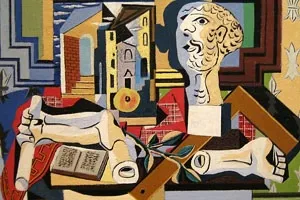
Based on the number of exhibitions, Picasso is indeed "the most important artist of our time."
One Picasso exhibition at one end of Europe barely ends before another begins at the other end. Picasso and Klee in Switzerland, Picasso in England, Picasso in Spain, and if we look more broadly, there is also the crowd-drawing Picasso in Russia and Picasso in the USA. Even in the small Pera Museum in Istanbul, a small exhibition of Picasso's graphics recently took place - so as not to lag behind the Europeans.
Neither Warhol, nor Miró, nor Klee, nor the Impressionists, nor Rembrandt and other old masters, who, it must be admitted, are also actively exhibited in Old World museums, can withstand any competition with Picasso. The reasons for the Picassophilia that has gripped curators and museum staff can be judged in different ways, but the simultaneity of a vigorous exhibition process and Picasso's firm establishment as "the most expensive artist" at recent auctions is striking. Most likely, by investing in the promotion of Picasso as an artistic brand, the owners of his works pursue purely material goals, increasing the capitalization of their assets.
Read more about these and other events in European cultural life in June in the latest issue of our regular column "Exhibitions of Europe."
AUSTRIA
Talking Heads, June 1 - September 12, Vienna. The main theme of the new cultural history exhibition opening at the Vienna Museum of Art History is the depiction of humans across different eras. The people whose portraits are presented here are separated by four millennia. "Talking Heads" is the name of this exhibition, whose curators invite viewers to look closely at the faces of Egyptian pharaohs and sphinxes, ancient Roman emperors and philosophers, as well as see medieval portraits, then courtly, heroic, and lyrical portraits of the Renaissance, ceremonial and psychological portraits of Classicism. Among the exhibits are paintings by Dürer, Parmigianino, Titian, Velázquez, Rembrandt, Rubens, busts, sculptures, paintings, tombstones, medallions, and coins from the main collection and storerooms of the KHM. Some exhibits are on display for the first time for the general public. //www.khm.at
ITALY
Nine Exhibitions in a New Museum, May 31 - January 23, Rome. May 31 is the opening day of the new Roman museum MAXXI, or the National Museum of 21st Century Art. The main sections of the museum are dedicated to architecture, design, and of course, 21st-century fine art. The museum's exhibition life begins with nine temporary exhibitions.
The first exhibition is called "Spaces" (May 30 - January 23), which brings together the best works from the museum's new collection. The exhibition of conceptualist artist Gino De Dominicis will run until November 7, and the exhibition of architectural projects by Luigi Moretti until November 28. Video installations by Turkish artist and filmmaker Kutluğ Ataman, who works in video art, will be exhibited at the museum until September 12, and the architectural design object "MAXXI_HADID" by the famous London-based architect Zaha Hadid, an Iraqi-born woman, until September 26. //www.fondazionemaxxi.it
The Virtue of Love, June 8 - November 1, Florence. The theme of the new exhibition opening in early June at the Galleria dell'Accademia is marriage in 15th-century Florentine painting. The exhibition explores various aspects of "virtuous love" in marriage, recreating episodes of betrothal, wedding celebrations, and the ritual of the wife entering the husband's home. Illustrations of Florentine marriage culture and family relationships will include literary quotes, household items, including famous wedding chests, forged furniture, tableware, tapestries, as well as paintings by artists such as Sandro Botticelli ("The Story of Virginia", Bergamo, Accademia Carrara), Filippino Lippi ("The Story of Lucretia", Florence, Galleria Palatina), and Francesco Pesellino ("The Story of Susanna", Avignon, Musée du Petit Palais). //www.unannoadarte.it
BELGIUM
Bruneaf Non-European Art Fair, June 9-13, Brussels. This year, for the 20th time, the traditional fair of non-European primitive art from Africa, Oceania, Indonesia, and Australia will be held at the Sablon exhibition center in Brussels. The exhibition will feature masks, weapons, jewelry, coins, textiles, sculptures, and handicrafts made of wood, gold, silver, bronze, ivory, and terracotta. Ancient and contemporary "naive" art will be presented by 70 galleries from France, Italy, Spain, Great Britain, the Netherlands, and the USA. //bruneaf.com
GREAT BRITAIN
Summer Exhibition 2010, June 14 - August 22, London. The traditional Summer Exhibition 2010 will take place in mid-June at the Royal Academy in London. It is one of the largest and most open events in the world of contemporary art, involving both renowned artists (Antoni Tàpies, Ed Ruscha, Michael Craig-Martin) and emerging ones, and the works presented feature stylistic eclecticism and varying levels of skill. This year, the summer exhibition will be held for the 242nd time, and about 1,500 works will be on display—paintings, photographs, sculptures, drawings, and models. Most of them will be sold during the summer. //www.royalacademy.org.uk
BP Portrait Award 2010, June 24 - September 19, London. At the end of June, the most prestigious portrait exhibition for the annual BP Award will open at the National Portrait Gallery. The exhibition will feature 58 works selected by a special committee for the final competition. The London exhibition undoubtedly reflects all the latest trends in contemporary portrait painting. This year's shortlist includes portraits by David Eichenberg ("Tim II"), Michael Gaskell ("Harry"), and Daphne Todd ("Last Portrait of Mother"). The winner will receive 25,000 euros.
As part of the exhibition, a new two-year BP project 'The Next Generation' also launches, timed to coincide with the 2012 Olympic and Paralympic Summer Games in London. //www.npg.org.uk
GERMANY
Adolph von Menzel, June 11 - August 8, Berlin. The life and work of German artist Adolph von Menzel (1815-1905) is closely tied to the traditions of 19th-century Berlin Realism; his interests also included history, politics, economics, science, and philosophy. Menzel's early successes in art were associated with printmaking: in 1842 he created 200 illustrations for Franz Kugler's 'Life of Frederick the Great.' The genre of historical painting would remain central to the artist's oeuvre, although his landscapes, interiors, and genre scenes also deserve attention. Menzel believed that 'any subject is worthy of being depicted.' The exhibition at Berlin's Old National Gallery will present more than 40 paintings, watercolors, and graphic works by this artist. //www.smb.spk-berlin.de
Arnulf Rainer, June 10 - September 5, Munich. A retrospective exhibition of Arnulf Rainer (born 1929), opening soon at Munich's Alte Pinakothek, marks the 80th birthday of the Austrian artist. Rainer's work is closely linked to the explorations of 20th-century Austrian modernism, although he had no formal art education. His early graphic works were created under the influence of Surrealism and the Vienna School of Fantastic Realism. The idea of automatism and the technique of blind drawing were close to the artist in the 1950s, and later he became interested in Abstract Expressionism.
A breakthrough in his work came with 'overpainted' photographic portraits - this technique brought the artist fame. In 1968, Arnulf Rainer created the first series of overpainted photo works, 'Grimaces.' Then he began to 'overpaint' his own paintings, works by his friends, and old masters. In the 1970s, Rainer became interested in the 'aesthetics of decay' and participated in collaborative art projects and scandalous performances. World fame came to Rainer with the 'Death Masks' cycle. The Munich exhibition will feature works from different periods, including Rainer's latest paintings. //www.pinakothek.de
DENMARK
Warhol and Munch, June 4 - September 12, Humlebæk. A new exhibition-dialogue between two popular 20th-century artists opens in early June at the Louisiana Museum of Modern Art, located on the shores of the Øresund Strait in the small town of Humlebæk (35 km from Copenhagen). The exhibition explores the influence of Edvard Munch's (1863-1944) painting on the creative quest of Andy Warhol (1928-1987). The core of the exhibition is four paintings by Munch and forty works by Warhol created based on the famous 'The Scream,' as well as 'Madonna,' 'Self-Portrait,' and 'The Brooch.' Warhol's main goal was to strip Munch's paintings of their mystical aura and turn them into objects of mass reproduction. It must be admitted that the experiment succeeded, especially since Munch himself created a lithograph of his painting 'The Scream' for the same purpose. //www.louisiana.dk
SPAIN
Turner and the Old Masters, June 22 - September 19, Madrid. This exhibition, which has already been a great success in London in autumn and in Paris in spring, can be seen in summer at the Prado in Madrid. The concept of this exhibition is a kind of dialogue between English artist Joseph Mallord William Turner (1775-1851) and 16th-19th century artists such as Canaletto, Rubens, Rembrandt, Titian, Lorrain, Poussin, and Constable. The main idea of the exhibition is to show Turner's complex, ambitious, and essentially contrastive 'imitation' of other painters.
'I don't understand how Rembrandt achieved such an effect, but I can do the same and even better,' Turner once said, and created the painting 'Moonlight: A Study at Millbank,' which will be compared at the exhibition with Rembrandt's 'Rest on the Flight into Egypt.' The exhibition will be built on such comparisons, reflecting the idea of continuity and rivalry (for example, Turner's 'Crossing the Brook' and Lorrain's 'Moses Saved from the Waters'). //www.museodelprado.es
Bulls: From Myth to Ritual, June 7 - September 5, Bilbao. A new thematic exhibition opens soon at the Bilbao Fine Arts Museum. It is dedicated to the depiction of bulls, which occupy a prominent place in the cultural space of the Mediterranean, from antiquity to the present day. Since ancient times, the bull has been considered a symbol of divine power, life-giving force, fertility, royalty, and elemental forces of nature; it was an object of both worship and rivalry. Its strength was a measure for many heroes of the ancient world, such as Heracles and Minoan acrobats, who had to jump over the bull's back, grabbing it by the horns, and then crawl under it.
The carefully organized ritual of modern bullfighting continues the long tradition of using the bull as a partner in a game with death. Myths, rituals, festivals and games of antiquity, popular Renaissance themes related to the myths of the Abduction of Europa and the Minotaur, bullfighting - these are the main themes of this exhibition. It will present 200 exhibits - bronze and ceramic items, sculpture, graphic works, and paintings by Francisco Goya, Édouard Manet, Ignacio Zuloaga, Gutiérrez Solana, Pablo Picasso, and Joan Miró. //www.museobilbao.com
Counterfeit Coins, June 11 - May 8, Barcelona. The history of counterfeiting money is as old as the history of minting real coins. This new exhibition at the National Museum of Art of Catalonia (MNAC), which runs until spring next year, is dedicated to these stories. Visitors will be able to compare ancient real and counterfeit coins, as well as modern forgeries that sometimes end up in numismatic collections. Among the exhibits will also be ancient coin minting tools, scales, and other devices for recognizing the authenticity of money. //www.mnac.cat
NETHERLANDS
Joan Miró and Jan Steen, June 17 - September 13, Amsterdam. Another exhibition on the theme of "modern interpretation of old paintings," or "creative copying - rivalry" (recall Velázquez's "Las Meninas" and Picasso, "Turner and the Old Masters"), will open at the Rijksmuseum in Amsterdam. This time, it proposes to compare paintings by Dutch painter Jan Havicksz Steen (1623-1679) and the series "Dutch Interiors" by Spanish painter Joan Miró (1893-1983), created during his return to individual figuration after a brief fascination with surrealism.
In 1928, Miró traveled to the Netherlands, visited the Rijksmuseum, bought postcards with paintings by 17th-century Dutch painters, and created three "Dutch Interiors," which some researchers call "a satirical paraphrase of the Little Dutchmen," "eliminating the distance between 'high' and 'low' art." These three paintings from the Museum of Modern Art and the Metropolitan in New York, the Peggy Guggenheim Foundation in Venice, as well as numerous sketches for these paintings, can be seen at the Amsterdam exhibition for the first time in comparison with the original sources from the Rijksmuseum collection. //www.rijksmuseum.nl
FRANCE
The Time of Dinosaurs, May 19 - July 31, Paris. Paris does not spoil us with new art exhibitions in June, but the exhibition "The Time of Dinosaurs" recently opened at the Paris Expo Porte de Versailles exhibition park. There you can see thirty dinosaurs in their natural habitat, watch how they moved, what sounds they made, and learn what they ate. It will be useful to get acquainted with the flora of the Mesozoic era, various hypotheses about the evolution and extinction of dinosaurs.
Special animated films and interactive installations will help to understand these paleontological issues. For young visitors, the journey into the past will begin aboard a spaceship. //www.pavillon-porte-de-versailles.com
SWITZERLAND
Klee and Picasso, June 6 - September 26, Bern. The Paul Klee Center in Bern has prepared a new dialogue exhibition that will explore issues of innovation and creative pursuits in 20th-century art. It is generally accepted that it is hard to find more dissimilar contemporary artists than Paul Klee (1879-1940) and Pablo Picasso (1881-1973). Klee is an introvert, immersed in contemplation and self-contemplation, lyrical, musical, "elusive in immanence," as he defined himself. Picasso is an extrovert, easily influenced by new trends, passionately searching, pompous and dramatic, superficial and charismatic. In many ways, the paths of these different artists are symbolic and reflect the main directions of the quests and experiments of new art. The Bern exhibition will present about 180 works by Klee and Picasso from museums and private collections gathered from around the world. //www.myswitzerland.com