
I really like the phrase of the writer Jack Kerouac: "...it doesn't matter how you travel, whether your trip was successful or had to be cut short. You always learn something. You learn the change of your thoughts." The Eastern world, naive and wise, somewhat mysterious, and somewhere primitive - contradictory and always not what you expect. It destroys any clichés and makes you look at yourself from the outside. Opening the East, you discover something new in yourself and return home a completely different person. Is that not enough for a trip to Afghanistan?
The Tajik border post is guarded by Russian border guards. Before going through customs, you need to buy a ticket for the boat at the office with the loud name "Nizhny Pyandzh Shipping Company". In the "shipping company" this boat is the only one, it sails about 500 meters back and forth across the muddy waters of the Pyandzh and charges $10 per passenger.
It is forbidden to go down to the pier on foot. Together with a group of Afghans, joyfully hauling several diesel generators and some sacks home, we drive past several rows of barbed wire in a battered, squeaky PAZ bus. A curious soldier with a good-natured Slavic face sat at the bow of the boat and sadly watched us settle in.
- Seryozha, are you coming with us? - the captain and accountant of the boat "Dushanbe", having counted the passengers, winks at the border guard.
- What are you doing! They'll kill me there!
And having already stepped ashore, he shouted to us:
- Guys, take care of yourselves! Come back...
Darn it, I had never wanted to turn back so badly...
Port Sher Khan is called a "port" only because a piece of wood is driven into the coastal clay, to which the mooring line of the only vessel sailing to Afghanistan is attached. You have to jump straight from the deck with your things onto the crumbling soil of the homeland of the Aryans and, ankle-deep in dust, climb a hill where the gates of this wild ancient country are located. In the dustiest spot, a little hay was scattered, a faded awning was stretched, and a mustachioed customs officer was seated. Such are the gates. For the sake of order, the representative of the authorities lightly, just a little, pats down the backpacks.
Bewildered, we look around: the customs tent, the border guards' booth, and sand, sand everywhere. How do we get a ride if there are no cars in sight? A kilometer away, some structures shimmer like a wavering mirage. We head there, but an English-speaking Afghan, a fellow passenger from the taxi to Nizhny Pyandzh, calls out to us.
- Where are you going? It's scary there. Many kilometers of desert. You need to wait here.
- Wait for what?
About 20 minutes later, the mirage of the settlement gave birth to three bright dots, which soon grew into battered Toyota minivans. The fare from Port Sher Khan to Kunduz is $2, or 100 afghanis.
You refuse to believe what is happening outside the window. Outside are bright, living canvases of the Orientalists Belli and Kunsthalle: boundless sands, clay perimeters of occupied and abandoned dwellings, caravans of loaded mules and camels, Bedouin drivers contemptuously looking from under their headscarves at gasoline transport, grimy children on donkeys, and sometimes women in burqas or old men with gray beards and turbans. It is strange that this passerby is just an Arab on a stately steed, and not Muhammad himself riding on a mare-woman named Buraq... It seems that the edge of time has been erased or swept away by the white sands of Asian deserts.
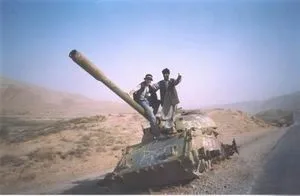
A monument to the turbulent 20th century is an asphalt road with traces of tank tracks from 15 years ago. Soviet tanks were once supposed to show the brotherly Afghan people the way from Islamic medieval times to a bright socialist future. Now these tanks are lying around in places, wrecked, adapted for barns or just like that, and we ourselves have traded the bright future for Coca-Cola and hamburgers. But in a distant country
Afghanistan, people live the same as a thousand years ago, just sipping mineral water - humanitarian aid from Nestle - and leading caravans along the old Soviet road.
In the center of Kunduz, I am in no hurry to give the driver $10 - he wants to cheat us out of 100 afghanis in the change. I try to prove something to him with gestures. Immediately a crowd gathers around us, everyone smiles, everyone is interested. Among them there was an English-speaking boy.
- Everything is clear! We'll sort it out now. Give me the money! - and immediately hands my hard-earned money to the greedy driver.
- Hey! What are you doing! He didn't give me two bucks in change! I shout at the smirking boor while the driver and the car make their way out of the crowd.
- What do you mean not important? I am the mister from Ukraine! For me, two dollars is very important!
But I gradually calm down. Am I a mister or not?
We make our way along crowded streets to the southern outskirts of the city without any specific purpose. Everywhere they sell something, motorcycles, cycle rickshaws, passersby, horse-drawn carts decorated with all kinds of frills, donkeys and cars teem. Dusk approaches, and a cloud of smog descends on Kunduz, making everything seem even more unreal. Closer to the outskirts there are fewer people, but a crowd of small fry runs after us, shouting something, laughing, and grabbing at our pants. If you hiss at them, they stop for a few seconds, then run again. Thank Allah, there was one old fellow, a dushman, a kind soul, who yelled at the kids and slapped their heads - they seem to have lagged behind.
Setting up the tent in the yard of some workshop almost became the main attraction. Thanks to the efforts of one persistent English-speaking guide, an incredible crowd gathered: to look at the "khariji" - foreigners. Nasir helped out, just grabbed us by the hands and dragged us to his home. The displeased crowd of fans continued hollering under the windows for another 20 minutes.
- Many of them would also like to invite you to their homes. They just didn't think of it. Foreigners usually stay at a hotel, - explained Nasir's younger brother, Safiullah. It is amazing how many people here know English, and quite decently! So much for a backward country...
When the dastarkhan was being spread, the head of the family - tall, gray-haired Muhammad - came into the room hung with carpets and lined with colorful pillows. Over the meal, having found out through Safiullah that we were travelers, Muhammad asked how much the "white mister" earns back home.
- 210 dollars a month, - the "white mister" even exaggerated a little.
The Afghans exchange puzzled glances. Then another son of Muhammad Sultan comes out with some phrase, and the whole family bursts into friendly laughter.
- He says, - translated Sofiulla, suppressing laughter, - move to Afghanistan,
here you will earn much more. In Ukraine, what, don't they respect computer specialists?
I didn't like the Afghan humor at all...
Having finished the soup, we start on the second course - small shashliks, most likely of mutton. Sofiulla, as the youngest, runs out the door and brings each of us about 20 skewers and a plate with a multitude of spices. Behind the door are women's voices; a couple of times one of the women tries to sneak a look into the room - of course, the house has live "foreigners", without machine guns, not shouting, not giving orders, just guests... But none of them sit at the dastarkhan; the only exception is Svetka - we are a "gift of Allah" after all. The attitude toward guests in any Islamic country is simply wonderful.
Although not completely... I never figured out who ratted us out, whether the host himself or someone from the disappointed "fans" on the street, but an alarmed Sofiulla suggested we go out into the yard, saying that a man was waiting for us there.
- Government policeman... - he clarified.
Imagination immediately conjured up a rainy night, a paddy wagon, and men in leather trench coats. Somewhat dejected, we go outside to surrender...
- Salam-salam... - the polite inquisitor, dressed in civilian clothes (a vest with pockets over something like pajamas), greets us and shows his ID. We can't make out the awful local scribbles; we take his word for it. The policeman is nervous; with trembling hands he flips through our passports. Is he really afraid? Or is it hard for him to perform his official duty instead of the natural Muslim urge to show hospitality? Having made sure of the visa (obtained in Bishkek for $30 and half a day), he apologizes long and sincerely. That is understandable without translation.
- He offers to escort you to the UN mission and treat you to dinner, so that you won't be offended. If you want... - added Sofiulla.
We didn't want to. So we went back into the house. After talking a few more minutes with the policeman, the beaming head of the family entered the room - terribly pleased that the "foreigners" had preferred to remain his guests.
Still, the visit by the Chekist had not the best consequences. The next day, Muhammad's family would not let us hitchhike to Kabul - they brought a ticket agent from the bus station and together with him urged us to take a minibus. The night guest had called for shielding the Ukrainians from any danger, and hitchhiking, in the opinion of the Afghans (to be fair, also in the opinion of our parents and most acquaintances), is a very dangerous activity.
South of Kunduz it is no longer so desert-exotic. There are fewer camels and more moisture. The valley along a small river is lined with the arteries of rice canals. The light brown palette of the landscape is more and more often diluted by patches of lush southern oases, and sometimes - the touching green of birch groves so native and strange here, by God!
The checks at numerous checkpoints distracted from the sudden homesickness - a tank track across the road, and next to it a rickety booth. The soldiers do not beg money from drivers; they merely peer into the bus businesslike, sometimes take men out for a search, and then issue a pass paper until the next checkpoint. Contrary to popular notions, the Kalashnikov is by no means part of the national costume of every Afghan - only the police and the army are armed, at least in appearance. But the roadsides and ditches are littered with fairly bulky out-of-commission weapons. After a while, all the passengers of the small but roomy Toyota look for a more decent piece of metal for us to photograph.
- Tank, mister! Aks! Aks? (Photo?)
The mad echo of explosions still climbs the walls of the mountain giants around the Salang Pass. At times, the ghosts of a forty-year war awaken. Approaching the tunnel that connects northern and southern Afghanistan - a marvel of Soviet engineering - you involuntarily notice strange stones painted red on the roadside. Sometimes there are signs with the inscriptions LM or MF. A highway marking is not particularly needed in a country without traffic rules. These are warnings of minefields. They say about 20 million mines are buried in Afghan soil, that is, one for every inhabitant. Locals are unlikely to let you go for a walk along an unfamiliar, even if very picturesque, path.
Parting with the Toyota's passengers was very sad. We had to get out of the already so familiar minibus in a deserted evening Kabul, in the center of the most unpredictable capital in the world.
On the night of the 23rd to the 24th of the month of Sha'ban in the year 1424 AH, under the starry dome of ancient Kabul, a weary traveler had a wondrous dream. He dreamed of a distant, incomprehensible country, Ukraine, where at that time it was raining and the wind was tearing yellowed leaves from the trees. Strange people lived in the cities. They lived seemingly well, in warmth and comfort, washed in hot water, yet they were not happy. Because each one strove to decide everything for himself, not listening to the advice of elders and wiser ones. Hard to believe, but few would have invited a wanderer into their home there. Policemen would not have helped "foreigners" lost at night, would not even have offered a flashlight, but rather would have extorted baksheesh from the poor souls... O Allah, you are great! Help Ukraine!
"Brrr... What a dream to have! We've been in the East for quite a while now," I thought, getting out of the tent. I got out - and was dumbfounded...
Yesterday at 11 p.m., wandering through the dead center of Kabul and encountering only garbage doomed to scurry along the empty asphalt of the streets, we suddenly came across a young policeman. He quickly grasped the situation, escorted us to the park, and helped us climb over the fence. Another policeman helped us set up the tent - with a mustache, a flashlight, and an AK-47. Surveying the surroundings, I couldn't help but rejoice that for the night we had chosen a certain elevation with an unfinished cafe. In the morning, the surrounding streets turned into a crowded bazaar; merchants had long since noticed the bright blue tent on the hill and awaited developments. When we started to come out, some even climbed onto the fence so as not to miss anything. A little further away stood our night acquaintance, keeping a sharp eye on the "fans." The tour of Zaporozhye travelers in Kabul was a sellout; the popular number - taking down the tent and packing the backpacks - drew up to six hundred spectators, but for some reason the stars refused to come out for an encore...
The city center lies in a valley surrounded by gray-brown rocky hills. The main structures are two- to three-story houses fused together along narrow streets. On the outskirts we saw painfully familiar five-story Khrushchevka buildings - a Soviet gift. And the tallest building in Kabul is the nine-story television center, next to which the park that sheltered us was located.
Having visited quite a few Eastern markets along the way, we could have paid no attention to them. But the bazaar of the Afghan capital is something amazing! In fact, half the city is a bazaar. A whole block sells only green tea, about 70 varieties, and one street is dedicated to tobacco and nasvay. Crowds, painted motor scooters, porters pulling a cart piled with a mountain of teapots two human heights tall. You are beckoned, grabbed by the hand, asked to taste, touch, smell their goods. A whole block of money changers with sacks of money. "Mister, test! Please, test!" - they ask you to be sure to recount a wad of afghanis; apparently, cheating is not customary, and it wouldn't work anyway - about 15 more people gathered to watch the exchange procedure. Raisins of forty kinds, dried apricots, apricot kernels, roasted beans, almonds, peanuts, local and Pakistani little bananas - all of it in tons, your eyes widen! After 20 minutes of wandering through Zaporozhye markets, my head usually starts to hurt, but here Sveta and I have already been bargaining for half an hour over a gorgeous skullcap. 160 - the seller clicks the buttons and hands me the calculator. No-o-o way, I shake my head and key in 70. In the end we settled on 100 afghanis and parted quite pleased with each other.
Communicating, by the way, without English-speaking helpers turned out to be not so difficult. Tajik, Dari, and Farsi are very similar, something like Ukrainian, Russian, and Belarusian. Allah is great - the conversational minimum we learned in Iran two years ago proved quite usable in these parts as well.
A ride around the city costs 2 afghanis (roughly 21 kopecks in our money). Often the buses are fitted with handrails along the entire length on the outside. If the cabin is full, you can ride on the roof or hang on somewhere on the side. Inside, the bus is divided into two parts - male and female. The requirements for women's appearance are not as strict as in neighboring Iran. We saw both completely sealed ladies and those with uncovered heads. Here everything depends on the husband. In fact, the Prophet Muhammad himself did not oblige all women to wrap themselves in a chador, well... except for his nine wives, of course. Sveta walked around in a T-shirt and jeans without any problem. And she had to put on a headscarf only because Afghanistan is probably the dustiest country in the world.
Climbing through the mud-brick neighborhoods of upper Kabul, one cannot shake the feeling of timelessness, the surreality of what is happening. Past two Zaporozhye engineers who fled the 21st century, sullen Afghans drag water skins to dwellings perched on top of one another. A ragman in a turban with a donkey walks from house to house, mournfully chanting in time to an eternal rattle. Women, with part of their faces covered by scarves, flash curious glances at the foreigners. But as soon as you take out a camera, they vanish, dissolving into the medieval half-darkness of doorways. From one Persian fairy tale into another, a girl with Eastern grace carries a tray of flatbreads on her head, and another carries the moisture of the magical Zam-Zam spring in a tall jug. From above, all of Kabul is visible, but we have already been invited for tea by Saltan to his little house, as dilapidated as the sacred Kaaba itself.
"Shuravi are very good people," says Saltan, adding dried mulberries to the saucer. "Americans are much worse..."
"Shura" means "council" in Dari, so "shuravi" means "councillors." Mention the country Ukraine, and any Afghan will unmistakably identify you as a shuravi. Saltan, as we understood, fought against the "councillors," but bears no grudge, treats us to tea and puts together a bag of sweets for the road. Such is the custom.
We first saw the American occupiers only at the US Embassy. While wandering around the city, we stumbled into the diplomatic district. The Americans walled themselves off from the Afghanistan they had captured and from the missions of the rest of the world with a triple perimeter of barbed wire and mountains of dark-green sandbags. From the predatory mouths of embrasures, the muzzles of large-caliber machine guns gaze out at the trusting Kabul. And above all this splendor flies a huge star-spangled banner. It flies in any weather because it hangs on a clever system of wires. Hollywood... Beneath the flag, a man and a woman stand at attention in full gear, their gaze from under their helmets fixed somewhere beyond the horizon, their eyes completely swollen from the forty-degree heat. They embody the world victory of democracy. For about ten minutes we tried in vain to attract the attention of a certain Jessica Lynch so that they would allow us to photograph the embassy fortress. We did not dare to take pictures on our own, fearing that the human rights fighters would first shoot and then sort things out.
The second and last time we saw Americans in Afghanistan was when we were already getting out of Kabul onto the highway. Oh, they are stylish after all! Like in the movies. Their uniforms are probably designed by leading fashion designers, and the huge off-road Hummers are a sight to behold! It’s just that the passing machine gunners, pressed into their weapons, very nervously sweep their barrels from side to side. Not the most pleasant feeling, you know, when from four jeeps at once the steel sights of the frightened masters of the world are aimed at you...
Having decided to go back to Kunduz by hitchhiking, we got onto the highway and understood why this country is considered so terrible. Anywhere on the road, while waiting for the next car, you feel the naturalness, the sheer ordinariness of death—here it is, under your feet, dusted with dust, rusty, of various calibers. The roadsides across Afghanistan are covered with an even, forty-year layer of shell casings. It is truly frightening.
But hitchhiking works well here—everyone gives you a lift: drivers of painted KamAZ trucks, jeeps of international organizations, private Toyotas. In extreme cases, you can squeeze in as the tenth passenger into a packed Volga.
In the evening in the town of Pul-i-Khumri, a police patrol stopped us.
"Hello, comrade!" The gray-haired Afghan commander has very funny Russian and a diploma from the Kiev KGB school.
"Two people from the USSR! Good! Why sleep in a tent? There’s an office! There’s a room! A good room! Let’s go?"
And they took us to the Pul-i-Khumri police headquarters. The room for guests from the former USSR was most likely a meeting hall. Portraits of comrades Karzai and Massoud, flags, a map of Afghanistan, and a pencil-drawn diagram of Pul-i-Khumri.
In the morning, the driver of a local taxi was handed a paper allowing him to pass any checkpoint without problems, and instructions were given to deliver the Shuravi safe and sound to the Kunduz authorities. We said goodbye to the Pul-i-Khumri police warmly and for a long time.
In the dusty steppe, under tarps, children sit with small boards and chalk in their hands. Under one tarp are boys, under another—girls. This is an Afghan school. The teachers allow photography and talk about the problems. There are no notebooks. The place is terrible—water is two miles away along the highway. People have to be persuaded to send their children to learn literacy.
"Mister, our children must study. We also want to be a developed country, like... like your Ukraine..."
During tea with the district police chief of Kunduz, I had a mercenary idea to get a document from the authorities that would allow free passage to Tajikistan. At a meeting at the highest leadership level, it was decided to send us with an escort to the UN mission, where such a document could easily be arranged.
"What did you say your name is?" an incredulous official asks.
"Vladimir... Like Vladimir Putin."
"Like Putin? No, you’re not like Putin... Putin is a president! A rich man. And you begrudge $20 for a ferry... And generally, what are your goals in Afghanistan?"
"Tourism."
"Tourism? Wow! I also love tourism. Two months ago I was in India, if you’re interested, I’ll tell you. What a beautiful country!"
We rode to Port Sher Khan from Pul-i-Khumri in the same Toyota with the driver Nur and his younger brother. In my pocket was a document from the UN, and Nur had a pass to the border zone. From Kunduz he carried us for free on police orders. But he didn’t lose heart, listened to his rattling music, kept trying to buy apples or nuts for the "foreigners," and every now and then, forgetting the road, turned his smiling bearded face with huge childlike eyes to us and asked, "Good?"
He is 27 years old, his brother 17. Nur’s arm near the elbow is crippled by some inhuman force.
"Shuravi?" I ask, pointing at the elbow.
"Na. Taliban! Oh... Machine gun! Tra-ta-ta!"
As we understood, they and their brother have no home; they live in the car and earn their living with it. They have no family either: their father, mother, and two more brothers were killed by the Taliban.
"Tra-ta-ta is bad. Paisa-maisa (money-money) is bad," Nur philosophizes and brings his index fingers together—a gesture that means friendship in many countries. "Good! Friendship is good!"
The captain of the boat recognized us but was a bit upset about the clever paper allowing us not to pay for the crossing. In the register of the Nizhny Pyandzh Shipping Company, the last evening entry on October 21, 2003, reads: "Name: Krasnogolovy. Organization: UN. Number: two people."
Spraying the calm Pyandzh sunset with its stern propeller, the boat "Dushanbe" approached the Tajik shore, and we looked at the opposite desert landscape with a dusty customs tent—the gates of wild Afghanistan. There we had just said goodbye to the taxi driver Nur and his brother. At the port, some English-speaking man got into the car, offering to help with formalities, and Nur asked to translate a question that had been bothering him for a long time: "Do we not consider him, and Afghans in general, bad people?"
"Oh, come on! Of course not! You are very good!"—dear me, we almost burst into tears.
And Nur jumped out of the car, started jumping in the dust and shouting, "Good! Good! Good!"
Goodbye, Afghanistan!
In Zaporizhzhia, before New Year, at the main post office, a middle-aged woman, already clearly nervous, is sticking a tenth stamp on a long envelope.
"Terrible... Afghanistan? There’s always war there. Who do you have there? Relatives?"
We have no relatives in Afghanistan. The bearded smiling driver with the elbow crippled by the Taliban and huge, childishly radiant eyes very much wanted a letter to be written to him. Nur has no address, so we had to ask an employee of a photo studio in Kunduz to leave his, and the taxi driver will sometimes drop by and wait for greetings from Ukraine. In whatever language, it doesn’t matter. We are sending photographs; our friend will definitely be happy to receive them.
Vladimir KRASNOGOLOVY.
Photo by the author.