
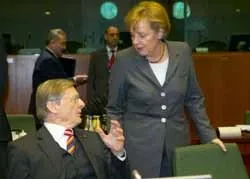
Suppose, contrary to all pleas, your dog, squinting fearfully, squats like an eagle under a rose bush in a neighbor's garden. This event is unlikely to be remembered by descendants, even if you are Osama bin Laden, the Sultan of Brunei, or a member of parliament of the South Pole from the Penguin party. Or take the strong male friendship that for years bound President Putin and Chancellor Schröder and was so readily called historic. Where is it now? Where are the troika, vodka, banya, awkward embraces and steel handshakes? Or maybe it wasn't a historic friendship, just a mild hangover passion, and all those mutual assurances, songs and praises are only enough for a term paper in the history department?
What did Merkel cook up?
Angela Dorothea Merkel, federal chancellor by the will of fate and parliament, now evokes exactly the same chemical reaction that accompanied Gerhard Schröder in his time: whatever event her hand touches immediately becomes historic. All around is what is called here the 'summer hole', the 'pickled cucumber season', the 'dog days'. Hot, languid, dull, at the word 'ocean' tears well up in the eyes. One doesn't even want to think about the present. And in the center of this stuffy hole, Chancellor Merkel, like a parka, weaves historic events.
George Bush's visit to Germany – a historic event? Of course, historic! The G8 summit in St. Petersburg, where presidents and prime ministers flirted outrageously with the only woman – Angela Dorothea, who in her gold jacket resembled a souvenir statuette – is undoubtedly also a historic event. Between these two Undoubtedly Historic Events, like Merkel between Blair and Prodi at the round table in the Konstantinovsky Palace, another one squeezed in. It's hard to tell whether it is historic or not. So for this intermediate incident, the chancellor invented an intermediate rank. 'It was almost a historic event, at any rate a very significant one,' she proudly declared, as the participants of this event, whether they had entered history or not, were going home. She said it and then left for St. Petersburg.
Angela's Heart
Officially, the Almost Historic Event is called the 'Federal Integration Conference'. 'Great events cast their shadow ahead,' Germans say. Literally – the shadow of the Almost Historic Event fell on the pages of German newspapers every day that summer. And no wonder: the Almost Historic Event was inspired personally by the chancellor, whom Bono, the lead singer of the world-famous band U2, considers the savior of the world, and whom after the G8 summit the heads of several non-governmental organizations called 'the most important person on the planet'. And indeed – the event was expected to be very important.
For the first time, the German government officially recognized that foreigners in the republic are not just passing through – viewing the Rhine castles, strolling through the Munich Pinakothek, taking photos in front of the Reichstag – they live here, many for several generations. And importantly, it's not a pitiful handful of exhibits in an ethnographic museum. It's a whole army – 15 million people. That means every fifth resident of Germany is a foreigner (when you go outside, it seems like every second). If your salary is €80 a month, with fifteen of those being rubles, that is certainly a reason to fundamentally reconsider your financial affairs. That's what Merkel did. So what does it mean? There are fifteen million foreigners in Germany. They are born, die, work, study, loaf around, laugh at Harald Schmidt's show, or don't laugh because after living in Germany for a quarter of a century they don't understand a word of German, receive social benefits, start businesses, get rich, go bankrupt, get married, sit in jail, ride bicycles, wash dishes, support the German national football team. But at the same time, they don't really exist. They surface in public consciousness when someone is killed. Or, in extreme cases, when someone kills them.
Angela Dorothea Merkel, the eighth chancellor of Germany, conceived a fantastic, astonishing act, generally not characteristic of German chancellors. She conceived of legalizing foreigners. That is, to acknowledge all their problems and all problems associated with them. And above all, Angela's noble heart suggested a solution: give the floor to the foreigners themselves. Let them say what they lack for complete and boundless happiness. And let them see that for the natives they are not a burden at all: they are welcome as family. With this noble goal, on July 14, 2006, Angela Dorothea invited 86 people to the Berlin chancellery. There were her ministers. There was Vice Chancellor Müntefering, as stern as a local police officer. There were the prime ministers of the states. There were representatives of Jews and Christians. There were heads of public organizations. And, of course, foreigners. As Maria Böhmer, who handles foreigner affairs in the Bundestag, proudly emphasized, the newcomers at the conference were 'one third'.
The Mysterious Two 'f's
Actually, calling a foreigner a 'foreigner' is not good. This word is considered ideologically alien, as is the word 'Gastarbeiter', which has taken root in many languages, including Russian. Now in Germany there are no foreigners, nor children of foreigners, nor, God forbid, guest workers. There are only 'migrants' and people with a 'migration background'. 'Migration background' resembles radiation background. For example, a person with skin the color of Swiss chocolate exudes an alien aura from a mile away, even if he recites Rilke's poems in flawless German.
The word "integration" is firmly attached to the lexeme "migrant". This mysterious integration is something like a reaction to a vaccination: some develop immunity, others simply don't notice it, yet others fear it like fire, and the fourth die from it in indescribable agony. It was around this "integration of migrants and people with a migration background" that the thoughts of modernist Merkel hovered when she called together the highbrows for a forum that, she hoped, would help develop a "national integration plan."
Declaring herself an integration modernist, the chancellor was being a little disingenuous. The fact is, foreigners were noticed in Germany long before Merkel even thought about a political career. Since then, a million and one "national integration plans" have been developed. For over twenty years now, German politicians have been endlessly deciding what to do with us, the unfortunate "migrants." For example, exactly five years ago, in July 2001, a special Federal Expert Commission on Immigration and Integration was working in the Bundestag under the leadership of Rita Süssmuth. And on January 1 of last year, an immigration law came into force.
To be honest, the main "integration" problem has long been clear without any conference. It is expressed by another classic political-journalistic cliché that, following the word "integration," is attached to the word "immigrant." In German, this cliché forms a simple pun: "fördern und fordern." Or in Russian: "support and demand." In fact, these clumsy linguistic Siamese twins very accurately describe The Most Important Question related to the settlement of fifteen million colorful and multilingual people in a large German communal apartment.
There are three options. You can support and demand. You can support without demanding. Or you can demand without supporting. That's it, really. Over these two "f's," German politicians have been endlessly quarreling for years: "reds" with "blacks," "yellows" with "greens," and everyone with everyone. Is a foreigner living in Germany obliged to fully assimilate – babble in German, believe in Christ, root for the German national football team? Or this: what to do with a foreigner who has been receiving social benefits for sixteen years of his life in Germany and only knows "Geben Sie mir das..." in German? And in Merkel's case, she also has to constantly pay homage to traditionalist voters who are convinced that if you kick the idle foreigners out of the country, paradise on earth will immediately reign.
Embrace, millions!
"We were served Turkish sweets on beautiful little plates," the chancellor admired, "I liked that very much." This seems to be the main thing in the Almost Historical Event that lasted three hours. It mainly consisted of lengthy speeches by various politicians. And the constructive part was a photograph in which Merkel, as usual symbolically dressed in the colors of the ruling coalition, posed in the center of a motley group of migrant delegates. It looked like a strange choir preparing to strike up the national integration gospel: "Embrace, millions!" Among the representatives of the millions who were supposed to embrace each other and the natives, there were no servants of Allah, who immediately became severely offended and declared the forum a farce. True, the Muslims were quickly reassured: in the fall, Interior Minister Schäuble planned a special federal conference on Islam.
Russians – the largest group of immigrants – also did not really make it into the photo of the embracing millions. Only Adolf Fetsch, chairman of the Landsmannschaft of Russian Germans, was invited to the conference.
True, there was one piquant and even, one might say, modernist moment. Merkel stated that integration is a mutual process. That means Germans too must change as a result of the presence of foreigners, sorry, migrants. And no sanctions – live calmly.
That's all. They said beautiful, noble words, tasted Turkish delicacies from beautiful little plates, sang the gospel, and peacefully dispersed. True, Merkel had warned in advance that the conference was symbolic in nature. And then, over the course of a year, six commissions with the participation of migrants from among the delegates of the first conference will study six main issues related to integration.
And immediately after the end of the Almost Historical Event, the following became clear. First, the "blacks" completely disagree with their leader. What do you mean – no sanctions?
"A foreigner is not a better person than a German," fumed Hans-Peter Uhl, the chief domestic policy expert of the "black" parliamentary faction. And added: "I miss a clear recognition of the need for sanctions."
"I expect from migrants a willingness to accept our values and integrate into society," echoed Günther Beckstein, Bavarian interior minister.
"Anyone who wants to become a German must acknowledge their belonging to the fate of the German people and its history and accept the dominant German culture," exclaimed the head of the "black" faction Kauder, quite in the spirit of the previous regime. Synchronously, at the other end of Germany, Roland Koch, premier of Hesse, remembered the "dominant German culture." Bavarian premier Stoiber criticized the chronic "unwillingness to integrate."
And the good aunt Böhmer, the host of the conference, proposed at its conclusion to teach German schoolchildren the national anthem in a mandatory manner.
Pie with nothing
But the main treat on the most beautiful little plate was served by the magazine "Spiegel" the day after the Almost Historic Event. The Ministry of Internal Affairs, the magazine reported, is developing a plan to decisively tighten immigration law. A report by a special commission, 260 pages long, lying on the desk of Federal Minister of Internal Affairs Wolfgang Schäuble, proposes expanding the law. More precisely, narrowing it. The report describes recipes for various treats. For example, recipients of Hartz IV benefits should be banned from so-called "family reunification." Foreigners whose temporary residence permits have expired are to be deported from Germany immediately, without the usual four-month "buffer" period. The document provides for the possibility of expelling foreigners receiving social assistance and even unemployment benefits.
So what was served to us on this beautiful little plate with a black-red-gold rim? It turned out like in an expensive restaurant: the plate is nice and big, but on it are some pathetic crumbs of who knows what—tasteless, odorless, and certainly not enough to satisfy. Why was this plate served to us right now? Because we are hungry? Did we order this luxurious dish? No, no one intends to fill us up. The restaurant is taking inventory. The books don't balance. And the regular customers have already started tapping their spoons on the plates out of hunger. That is why this Almost Hysterical Event is needed—to create an illusion of satiety. A pastry for everyone. One with jam. Another with cabbage. A third with eggs. But for us, latecomers to this giant luxurious table—nothing.