
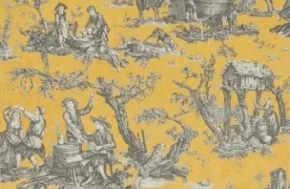
Jean-Christophe began printing designs on fabric using copper cylinders. Engraving on metal made it possible to transfer any, even the most complex, design onto fabric, while also significantly increasing printing speed. Oberkampf organized his enterprise in Jouy-en-Josas, in close proximity to Versailles. And soon orders flowed from there like a river. After all, the printed fabrics, which were called "toile de Jouy" – "cloth from Jouy" – were used not only for interior decoration, but also for dresses for Versailles fashionistas and even for men's waistcoats.
Initially, Jouy was produced in two types – red on an ecru background. These patterns imitated chalk drawings. Similarly, light-toned designs on a blue background imitated the painting on expensive Chinese porcelain. The first design patterns were mainly floral ornaments – garlands of flowers, tree branches, bouquets, complemented by ribbons. Such Rococo-style decors were very popular at the court of Louis XVI.
Later, artists took on more complex compositions. Pastoral scenes and mythological subjects, sketches from everyday life appeared on Jouy. Moreover, in Jouy designs one could see both society ladies on a walk and peasant merriment. After the French Revolution, "toile de Jouy" turned into a kind of pictorial newspaper. All events that took place in the republic were immediately reflected on the fabric.
Traditionally, these fabrics were used for wall coverings in bedrooms. And since the times of Louis and the Republic, practically nothing has changed in this regard. Modern manufacturers of Jouy are very conservative and, despite the growing popularity of this type of decor, they are in no hurry to modernize production. Many of them still use ancient copper cylinders, which they put into use several times a year. Among the customers of these fabrics is the famous Parisian hotel "Bristol".
But some manufacturers still dare to deviate from the canons. The traditional palette of Jouy consisted of five colors: black, red, blue, green, and yellow. Now the palette has been supplemented with new colors, such as purple, lilac, bright pink.
The house of Pierre Frey released Jouy with views of Hong Kong and with rural-themed designs. Moreover, all these horses, carts, and other rural attributes were printed not on cotton fabric (the traditional material for Jouy), but on linen, resembling sackcloth in appearance. Although true connoisseurs of Jouy view such a liberal interpretation of ancient art with disapproval.
Having visited the salon, you will probably want to buy something. But in order to call home and consult about the upcoming purchase, profitable unlimited tariffs will not do.
After all, these services of our operators do not work abroad. When going on a trip abroad, you need to buy a tourist SIM card. They are sold by all mobile operators.
Even at the dawn of civilization, man intuitively felt the connection between music and color. After all, it was not for nothing that ritual dances were held in the light of reddish-golden reflections of the fire, which seemed to dance themselves to the rhythm of tom-toms.
The question of the connection between sounds and colors troubled people even in the Middle Ages. The Italian painter Arcimboldo conducted such an experiment: to the students of the painting school where he taught, Arcimboldo played notes and asked them to match each note with cards of the corresponding color. It turned out that most students chose cards of the same color for a certain note.
Isaac Newton also did not stay away from solving the issue of the relationship between colors and music. He broke down the musical scale in accordance with the solar spectrum: 'do' is red, 're' is violet, 'mi' is blue, and so on.
And Kircher – the inventor of the world's first projection apparatus – translated the colors of the solar spectrum onto a screen. Inventor L. Castel worked a lot on the problem of combining color and sound. As a result of his research, he invented a machine that allowed deaf people to understand music by perceiving it through visual sensations. This amazing machine was called the harpsichord for the eyes. Unfortunately, neither the machine itself nor its drawings have survived to our days.
Another color music instrument was a giant organ designed by the Englishman A. Remington. The organ was equipped with twelve colored lanterns, which during play projected beams onto a special screen, showing the listeners (and viewers) the color of the music. Paradoxically, this instrument did not produce sounds, and during the concert it was accompanied by another musical instrument.
The research in the field of color music by T. Wilferd was crowned with a very unusual result. He created a concert of color music without musical accompaniment. On the screen, multi-colored geometric figures appear, disappear, and pulse.
The Russian composer A. N. Scriabin went further than anyone in the study of color music. He can boldly be called the founder of modern color music. In his opera 'Prometheus', the composer wrote a separate score for color. He also constructed a machine on which a 'color opera' could be performed.
But, perhaps, even the genius composer could not imagine the rapid development of color music that occurred in the 20th century. Color music became not only part of dance and musical concert shows, it stepped onto dance floors and school discos. Color music shows gained particular scale in the 1990s – just consider the productions of Jean-Michel Gérard! These productions involved the most complex color music installations.
It is interesting how the further development of color music will turn out. Perhaps it will be used by manufacturers and mobile operators. And if you want to download a new ringtone, an SMS message will come: tell the color of your phone's body. Or it will be a phone with a chameleon body that changes color depending on the melody. Corporate tariffs and golden numbers have long ceased to be a novelty. But a phone that changes the color of its body to music is not yet available to anyone.
_