
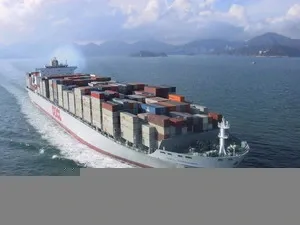
When hearing the word "piracy," a standard set of attributes comes to mind - a skull and crossbones, something under sail, sabers, daggers, and a feature film about Captain Blood. When hearing "modern piracy," first of all video and audio piracy comes to mind. Meanwhile, as IA Rosbalt notes, this is a far more serious matter than daggers, brigantines, and copyright infringement. So what is it - piracy of the 21st century?
Piracy today is attacks on merchant, fishing, auxiliary and other vessels with the aim of robbing crew members, looting cargo, hijacking ships with cargo for subsequent sale, and taking crew members for ransom. To give an idea of the scale of this criminal enterprise, I cite excerpts from the annual report of the International Maritime Bureau (IMB). In 1991, the problem became so serious that the International Piracy Center was opened in Kuala Lumpur, the capital of Malaysia, which mainly collects, analyzes and statistically processes information on pirate attacks worldwide. Accordingly, statistical data on piracy is available only from 1991.
From the IMB report "Pirate Attacks in 2003"
In the past year 2003, the number and aggressiveness of pirate attacks on vessels increased significantly compared to 2002 - 445 attacks versus 370. Thus, 2003 marked the second year in terms of the number of attacks (since 1991, when attacks began to be officially recorded); the highest number - 469 - was recorded in 2000.
In the past year, 21 seamen were killed. 71 seamen and passengers went missing. In 2002, 10 seamen were killed.
In the Strait of Malacca, the number of attacks increased from 16 to 28, but almost all of them occurred in Indonesian waters. During the last half of 2003, there were no attacks in Malaysian waters.
The number of attacks involving firearms increased from 68 in 2002 to 100 in 2003. The number of hostages almost doubled; in 2003 there were 359 people. In 311 cases, vessels were boarded, and 19 vessels were hijacked.
The waters of Indonesia remain the most dangerous - 121 attacks, followed by Bangladesh - 58 attacks, and Nigeria in third place - 39. The number of attacks in Nigerian waters tripled compared to 2002; today these are the most dangerous waters in Africa.
What, in fact, is the horror of what is happening and what should we fear, you might ask. So what if somewhere someone climbed onto a ship, hit a sailor on the head, tied up the navigator, burst into the captain's cabin and, under threat of a knife or submachine gun, stole the ship's cash box. What does humanity have to do with it?
I sailed in the 70s and 80s, and piracy existed back then. Since I worked in Far East shipping companies, it was natural that the main sailing areas were the seas of the Far East and Southeast Asia. We had heard about the exploits of Indonesian freebooters even without the center in Kuala Lumpur, weekly statistics, and the Internet. We were not afraid of attacks. Rather the opposite - we wanted them. Not because the great and mighty Soviet state stood behind us. The beloved fatherland, whether Soviet or Russian, only rushes to defend its citizens when it is advantageous for it to do so. Or when it has to. And we wanted attacks because we ourselves wouldn't have minded profiting - at least from the pirates' clothes. But they didn't attack. There were attacks in Vietnam. However, these wretches cannot be called pirates - the tongue doesn't turn. Hungry, skinny, ragged Vietnamese climbed onto ships through every possible gap, primarily to try to drag away mooring lines - they would later unravel them and make various handicrafts for sale. The second valuable item was non-ferrous metals, and these "pirates" managed to unscrew with their heel the brass plugs from the bilge water sounding pipes. Moreover, before arriving at ports in Vietnam, India and some other countries, these plugs were specially and particularly firmly tightened. It didn't help. During stops in ports of these countries, an extra watch was often posted, and as soon as a "pirate," having made his way through the anchor hawse, saw that people were not sleeping, he immediately jumped overboard, and did not brandish knives and submachine guns at all.
But the touching times of pastoral seekers of fiber for handicrafts and bronze bushings have long passed (although in Bangladesh and Vietnam they still don't disdain this). A cruel bandit has come out onto the expanses of the seas and oceans, often associated with political groups of fighters against something and for something. The use of firearms has become the rule, not the exception. Moreover, weapons are used not in case of resistance, but immediately - without preparation and warning. A boat flies up to the side, and scoundrels in masks and camouflage begin to dashingly pour fire on the decks and superstructure of the defenseless vessel. Having burst on board, the bandits take one or two crew members hostage and, under their cover, begin to loot the cabins. As a rule, those who are on the navigation bridge and in command of the ship are taken hostage, thus for the entire duration of the attack the ship remains uncontrolled. Very often, tankers with oil products or chemical tankers are the targets of attacks. If the ship is hijacked and the crew is not needed, people are simply thrown overboard.
A recent example. On February 1, 2004, near the coast of Kien Giang Province, Vietnam, three bandits opened fire on two fishing vessels with automatic weapons. Then they forced the members of both crews, totaling 18 people, to jump overboard. One person was seriously wounded. The bandits fled in the direction of Thailand and took the vessels with all equipment with them. Several hours later, a passing Malaysian vessel picked up 15 of the 18 people; three drowned.
Here is an example of how hostages are treated. The tanker Cherry - 201, owned by PT Musim Masre, which was sailing from Aceh to Belawan with a cargo of 1,000 tons of palm oil, was captured by pirates on January 5, 2004. The 13 crew members were taken hostage. Captain Maurice Sinaga was released as a messenger, and he informed the company that the bandits demanded a ransom of 400 million Indonesian rupiah - that is about $50,000. PT Musim Masre contacted the bandits directly, who confirmed the demand for the release of 12 hostages. The company began to bargain, and the bandits agreed to 100 million. But encouraged by its success, the organization did not stop there and continued to bargain, offering 70 million and immediate payment. However, the bandits waited for the money for a month, then lost patience and shot four hostages. The rest were thrown overboard.
An example of an ordinary, so to speak, robbery: on January 29, 2004, at 03:00 local time in the Singapore Strait, five bandits armed with knives climbed aboard a passing container ship. Climbing onto the bridge, they took the watch officer hostage. Using him as a shield, the robbers burst into the captain's cabin and forced him to hand over the key to the safe with the ship's cash. The captain managed to break away and locked himself in the bedroom. From there he sounded the general ship's alarm. The bandits fled, having managed to grab the captain's belongings.
However, all this is far from the worst. One could somehow tolerate such piracy. The bandits need neither environmental disasters, nor publicity, nor shocks to the world economy. Robbing the ship's safe or a ransom for crew members is all they need. But those who are increasingly appearing behind them need something quite different.
Political terrorists are taking to the seas. Security experts are already clutching their heads and raising the alarm. There have been cases when the seizure of tankers strongly resembled an exercise - the gang of militants that captured the ship took control and sailed the tanker for some time, after which they left without particular excesses. Several times in 2002 and 2003, crew members were kidnapped not for ransom (although they demanded it for form's sake), but so that the kidnapped - as a rule, qualified specialists, navigators and mechanics - would teach the militants the difficult art of ship navigation.
According to a report from the World Net Daily news agency, Al-Qaeda acquired 15 ships to organize terrorist attacks. These ships left their home ports in the Horn of Africa region, and some of them headed somewhere to Asia. As the head of the research department of Aegis Defence Service agency, Dominic Armstrong, noted, "Southeast Asia has become explosive. Given the region's general sympathy for militants, the likelihood of one or two terrorist attacks is very high."
Specialists of the Aegis Defence Service agency believe that the abduction of the chemical tanker Dewi Madrim on May 26, 2003, off the coast of Sumatra was nothing other than training in ship handling.
In numerous analytical articles, which I will not quote here, an approximate scenario of a terrorist attack is also spelled out. First, the seizure of a small vessel, then proceeding to a world-class port (for example, Singapore) and the seizure there of a supertanker with all the ensuing consequences.
To a land-based person, the word "supertanker" means nothing special, because he assumes, having gathered his knowledge from the media, that, for example, the liner Queen Mary - 2 is not just the largest liner in the world, but also the largest ship in the world. However, a supertanker will be bigger. But let us take not even a super, but simply a tanker with a displacement of 20-30 thousand tons. So, imagine an ordinary five-story Khrushchyovka, remove its roof, in all entrances, like pulp from a watermelon, take out the floors and apartments, leaving the entrances isolated, and pour something flammable into the resulting empty space - high-octane gasoline, for example. Or liquid, and by no means harmless to people and other flora, chemicals. You get a small tanker with cargo. Throw a match into it - there will be a fire. Place it near some embankment - the contents will flow in different directions.
So, a supertanker is 10-20 times larger than the example described above. Its displacement can reach 400-500 thousand tons. It is exactly such tankers, the largest in the world, that travel through the Strait of Malacca, where piracy has flourished. They supply oil to Japan, China, and Korea. They do not have to pass through canals like Suez or Panama, so they have no restrictions on their size, other than technical and economic ones.
Such a tanker could be captured, for example, in a Japanese or European port, but the effect would not be the same, because only one port and one state would suffer. On this topic, by the way, Frederick Forsyth fantasized quite convincingly in one of his novels. But the capture of such a tanker in Singapore is a completely different matter, because the whole world economy would suffer. The Singapore and Malacca Straits would close - one of the world's main transport arteries. Japan, Korea, and China would be left without oil, Europe without Asian goods. Economically, the damage would be far more significant than that of September 11.
The Strait of Malacca lies between Malaysia, Indonesia, and Singapore. Indonesia is today the main breeding ground of world piracy, which is also mixed with politics. There are endless squabbles and, in fact, civil wars here. The main argument is the Kalashnikov. Indonesia is an Islamic country. If you constantly monitor reports of pirate attacks, you get the impression that this water safari is supported at the state level. In any case, at the level of the local population: coastal villages and ports give pirates all kinds of support - partly out of fear, but more because the pirates financially support the local population and share the spoils.
Indonesia's neighbor Malaysia is also a Muslim country and not without internal problems. However, this state prefers to live by its own labor, and in its waters it has established such order that pirates fear it like fire. As for Indonesia, as soon as the prime minister of this country tries to curb piracy, he immediately loses his post.
Security experts and sailors are raising the alarm, but few hear them. Let human rights activists throw stones at me, but if a nation or a state, or the regime or ideology reigning in a given country, prefers to live not by righteous labor but by violence, then something is wrong there and one must defend oneself against them. The horror of the current state of affairs is that a catastrophe of world scale requires not a world war between leading powers, but insane actions of one small state or even a group of political extremists. The path of preventive strikes chosen by the United States and Britain is slippery, but there seems to be no other.
Undoubtedly, it is long since time to establish new rules of the game that would also provide new legal ways to solve such problems threatening world stability. Or we will be forced to get used to the idea that the skills of rapid firefighting, clearing debris, and providing first aid on the spot will soon become of primary importance for us.