
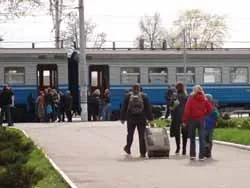
Russian authorities are reviewing 4,500 applications from potential repatriates, said Deputy Director of the Federal Migration Service (FMS) Vladimir Kalanda during the international information forum 'Integration of Compatriots-2007'. For example, about 480 applications were received in the Lipetsk region, 200 in Tyumen, and 300 in Tambov. 'Of these, about 1,500 have received a positive response from the subjects of the Russian Federation regarding the possibility of resettlement,' added Kalanda. And as of now, only 130 people have entered Russia under the compatriot resettlement program.
'The figures are not rosy,' stated the deputy director of the FMS. After all, according to Deputy Minister of Regional Development of the Russian Federation Vitaly Shipov, about 30 million compatriots live in the near and far abroad. Thus, it seems that saving Russia from the demographic crisis and solving the problem of personnel shortage with the help of repatriates, as the Russian authorities had planned, will not be possible.
The compatriot resettlement program started at the beginning of 2007. The government promised resettlers a mortgage loan, payment for travel to the place of residence, and a one-time allowance. Of the 55 subjects of Russia that declared their desire to participate in the program, the FMS selected 12 pilot regions: Primorsky, Khabarovsk, and Krasnoyarsk territories; Irkutsk, Amur, Tver, Tyumen, Lipetsk, Kaliningrad, Tambov, Novosibirsk, and Kaluga regions. By 2012, the FMS hoped to receive 300,000 program participants, not counting their family members. However, these dreams are unlikely to come true. In practice, the implementation of the idea has faced many problems. That is why compatriots are in no hurry to move to Russia.
Deputy Head of the Federal Service for Labor and Employment Yuri Gertsy accused the regions of inaction during the forum. In his opinion, local authorities do not pay enough attention to finding jobs for resettlers. 'We rarely see measures for adaptation to working conditions,' he threw an accusation at the regional authorities.
However, he did not manage to shift the responsibility. 'Do not look for shortcomings with us, look at yourselves,' retorted the governor of the Kaliningrad region, Georgy Boos. For example, a number of issues in tax and labor legislation are completely unresolved, he stated. For instance, it is unclear whether resettlers who have not yet received citizenship can work in trade.
In general, according to the governor, the implementation of the program is hindered by 'strong interdepartmental barriers'. 'The embassies are doing a very poor job,' he addressed the director of the department for work with compatriots abroad of the Russian Foreign Ministry, Alexander Chapurin. Consulates often simply refuse to accept resettlers' applications. 'I have no words for how the embassy in Kazakhstan works,' the governor fumed: the region received 13,000 applications from Kazakhstan, and each of them expressed dissatisfaction with the embassy's work. If such complaints continue, it makes sense to recall ambassadors and consuls from the regions, 'so that they understand how important this is,' Boos suggested.
Moreover, many resettlers have neither tax nor credit history. They start 'living from a clean slate', so it is difficult for them to get a loan to buy an apartment. Bankers consider this category of citizens a risk group and are afraid to lend them money. As a result, resettlers have nowhere to live. To reduce the bank's risks, the state should perhaps think about creating a collateral fund, stated Georgy Boos.
And these are far from all the reasons why compatriots do not risk going to Russia. There is, for example, the problem of children's adaptation to the new environment. They grew up in completely different conditions. 'Perhaps special programs for children and youth are needed,' suggested Vladimir Kalanda. In addition, the names of positions and qualifications in other countries and Russia often do not match. And it is sometimes unclear what specialty to look for a job for a resettler. Also, residents of Russia are not always tolerant of arrivals from neighboring countries.
Natalia YEREMINA.
Gazeta.Ru er="0">