
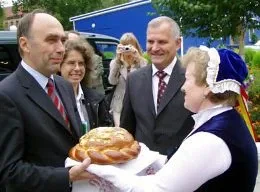
The Federal Government Commissioner for Resettlers and National Minorities Christoph Bergner (pictured left) intends to achieve simplification of the family reunification procedure for late resettlers
"The Federal Expellees Law (Bundesvertriebenengesetz) remains relevant because it reflects Germany's historically moral obligation towards those Germans who were held collectively responsible for the policy of annihilation and the horrors of National Socialism due to their nationality," said Bergner in an interview with Berliner Zeitung. "And this concerns our attitude towards Germans as national minorities in European countries and in the successor states of the USSR."
Bergner further expressed his full understanding of another problem: "Russian Germans came to Germany expecting that national solidarity would be shown to them precisely as Germans who suffered because of German history. But our society did not show this solidarity. German ancestry often does not play a big role here. And this leads to disappointment and alienation. But I would like to note the following: despite the large number of late resettlers, their integration process is proceeding successfully. Since 1950, Germany has accepted 4.5 million resettlers, which corresponds to the population of an average federal state. In the past 20 years alone, more than 3 million resettlers have arrived, among them 2.3 million from Russia. And the vast majority of them have integrated well."
The commissioner also spoke about the attention that far-right parties have recently been paying to Russian Germans: "The far-right have intensified their attempts to win over, in particular, Russian Germans. But fortunately, their success so far is insignificant. Russian Germans, with their rich experience of interacting with other cultures in Russia, are not very susceptible to the concept of racism. Moreover, far-right propaganda itself is very contradictory. For example, the NPD distributed leaflets in several cities, in areas where Russian Germans live, demanding that these areas be declared 'Russian-free zones.' This greatly offended the resettlers. I constantly point out the duplicity of the NPD."
Asked about the future of the 'Commissioner's Office' if the process of accepting resettlers is essentially wound down, Bergner replied: "Yes, our functions will change. However, the coalition agreement (between the CDU/CSU and FDP) contains a clear reference to special responsibility for German minorities in their current places of residence, as well as for resettlers and expellees living among us. I see our main task in this electoral term as addressing the issues of their further integration. In addition, we need to develop EU structures and their partnership relations with the successor states of the USSR. And Russian Germans living in Germany can be of great help in this matter."
Chairman of the Federation of Integration Councils of Germans from Russia, head of Berlin's Integration Center Neubeginn, candidate of pedagogical sciences, Professor Anatoly Graf believes that "the planned by Mr. Bergner simplification of the family reunification procedure, although it will not remove all barriers, is already a noticeable step forward. We have repeatedly appealed both to the Federal Government and personally to Mr. Bergner about the fact that the Federal Expellees Law in its current version has actually blocked the path for Russian Germans to return to their ethnic homeland. We were answered in the sense that, yes, it's time to face these issues, they are obvious, let's solve them together, the time has come.
And now, finally, the issue seems to have moved from a dead point. I regard Mr. Bergner's plans as a response to our calls for restoring justice towards Russian Germans – the only unrehabilitated people. Let us hope that our lawmakers will have enough political will to approve these changes."
Sergei DEBRER.
Russkaya Germaniya