
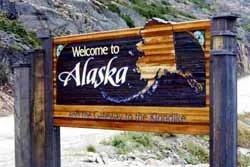
Discovered by Russian explorers, Alaska today belongs to Americans
Great Russian explorers are credited with many geographical discoveries, including the rich lands of Alaska. But after 126 years, the former colony of the Russian Empire passed into American hands.
They were the first
Alaska belonged to the Russian Empire for 126 years, but the exploration of this land began much earlier: several expeditions to the shores of the northwestern coast of the American continent were dispatched, all of which ended in failure. Only in the summer of 1741, on the day of the prophet Elijah, did the expedition of Alexei Chirikov and Vitus Bering first land on Alaska. From the sea, seeing the peak of an unknown mountain, Bering named it after this saint especially revered in Rus'. However, according to scientists, Alaska was discovered by Siberian hunters much earlier, back in the Stone Age, when the ancestors of most indigenous American Indians migrated across the ocean from advancing glaciers. Salmon, flounder, cod, herring found in Alaska's coastal waters, as well as an abundance of fur-bearing animals, helped the Siberian natives choose a site for their settlement.
The territory of Alaska was explored at various times by the Spanish, British, and French, but only Russian explorers managed to establish a colony in this "bear corner." In 1784, the merchant, industrialist, and entrepreneur Shelikhov sent ships built with his own money to Kodiak Island. Thanks to his energy and foresight, the first Russian possessions appeared in Alaska, and Shelikhov himself headed the first agricultural colony, "Slava Rossii." Gradually, with the emergence of new merchant-industrialists, Russian possessions in Alaska expanded to the south and east. With the merger of the companies of merchants Shelikhov, Golikov, and Mylnikov in 1798, the Russian-American Company was created, with shareholders including emperors, grand dukes, and major statesmen. The company received from Paul I monopoly rights to fur trade, commerce, and the discovery of new lands in the northeastern part of the Pacific Ocean. Moreover, it was "called upon to represent and defend Russia's interests in the Pacific Ocean using its own means."
For 11 million
Russian possessions in America were quite extensive, comprising 6% of the then Russian territory or 1.1% of the entire land surface of the Earth. The borders of Russian territories in northern and southern Alaska were determined by a special Russian-American convention of 1824, adopted in St. Petersburg. In 1825, Russia also reached an agreement with Britain, defining precise eastern and western boundaries. According to the conventions, the Russian Empire granted Britain and the United States the right to trade in Alaska for 10 years, after which Alaska would fully come under Russian ownership.
Suddenly, all the land with all its fishing villages, trading posts, redoubts, and fortresses was sold at a surprising price - 11 million rubles or $7.2 million. This was the value assigned to the islands belonging to the Russian-American Company with an area of 31,205 square kilometers and a part of the North American mainland with an area of 548,902 square kilometers. It was believed that by the mid-19th century, the Russian-American Company had become unprofitable, and the American possessions themselves brought nothing but problems to Russia. To improve its affairs, the company tried to generate profit from new sources: coal mining, whaling, and even exporting ice to San Francisco, but to no avail. By 1866, it owed the Ministry of Finance 725,000 rubles. The official reasons for the sale also included the need to focus on the development of the Amur region and Sakhalin, and maintaining good neighborly relations with America. Moreover, fears were raised that in the event of war, Russia would not be able to defend its colony. One of the decisive factors in the sale of Alaska was the Crimean War (1853-1856), which depleted the treasury and at the same time demonstrated the vulnerability of territories in the Pacific Ocean to the British fleet. Thus, one hectare of "dear little Alaska" cost "Uncle Sam" 5 kopecks.
It is noteworthy that this was already the second treaty for the sale of "Russian America." Back in 1854, during the Crimean War, the U.S. government, taking advantage of the worsening Russian-English relations in the Middle East, offered Russia to buy Alaska from it. The parties, represented by the Russian-American Company and the American-Russian Trading Company, shook hands and signed a treaty on May 31 (19), 1854. The American side undertook to pay the Russian side $7.6 million. However, this treaty never came into force because it was fictitious: its purpose was to force the British to refrain from attacking the territory of Russian possessions. Otherwise, a new conflict between England and the United States would inevitably arise, which was extremely undesirable for Britain. In reality, Alaska was sold for $400,000 less.
As scientists believe, the sale of Russia's overseas possessions "was caused by a complex set of economic and geopolitical reasons." Most economists, led by academician Nikolai Bolkhovitinov, agree that "the treaty on the sale of Alaska was a mutually beneficial result of the implementation of American geopolitical ambitions and Russia's sober calculation-based decision to concentrate efforts on developing the Amur and Primorye regions annexed to the empire in 1860." As historians note, the Russian side paid close attention to the colony it intended to part with before concluding the treaty. The geographical features of the overseas colonial possessions were well known, so the greatest interest for those making the decision to sell was socio-economic factors. The fact is that on January 1, 1862, the privileges of the Russian-American Company were to expire. In addition, this date coincided with the period of reforms to abolish serfdom in Russia, and anti-serfdom and anti-colonial public opinion had to be taken into account.
As for America, the initiative to buy Alaska belonged to US Secretary of State William Seward, but in fact, back in 1819, US Secretary of State John Quincy Adams stated that "all other states of the world must reconcile themselves to the thought that the continent of North America is the lawful possession of the United States." He also believed that "to wrest part of the American continent from the Russians, the best weapons will be patience and time." His successor, US Secretary of State William Seward, made an even stronger statement in 1848: "Our population is destined to roll its irresistible waves up to the icy boundaries of the North and to meet with Eastern civilization on the shores of the Pacific Ocean." By the way, contemporaries long criticized him for the thoughtless spending of public money on the purchase of a "polar bear zoo," and the press called him a "fool." But at that time, no one could even imagine that Alaska would turn out to be a rich gold-bearing region.
Where is the money?
In 1867, the St. Petersburg Gazette, expressing the point of view on the sale of "Russian America," would write: "It usually happens that states strengthen themselves by all measures to expand their possessions. This general rule does not apply unconditionally only to Russia. Its possessions are so vast and stretched that it has to not annex lands, but on the contrary, cede these lands to others."
The money from the sale of Alaska did not reach the Russian state treasury. Of the $7.2 million, approximately $1.5 million was lost in exchange bank operations carried out by the Russian envoy in Washington, Baron Stoeckl, and 200 thousand went to bribes to American senators, officials, and journalists. The rest of the gold, which was to be delivered to St. Petersburg on the English barque 'Orkney' for some reason, disappeared under mysterious circumstances. The ship carrying the gold sank in the Baltic Sea during a complete calm. And in the end, Russia ended up with neither the money nor Alaska. So the official of the financial department in St. Petersburg who put forward the most original argument against the sale of Alaska was right: "They will steal it all anyway."
Talk that Alaska in 1867 was allegedly not sold but leased for 99 years arose roughly after World War II. But there is no basis for such claims, because according to the treaty concluded in 1867, Alaska unequivocally, finally, and irrevocably passes into full ownership of the United States.
Alaska today is a quarter of all US underground and marine wealth, including 4.5 billion barrels of proven oil reserves, as well as gas, timber, and copper. In some business circles, the idea is quietly maturing that the US could reduce the federal budget deficit and national debt, as well as increase GDP, if it decided to sell Alaska to Russia for one trillion dollars. From the Americans' point of view, the moment for such a deal has come, as prices for minerals are approaching absolute records, and Russia has accumulated a sufficient amount of petrodollars.