
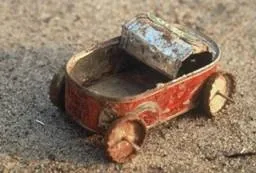
Unusual exhibition of handmade children's toys opened at the Leopold Museum in Vienna
Painting lovers are recommended to take note of the recently opened "From Botticelli to Titian" in Budapest (bringing Leonardo's "Lady with an Ermine"), "Rubens and Old Masters" (theme: Rubens and the great Italians of the 16th century) in Munich, "Family Portrait" in London, and a large (80 works!) "Botticelli" in Frankfurt am Main.
Among those opening in December, we draw attention to the exhibition at the new Eugène Delacroix Museum in Paris (where more than 100 works of the master will be displayed) and the international contemporary art biennale in Florence.
Of undoubted interest is the Decode Digital (Computer) Design Exhibition, starting in London on December 8. For archaeology lovers, Paris will present the "Golassec Culture" exhibition, and 200 miniature portraits in Stockholm will tell in detail the history of this once popular genre. Also awaiting their fans are Auto retro in Barcelona and contemporary official art of North Korea in Vienna. The Picasso Museum lures visitors with Japanese erotic prints that the Spanish artist collected and tried to compete with.
AUSTRIA
Other Toys, November 20 – March 31, Vienna. The Leopold Museum in Vienna recently opened an unusual exhibition of handmade children's toys from the collection of Austrian ethnologist Fritz Trapp. We are all used to mass-produced store-bought toys, and handmade toys often resemble the same mass-produced ones. Fritz Trapp collected his collection after traveling to poor countries in Africa, Asia and Latin America, where children have to make their own toys from available materials and waste from adult life. Children's fantasies, dreams, fears – all are reflected in these cars made from tin cans with wheels from beer caps, wooden weapons, wire headphones, rag dolls. The "exhibits" are presented in a video context, so visitors can see photographs of the children who made these toys and learn about the history of their families. Another life is learned through "other toys". The exhibition is both philosophical and cultural, intellectually deep and simply "kind". //www.leopoldmuseum.org
Flowers for Kim Il-sung, December 2 – March 14, Vienna. A rare opportunity to see North Korean official art in person is offered to visitors of the Austrian Museum of Applied Arts (MAK). This exhibition was prepared jointly with the National Gallery in Pyongyang, featuring more than 50 exhibits – mostly monumental socialist realist canvases whose theme is the absolutely happy life of the North Korean people in complete unity with the party and its main leaders – Kim Il-sung and Kim Jong-il. After getting acquainted with the official culture of the socialist state, you can visit the tea cup exhibition in the same museum and relax there, examining exhibits from China and Japan from the 12th to 21st centuries. //www.mak.at
BELGIUM
International Exhibition-Fair Lineart, December 4-8, Ghent. For the 28th time, the traditional December exhibition-fair Lineart will take place at the Ghent exhibition center Flanders Expo, attracting more than 25,000 visitors annually. This year, works of art from the 19th to 21st centuries will be presented by 140 galleries from 20 countries. The exhibition will be interesting both for collectors and lovers of fine arts, because it is not at all necessary to buy rare exhibits; you can simply look at collections of painting, sculpture, photography, glass and ceramics – antique and modern. Visitors are also awaited by special thematic mini-exhibitions "Ceramics-2009" and "Chinese Art". //www.lineart.be
GREAT BRITAIN
Digital Design Exhibition, December 8 – April 11, London. The Decode exhibition, which opens at the Victoria and Albert Museum, will explore one of the important issues: can modern digital design be considered art? In the first part of the exhibition, visitors will be able to get acquainted with the so-called "kitchen" of computer design. The main object in this section will be Daniel Brown's "illusory plants," which will grow and change in front of visitors. The second section presents interactive objects by Golan Levin and Greg Baltus, including the famous "Opto-Isolator," which is a wall-mounted sculpture in the shape of an eye that enters into a visual dialogue with a person standing opposite it. If you look intently at the object, a complete illusion of contact is created: the gaze is averted, then the object blinks a second after the person looking at it. The third part of the exhibition analyzes the problem of using advanced technologies in social networks and mass media. //www.vam.ac.uk
Family Portrait in Interior, until February 14, London. An exhibition recently opened at Buckingham Palace (Queen's Gallery) dedicated to the popular genre of family portrait in interior from the 17th to 19th centuries, from the royal painting collection. The exhibition opens with paintings by Dutch masters – a family portrait of Charles I and Henrietta Maria by Hendrick Pot, genre scenes from court life by Bartholomeus van Bassen. The next section is devoted to genre scenes by Pieter de Hooch, Godfried Schalcken, Melchior d'Hondecoeter, acquired by the royal family in the early 19th century. Then visitors will see paintings by William Hogarth, Philippe Mercier, Charles Philips, John Wootton, Johann Zoffany, Thomas Gainsborough, George Stubbs. The exhibition ends with scenes from the life of Queen Victoria by English artist Edwin Landseer from 1838 to 1850. //www.royalcollection.org.uk
HUNGARY
From Botticelli to Titian, until February 14, Budapest. The Museum of Fine Arts in Budapest is hosting a large exhibition dedicated to Italian Renaissance art, featuring about 130 paintings by great artists of the 15th–16th centuries. Only 30 paintings in this exhibition belong to the Budapest museum; the remaining works are gathered from 30 private collections and 80 museums around the world, including the Louvre, the Prado, the National Gallery in London, the Kunsthistorisches Museum in Vienna, the Uffizi Gallery, and the Metropolitan Museum of Art in New York. Visitors can see paintings by Leonardo da Vinci, Giorgione, Veronese, Raphael, and Titian. Among the masterpieces are 'Lady with an Ermine' by Leonardo da Vinci, 'Young Man with a Glove' by Titian, 'Flora' by Bartolomeo Veneto, 'The Story of Virginia' by Sandro Botticelli, 'Portrait of Francesco delle Opere' by Perugino, and 'Tobias and the Angel' by Giovanni Girolamo Savoldo. //www.szepmuveszeti.hu
GERMANY
Rubens and the Old Masters, until February 7, Munich. The exhibition at the Alte Pinakothek in Munich explores the influence of Italian Renaissance artists such as Raphael and Titian on the painting of the famous Flemish artist Peter Paul Rubens (1577–1640). In May 1600, Rubens traveled to Italy, and in Venice he was struck by Titian's paintings, an admiration he would retain for life. The influence of Italian painting is evident in both Rubens's portraits and his paintings on biblical and mythological subjects. The exhibition's core concept is a dialogue between artists. Visitors can compare Titian's and Rubens's 'Adam and Eve', as well as Rubens's portraits and mythological scenes inspired by Italian artists. Paintings for this exhibition are provided by European museums such as the Prado in Madrid, the Kunsthistorisches Museum in Vienna, and the Nationalmuseum in Stockholm. //www.pinakothek.de
Exhibition of Sandro Botticelli, November 13 – February 28, Frankfurt am Main. Over 80 paintings by Italian artist Sandro Botticelli (1445–1510) and his contemporaries are presented at the Städel Museum in Frankfurt. The fate and work of this artist are inextricably linked to the Medici court and Florence; all the political vicissitudes of the era touched him and are reflected in his work. Interestingly, this 'solitary interpreter of aristocratic humanism and poetic idealism' was long forgotten and only regained popularity in the 19th century, especially among English intellectuals, from the Pre-Raphaelites to Art Nouveau artists. Botticelli's work at the Frankfurt exhibition is presented in three sections. The first part features allegorical portraits, the second mythological scenes, and the exhibition concludes with paintings on biblical subjects. Also on display are works by Filippo Lippi, Botticelli's teacher, and Andrea del Verrocchio. //www.staedelmuseum.de
SPAIN
Picasso and Japanese Erotic Prints, until February 14, Barcelona. A favorite genre for temporary exhibition curators at the Picasso Museum in Barcelona is artistic dialogue. This time, visitors are invited to compare 19 Japanese erotic prints from the 17th–19th centuries from Pablo Picasso's personal collection with 27 drawings and prints by the artist himself, created under the influence of shunga (for example, 'The Dream of the Fisherman's Wife' by Hokusai and Picasso). But the exhibition has broader goals—to trace the influence of Japanese prints on 20th-century painting. Hence, it also features works by contemporary Japanese and European artists inclined toward erotic primitives, and more broadly, toward primitive art. The exhibition includes special lectures on the art of Japanese printmaking, and on December 16 and January 18, the museum will host a performance of 'Short Erotic Stories' with Yoshi Hioki. //www.bcn.cat
Exhibition of Vintage Cars, December 4–8, Barcelona. The Barcelona Auto Retro exhibition is the best show of retro cars and motorcycles in Spain. This year marks its 26th edition. In addition to vintage cars and motorcycles—over 500 last year—the exhibition offers a huge selection of parts and accessories for fully restoring classic models and giving them a second life. Visitors will receive plenty of useful information on car repair and restoration, where to find rare parts, how to perform nickel plating, and where to order custom upholstery. The program of the 26th Auto Retro, held at Fira Barcelona, includes themed photography exhibitions, presentations, concerts, rallies, as well as shows of vintage boats and aircraft. 15 retro cars presented at the exhibition will be sold at auction in Paris on January 23, 2010. //www.autoretro.es
ITALY
Exhibition of Giovanni Boldini, November 25 – March 14, Rome. The Chiostro del Bramante museum in Rome opens a series of exhibitions titled 'Italians in Paris'. The first in this series features the artist Giovanni Boldini (1842–1931), who settled in Paris in 1872 and became a true salon painter, later a symbol of the so-called La Belle Époque. Elegant style, modern life, views of Paris, and portraits of Parisian celebrities made him a celebrity of Parisian high society. He painted the most famous Parisians of that 'beautiful era' – Robert de Montesquiou, Madame Lapthelme, dancer Cléo de Mérode, actress Sarah Bernhardt, Marchioness Casati, etc. Of course, all those 'famous Parisians' are now forgotten, perhaps except Sarah Bernhardt, and the salon painter himself is also forgotten, but this exhibition reminds us that there is real and fake art, reminds us of the problem of choice and the artist's responsibility for talent. //www.romeguide.it
International Biennial of Contemporary Art, December 5–13, Florence. For the 7th time, the exhibition complex Fortezza da Basso will host the contemporary art exhibition Florence Biennale as part of the UN program "Dialogue among Civilizations." It will feature over 800 artists from 84 countries, competing for special prizes and awards that will be presented on the last day of the biennial. The exhibition will include conferences, concerts, and performances with artists. Special exhibitions this year are dedicated to works by renowned contemporary artists Marina Abramović and Shu Yun. //www.florencebiennale.org
FRANCE
Exhibition of Eugène Delacroix, December 16 – April 5, Paris. In mid-December, the National Museum of Eugène Delacroix, opened several decades ago in the last apartment and studio of the famous French artist, will host a major exhibition of his works. About a hundred paintings, drawings, engravings, and sketches by Delacroix (1798–1863) have been loaned for the Paris exhibition from the private collection of Karen B. Cohen. These works will then be shown at the Metropolitan Museum of Art in New York. The museum preserves the artist's furniture, Moroccan souvenirs, letters, sketches, drawings and engravings, family portraits, a portrait of his servant Jenny Le Guillou, as well as "The Abduction of Rebecca" and "Hamlet and Horatio in the Graveyard." The exhibition of works from the private collection will fit seamlessly into the museum's interior and promises to be one of the important events of Parisian cultural life. //www.musee-delacroix.fr
Golasecca culture, November 27 – April 24, Paris. The Saint-Germain Palace, which houses the National Archaeological Museum (Musée d'Archéologie nationale), has opened a new archaeological exhibition dedicated to the Golasecca culture, named after the excavation site in the south of Lake Maggiore, on the left bank of the Ticino River that flows from it. According to scholars, it occupied part of Lombardy, Piedmont, and the canton of Ticino in Switzerland. Its origin is linked to the development of the Urnfield culture in Northern Italy in the 9th century BC, and some researchers suggest even more ancient roots. The Golasecca culture flourished in the 6th–5th centuries BC, and its decline is associated with the arrival of the Celts in the 4th century BC and the subsequent incorporation of the territory into the Roman Republic. The Paris exhibition is based on the latest historical research and includes over a hundred artifacts of the Golasecca culture from museums in Italy and Switzerland – urns, bowls, amphora-shaped vessels, weapons, fibulae, bronze vessels, and funerary stelae. //www.musee-antiquitesnationales.fr
SWEDEN
Exhibition of Miniature Portraits, November 22 – February 15, Stockholm. About 200 miniature portraits will form the basis of a new exhibition at the Nationalmuseum in Stockholm. The main goal is to introduce visitors to the history of miniature portraits and their techniques. Miniature portraits were extremely popular from the 16th to the 19th centuries, and their techniques constantly improved. In the 16th century, artists worked in gouache on parchment stretched over cardboard, while in the 17th century, enamel on metal appeared. The 18th–19th centuries were the heyday of miniature gouache on ivory, which was used in very thin plates, allowing the artist to exploit their transparency: paints could also be applied on the reverse side of the portrait. //www.nationalmuseum.se
Nyuta KUKUSHKINA.
Газета.Ru er="0">