
We know a lot about the Great Patriotic War. About World War II - much less. And it is not our fault that many events that firmly linked us and our allies during this terrible battle were covered with the dust of oblivion for decades.
«Frantic» means «frenzied»
«Second Front», «lend-lease», «meeting on the Elbe» - that is probably all that hastily comes to mind when we talk about America's participation in the war. Of course, military historians are much more knowledgeable people. But even into their lives, this or that page of history sometimes enters quite unexpectedly.
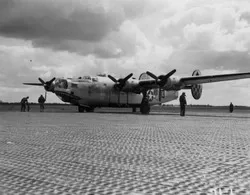
In the spring of 1999, Igor Vasilyevich Chichkan, head of the research department of the Central Museum of the Armed Forces of Ukraine, began preparing an exhibition dedicated to the direct combat cooperation between the US and Soviet air forces during the Great Patriotic War. American 'flying fortresses' carried out successful 'shuttle' bombing raids on Germany, based at Ukrainian military airfields - in Poltava, Mirgorod and Piryatin. At that time, information about the joint Soviet-American operation 'Frantic' was strictly classified not only in the USSR but also in the USA. And the passing years pushed this glorious page of history even deeper into the shadows.
But it so happened that during a summer holiday in the Crimea, Igor Vasilyevich met a pilot from Poltava - a man who could best tell about the mark this glorious operation left on the history of Poltava. Both interlocutors had been through Afghanistan, had seen war 'face to face', and their conversation was sincere and profound.
Returning to Kiev, Igor Vasilyevich continued collecting and analyzing information. Documents, photographs, letters, newspaper clippings came from Ukrainian archives, from our former compatriots in the USA, from staff of the Berlin Military Museum. And history came alive.
«Roosevelt's falcons» were eager for battle...
«Strategic bombing of the enemy is the key to victory» - this was the position the allies firmly held. Bomb the factories, railway lines, power plants and oil-refining complexes of Germany! On the American side, the mission was assigned to two air forces: the 8th, based in England, and the 15th, whose main bases were located in the liberated part of Italy.
However, strategically important targets located in eastern Germany and in a number of occupied countries were inaccessible due to the distance for American bombers. At the same time, territory liberated by Soviet troops lay ahead on their route. Thus arose the idea of a joint Soviet-American air operation. After lengthy negotiations with the Soviet government, by mid-December 1943 the matter was resolved politically. The time had come for practical action.
Airfield – by the hands of «small but sturdy Ukrainian women»
US strategic aviation bases needed runways that were enormous by the standards of that time, necessarily with hard surfaces, powerful radio-technical equipment, and a complex of facilities for maintenance and repair. Moreover, according to plans, up to 360 'flying fortresses' were to land at such a base per day.
In the end, the experts chose Poltava: the local airfield had been one of the main bases of Soviet bomber aviation in the pre-war years. Also of considerable importance was the proximity of the airfields of Mirgorod and Piryatin, which were also 'given over' to the Americans.
To carry out the preparatory work, in March 1944 a special aviation unit was formed in the Soviet Air Force - the 169th Special Purpose Air Base. The first group of American officers flew to Poltava on April 14, 1944, and in early May the first echelon arrived with the permanent American contingent of the air base (390 men).
Soviet and American servicemen lived and worked under the same conditions, ate the same food, and relaxed together. Everyone worked: work continued day and night, without days off. They prepared runways, airfield equipment, repair and living quarters, and hospitals.
Here is how, three weeks later, the head of the US military mission in Moscow, General Dean, commented on the results of the joint work: «The airfield was swarming with women laying iron plates on the runways. The work went on continuously and at such a speed that it seemed a steel carpet a mile long was growing right before your eyes...» And the American Ambassador Harriman, in a conversation with Molotov, noted that «one American officer told a Soviet officer that the Americans lay 10 yards (9 meters) of metal runway a day. This figure was taken by the Russian officer as the norm, and the Ukrainian women doing this work laid 12 meters a day. Thus, the small but sturdy Ukrainian women exceeded the American norm».
At the same time, in the USA the operation 'Frantic' was shrouded in secrecy. When at 3 a.m. on June 2, 1944, the crews of the 15th Air Force assembled at their Italian bases to receive flight assignments, a surprise awaited them. The pilots stared in amazement at a map hanging on the wall showing the route 'Frantic-1'. Their return to base was not planned! The route line continued further and further until it ended in the Soviet Union.
Euphoria of victories, bitterness of failures
The first mission's target was bombing the major railway junction in Debrecen. And the very first 'shuttle operation' of American bombers ended in triumph.
On June 21, 1944, Operation Frantic-2 began, becoming historic in many respects at once. At 5:39 a.m., the "Flying Fortresses" took off from their bases in Britain. These 163 heavy bombers and the 70 "Mustangs" escorting them were only part of a giant operational air group numbering 2,500 American aircraft, which took off that morning for the most powerful raid in history on Berlin. They were the ones who were to land in the Soviet Union after dropping their bombs.
The operation was successful. But on that same day, June 21, a German pilot, Lieutenant Hans Müller, managed to photograph the parking area of American bombers after their landing in Poltava. Within literally a few hours, the finished aerial reconnaissance photos were in the hands of commanders of Luftwaffe bomber wings. And the commander of the German air corps made the decision to bomb the airfields at Poltava and Mirgorod.
At midnight, German aircraft struck. Due to weather conditions, the Germans simply lost the "Mirgorod" target, and the entire force of the strike fell on Poltava. Here is what American pilot Marvin Bowman wrote: "We learned that our comrades in Poltava were completely devastated. Many Soviet people died who were trying to save heavy machine guns from burning aircraft. Later the Russians wondered why the Americans did not help them. The answer is simple - we had machine guns in abundance..."
In Poltava, American strategic aviation suffered its greatest losses on the ground in the entire Second World War.
Difficult Results
Throughout the first half of July 1944, the question of the future fate of Operation Frantic remained open. In the end, it was decided to continue the raids with fighters alone, without risking heavy bombers until the air defense of the Poltava air hub was strengthened. And then came the "Warsaw tragedy," when the Soviet leadership refused to allow the supply of ammunition and food to the Warsaw insurgents, and a noticeable chill set in in American-Soviet relations.
The front moved farther and farther west. The Poltava airfield hub was now 800 km from the front, and its use had lost practical meaning from a military point of view. Operation Frantic was drawing to a close.
But the summer of 1944 remained in the hearts of all whom fate had brought together in that harsh time. The Americans learned a great deal about the character of the Soviet people. "Everything for victory!" - they saw what those words meant to us. The anti-aircraft gunners suffered heavy losses; they had lost control and target designation, but continued to fire. The Americans at that time sat in trenches and shrugged their shoulders in bewilderment. However, the strongest impression on them was made by the behavior of the servicemen of the 169th Special Purpose Air Base during the cleanup after the raid. Soviet soldiers, armed with probes, combed the fields, trying to detect and defuse small-caliber bombs with which the Germans had literally seeded the area. The operation commander, General Walsh, was brief in his assessment of what he saw: "Their behavior does honor to themselves and to the Red Army."
"Girls, war, war - and youth is gone..."
Not only historians and generals keep the memory of those days. There is also the memory of the heart.
Then, in those distant days, they were young and eagerly wanted happiness - even if short-lived, even if unrealizable, even if dangerous. In Poltava, an American Club was opened, where American films were shown, a special library with American literature, and even a place for performing religious rites. More than one Ukrainian girl lost her head over the dashing American fellows.
Among Poltava old-timers, there is a tale, half truth and half legend, about how an enamored pilot hid his Ukrainian sweetheart so securely on board his bomber that even the aircraft commander did not know about it. Over the target, the aircraft was hit by the Germans. With difficulty keeping the flaming machine on course, the commander ordered the crew to abandon the aircraft. Turning around, he saw with amazement a girl crazed with fear. There was no spare parachute... Then her lover put on his own parachute, grabbed her in his arms, and jumped overboard. The commander, having miraculously survived and returned to his homeland, recounted the incident.
Among the yellowed clippings from American wartime newspapers in Igor Vasilyevich's archive, I came across a story by Captain Paul Doran of the US Air Force. In 1944, he left his bride, Vera Lenskaya, in Poltava, and, telling a correspondent about this in the spring of '45, he hoped to take her home to Albany after the war ended. How did this story end? Who knows.
Operation Frantic became the first experience of combat cooperation between the USSR and the USA. The "shuttle operations" lasted three months, during which more than 2,000 sorties were carried out, hundreds of objects destroyed and German aircraft shot down. Now on the site of the Poltava airfield there is land overgrown with grass and a modest memorial. But perhaps the greatest value of that experience will remain in the memory of our peoples as the simple words of the US Eastern Air Command, addressed to its personnel when the first American pilots were departing for their homeland:
"Remember: 1. The Russians removed all the bombs and mines dropped by the Germans on June 21, 1944, and in removing them they suffered heavy casualties. The bombs were intended for American aircraft and personnel.
2. The Russians did a great deal of physical work, creating good living conditions for us. No other nation has done as much for us as the Russians have.
3. You must be honest and truthful in your statements about Russia."
Words of honor, gratitude, and memory are the best monument in the world.
Yekaterina PROVOZINA.