
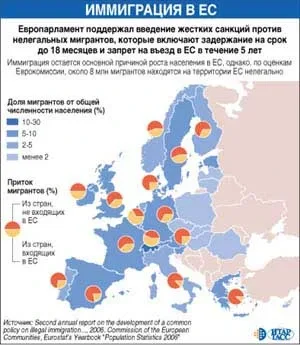
"Thanks to the new law, deporting those we want to get rid of will become much easier," said German State Secretary Peter Altmaier at the beginning of the month. In addition, the European Commission intends to introduce uniform rules for granting asylum in EU countries, since today, according to European politicians, the level of protection for refugees is extremely low. For example, an immigrant after having their asylum application rejected in one EU country can file an application in another country. Under the new law, if a migrant is denied legalization, they must voluntarily leave the EU territory, otherwise they will be forcibly extradited. Moreover, in case of deportation, the migrant cannot enter the EU for the next five years. Children of illegal migrants born and illegally present in the EU are also subject to mandatory expulsion.
Another point of the directive is the increase of the maximum period of detention of illegal migrants to 18 months. Currently, each country sets its own terms for detaining illegal immigrants. For example, in France this period is 32 days, in Hungary - one year, in Latvia - 20 months, and in some countries there is no time limit at all. It is around this point that the main debates have unfolded. Some MEPs are in favor of limiting the detention period to three months.
According to the European Commission, last year 220,000 asylum applications were filed in EU countries. About 51,000 illegal migrants arrived by boat to the shores of Italy, Spain, Greece and Malta. And in 2006, 900,000 people were detained at the EU borders attempting to illegally enter Europe. Another 500,000 people without documents confirming their right to stay were detained within the EU. In total, according to the European Commission, there are currently about 8 million illegal immigrants in the EU.
During the debates, Jacques Barrot, EU Commissioner for Home Affairs, said that special programs should be created for countries on the EU's external borders so that the burden on them is not so great. In particular, Barrot proposes to create a European Asylum Support Office (EASO), which will provide advice to EU countries on how to improve the procedure for granting refugee status.
In addition, the directive proposes to accept refugees from troubled regions - from Asian and African countries affected by military conflicts. And German Interior Minister Wolfgang Schäuble also proposed accepting Iraqi refugees from camps in Jordan and Syria.
The European Parliament's decision has caused great dissatisfaction among human rights activists, who believe that the new rules contribute to excessively long imprisonment of migrants. Amnesty International stated that the adopted bill does not guarantee the return of illegal immigrants to their homeland "in safety and dignity." The organization also believes that the new rules will lead to lower standards of treatment of foreigners.
European demographic trends - the mass influx of residents from Muslim countries and the resettlement of European residents to its western part - lead to acute conflicts between immigrants and the local population. In particular, according to Lenta.ru, a tense situation has developed in Italy, where citizens are extremely hostile towards newcomers from Romania. The new government of Silvio Berlusconi, without waiting for the approval of pan-European rules, has already extended the detention period for illegal immigrants to one and a half years.
In August, the bill adopted by the European Parliament will be discussed by the justice ministers of EU member states. The ministers participated in the discussion of the new rules with European deputies, and therefore the bill is expected to encounter no obstacles. If approved, countries must implement the new rules within two years.
According to European politicians, some amendments may still be made to the document. Moreover, the directive must be approved not only by the European Parliament but also by the European Council, so the process of introducing new rules could drag on significantly. The new migration law, if adopted, will not apply in the United Kingdom, Denmark, and Ireland, as these countries refused to support the directive.