
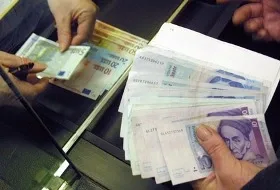
In recent years, the activity of German citizens in exchanging cash marks for euros has sharply declined
Coins and banknotes are kept in piggy banks and worn wallets, unexpectedly found in the pocket of an old jacket destined for the trash, or between the pages of a long-unread book where they were once hidden 'for a rainy day'.
Interestingly, since 2008-2009, the activity of German citizens in exchanging cash marks for euros has sharply declined. Thus, over the past 12 months, 47 branches of the Bundesbank accepted 162.8 million marks for exchange – almost a third less than in previous, pre-crisis years. And it's not at all because the supply of cash marks is simply running out.
All recent weeks, sociologists have been vying to talk about the conscious yearning of Germans for the former national currency. According to a survey conducted by the Emnid agency, almost half (49%) of residents of the Federal Republic want a return to the German mark as the sole means of payment. 51% are dissatisfied with the euro, and 77% believe that the single European currency has lowered their standard of living. Only 17% of respondents stated 'personal benefit' from the switch to the euro; 64% of them are supporters of the Green Party and 72% are under 30 years old.
Against the backdrop of the financial and economic crisis and radical measures to save the euro, 67% of Germany's population expresses doubts about its stability, 57% fear inflation, and at least 54% characterize their level of trust in the euro as 'extremely low'. Increasingly, from newspaper pages and at café tables, calls ring out: 'Give us back the German mark!' The old national currency has ceased to be an element of nostalgia for times when we were all younger – it has regained symbolic significance, as in the years of the post-war 'German economic miracle'.
Indicatively, the question of the possibility of Germany leaving the European Monetary Union is currently being examined in detail by economists. Financial experts are analyzing the paths and mechanisms of a new currency reform and declare: it is quite realistic.
'No currency union lasts forever,' says Professor of Economics at the University of Darmstadt, financial advisor to the Federal Government, Wolfgang Gerke. 'From 1872 to 1924, the Scandinavian Monetary Union existed between Denmark, Sweden, and later Norway; the attempt to merge into the Latin Monetary Union of France, Italy, Belgium, Greece, and Switzerland in the 19th century also proved unsuccessful. The euro could theoretically also be consigned to the dustbin of history.'
What 'pros' can a return to the past bring to the German pocket? According to Wolfgang Gerke, they are obvious. First of all, by abandoning the single currency, Germany will be relieved of its obligations for financial aid to Greece and Ireland – that is no less than 30 billion euros. At the same time, imports of raw materials, energy, and consumer goods to Germany would become significantly cheaper (if the new-old mark remains stable).
Unfortunately, there are also 'cons'. According to former German Finance Minister Theo Waigel, switching to the mark would be a 'catastrophe for the country's economy', primarily for German exports: German goods would become significantly more expensive, which could deter potential buyers in other EU countries.
Moreover, the politician emphasizes (and it was he who came up with both the idea and the word 'euro'), the average consumer would lose a large part of their savings, which through insurance and investment funds are placed in many foreign banks. And the technical refitting of ATMs, payment terminals, and printing new banknotes could cost the German taxpayer 60 billion euros – an amount comparable to 2.5% of gross national product.
Measure twice, cut once – this proverb is still relevant today. The most interesting thing, however, is that the question of 'cutting' in relation to a possible currency reform is being raised in all seriousness. Could one have foreseen just a year ago the conscious desire not only of ordinary people but also of specialists to return to a perhaps not-so-distant but already forgotten past?