
Multiculturalism led not to integration but to the formation of dangerous parallel worlds inside an already small country. The result of these events was a rollback to the policy of the “dirty broom” and the “iron fist.” Today the Netherlands has the most stringent migration laws in Europe.
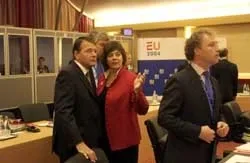
The leader and inspiration of the “closed-door policy” may rightfully be considered Rita Verdonk – a member of the ruling right-liberal party in the Netherlands, a former prison warden. Today she holds the post of Minister for Integration. Under her, the very name of this department has turned into a curiosity: there is no longer any talk of integrating foreigners in Holland; the opposition believes that it should be renamed the “Ministry of Protection from Aliens.” Rita Verdonk has literally split the nation in half: for one part of the population she is a kind of fearless Dutch warrior woman, standing with sword in hand in the path of hordes of vicious Islamists, while for the other she is a Nazi who has sworn to throw out of Holland everyone whose skin color is even slightly darker than it should be and who did not absorb the Dutch language with their mother’s milk. Rita is adored and Rita is hated – tertium non datur.
The intention of Mrs. Minister to throw out of the country 26,000 applicants for political asylum, who, by the way, have lived in Holland for years awaiting a decision on their fate and periodically filing protests with judicial instances in case of an “incorrect” choice by the authorities, were dubbed “deportation” by the Dutch media. In January, Verdonk was even called to account before the European Council because her subordinates grabbed children of such rejected applicants right in schools and, in handcuffs like dangerous criminals, took them to deportation camps.
After a while, the restless Rita, nicknamed “Iron Fru,” came forward with another initiative: to forbid foreigners from speaking languages other than Dutch on the streets. Those caught using other tongues will have to prove to police officers with documents that they are tourists.
In early March, three events were recorded on her “battle account”: the trial of a group of young Islamic extremists found guilty of creating a terrorist organization, as well as two scandals. The first is connected with the expulsion from Holland of schoolgirl Taida Pasic, a minor applicant for political asylum from Kosovo, who was not even allowed to finish school, although only a few weeks remained before she would receive her Dutch high school diploma. The second is connected with the refusal to grant citizenship of the Kingdom of the Netherlands to Salomon Kalou, a football superstar from the Republic of Côte d’Ivoire (Ivory Coast). The footballer failed the citizenship exam. “Rules are rules,” declared Mrs. Verdonk, and now Kalou has been deprived of the right to score goals at the 2006 World Cup for the glory of the Netherlands. “Well, at least they didn’t kick me out of the country,” joked the famous forward about this.
Many Dutch people consider such tactics too harsh. “Of course, it is impossible to continue the policy of multiculturalism,” Verdonk’s opponents believe, “but one cannot fall into the other extreme!” Even many “Dutch Dutchmen” – those whose spouses are foreigners – felt the tough conservative course on their own skin. Because to make it harder for so-called “imported brides” to enter the country, a new law was adopted in November 2004, according to which the minimum age limit for such couples is set at 21. In addition, the Dutch partner (male or female) must earn at least €1,140 per month. The average salary of an ordinary worker in the country is only a hundred euros less, so marriage to a foreign woman is now not for working men, unless they ask their bosses for a raise.
Over the past year, the number of “imported brides” in Holland has decreased by a quarter, but Mrs. Verdonk wants more: since early March, immigrants wishing to come to the Netherlands are required to pass something like an entrance exam at a computer in the Dutch embassy in their own country and prove knowledge of the Dutch language and the kingdom itself. To pass such an exam, the immigration minister declares, each applicant will have to spend at least 300 study hours. The exam itself costs €350, and for €64 the “candidate” will be sold a textbook with four DVDs in one of 14 possible languages.
“We have been naive for too long,” declares Rita Verdonk. “Whoever wants to live in Holland must be prepared for this. We have become an example for many countries.” This is true – many EU states are thinking about introducing a similar system at home. Especially those that are currently a real magnet for refugees due to soft migration laws: Germany, Spain, Italy...
At home, however, the “Iron Fru” is increasingly encountering resistance. The head of the Dutch Employers’ Union, Bernard Wientjes, for example, wrote an open letter addressed to all Dutch people, calling for the Netherlands to regain its reputation as an open and tolerant country.
The mayors of many cities are also watching the political course of The Hague with a certain wariness. For example, the mayor of Rotterdam, Job Cohen, stated that “more and more draconian instructions are being handed down from above, without thinking that it is we who have to implement them locally.” He himself is a supporter of dialogue and for a long time has been allocating €5 million per year from the city budget to integration projects designed to somehow bridge the gap between the local population and immigrants. He is a highly authoritative politician and has been recognized as the best city mayor over the past 25 years. Under his auspices, Christians and Muslims celebrated Ramadan together for the first time. However, it should be noted that a joint celebration of any Christian holiday in Amsterdam has not yet been noticed – perhaps there will be one? Around the city there are posters: “I have no job because my name is Ali.” For Muslim residents, there is a round-the-clock “anti-discrimination phone” at the city hall.
One can understand the mayors: under Dutch law, immigrants gain the right to vote at the municipal level after five years of residence in a city. In the municipal elections held in early March, many immigrants used this right for the first time. Among people of Moroccan origin alone, statistics show, voter participation jumped from 39% to 55%, with 88% of votes cast for the opposition Social Democratic Party. So it is not surprising that local leaders are so concerned about the reaction of a significant part of the electorate.
Immigrants consider the actions of local authorities aimed at their protection to be very timely. “This simply has to be done,” says Aisha Lagna, a 38-year-old native of Amsterdam whose parents came to the country from Morocco. “I have to justify myself almost every day for being a Muslim!” Her husband Radwan, who came from Casablanca 13 years ago and is studying to become a lawyer, adds: “I feel hostility towards us everywhere – on the street, in the store... I am no longer Radwan from the neighboring apartment; I am a damned Muslim, a terrorist, a criminal! It is good that we have no children, and no one needs to explain why Dutch guys can enter a disco hall and Moroccans cannot.”
Incidentally, unemployment among immigrant youth is four times higher than among locals. Moreover, origin plays a far from insignificant role in hiring. Many immigrants have seriously thought about leaving: “I don’t know if this is the country where I would want to give birth and raise a child,” Aisha admits. “At least, it is no longer the country where I was born and grew up.”
The “tightening of the screws” has also ricocheted against many migrants from the CIS: according to statistics, more than half of illegal migrants from Commonwealth countries have either left the Netherlands, going to “tell legends” in other European states, or are about to do so. “Legend” is a specific term among “Russian” illegal migrants, meaning a pre-prepared and well-thought-out story about certain “persecutions” at home, presented to officials of migration agencies, since economic immigration to Europe is not recognized as a sufficient ground for granting asylum. There are even quite numerous forums on the Internet where those who have managed to “push through” their “legend” in one country or another share their experience with those who are only about to undergo such an interview.
However, there is nothing to reassure the “persecuted”: the migration legislation of most EU countries is either already being tightened or is about to begin changing. Moreover, the relevant authorities of these countries have also begun to learn from their mistakes. For example, in Germany and France, special police departments have been created and are successfully operating, fully staffed by those for whom Russian is their native language (in Germany, these are ethnic German resettlers from the former Soviet Union, and in France – descendants of the first and second waves of Russian emigration). Their task is to track and collect “legends” on these very forums, and then pass them on to colleagues so that they do not get fooled.
Boris Altner.
IA Rosbalt