
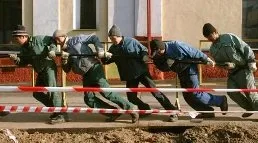
Today Moscow receives almost a quarter of all labor migrants arriving from abroad to Russia
It should be noted that the peak parameters of external labor migration occurred mainly in 2007 and partially in 2008. Starting from the current year, these parameters have been significantly reduced. The Moscow government believes that this trend will continue in 2010.
The quotas allocated to the city of Moscow for attracting and using foreign labor in 2008 amounted to 508 thousand people, in 2009 – 392,157 thousand, and for 2010 it is planned within 200-250 thousand people.
Moscow still has the greatest economic and social attractiveness among foreign citizens, especially from CIS countries. In this regard, the flow of foreign citizens interested in working in Moscow practically does not decrease.
The average total share of foreign labor in the employed population was 7.5% in 2007 and 10.7% in 2008. Under such conditions, the priority of employment of Russian citizens, primarily Muscovites, is ensured by granting them preferential rights over foreigners to fill vacant jobs.
For example, in 2008 there were 4 foreign workers for each vacant job, and in the current year the same 4 foreigners are accounted for every 3 vacant jobs. In 2010, it is planned to maintain these proportions. Thus, competition for employment among unemployed Russian citizens is reduced (for one Muscovite there are 3-4 vacancies). Thus, the reduction of quotas for 2010 by the Moscow government in the context of the ongoing financial crisis is considered as one of the tools to ensure the priority of employment of Muscovites.
And yet there is progress. In general, the Moscow government managed to achieve a real reduction in the volume of illegal or unregulated labor migration. For example, in 2008 only every third foreign citizen arriving in Moscow received a work permit, and the ratio of issued work permits to received notifications of their employment was only 64%. In other words, 70% of foreign citizens in 2008 illegally carried out labor activities in Moscow, and 36% of visa-free foreign citizens who received work permits in the Russian capital in 2008 were either unemployed or worked without a formal employment contract.
In the current year, the ratio of issued permits to received notifications has already reached 86%. Thus, the level of migrants working without official employment relations has decreased to 14% of visa-free foreign citizens who received work permits.
It is clear that illegal and unregulated labor migration objectively leads to increased pressure on urban infrastructure, significantly affects and deforms the regional labor market, contributes to increased social tension among city residents, and poses a serious threat to the economic, social, and public security of the capital. This especially applies to those sectors of the city's economy that are under the greatest pressure from foreign workers.
According to the data of the ZIC GUV for 7 months of 2009, 11,312 thousand crimes were committed in the city with the participation of labor migrants, which is 10.2% higher than the indicators of the same period last year. The increase in crimes committed with the participation of foreign citizens from neighboring countries is noted primarily due to the increase in the number of grave and especially grave crimes.
In order to suppress the illegal activities of persons involved in the production and distribution of fake work permits and registration at the place of residence, units for combating economic and tax crimes in the current year repeatedly conducted special operational and preventive measures, during which 151 criminal cases were initiated, 928 administrative protocols were drawn up, and 2,237 fake documents were seized from illegal circulation. During joint measures, over 103,107 facilities in Moscow were inspected.
Moscow is trying every year to reduce the number of labor migrants. Thus, in 2009, the Interdepartmental Commission on Attracting and Using Foreign Workers considers each application submitted to it especially carefully. Since April 15 of this year, applications from 1,340 organizations have been accepted for consideration. 1,129 applications for attracting 27,865 people have been satisfied. 70 organizations were denied the attraction of 18,982 people.
First of all, the commission refused organizations engaged in leasing foreign labor. Cases of employers presenting unreasonable requirements that are completely unrelated to the qualification characteristics necessary for the performance of official duties and labor functions were also suppressed.
In order to regulate labor migration and improve federal migration legislation, as well as as an anti-crisis measure, a draft Federal Law "On Amendments to Certain Legislative Acts of the Russian Federation in Connection with Improving the Mechanism for Regulating the Attraction of Foreign Citizens for Labor Activities" has been prepared. The draft has already passed legal expertise and has the conclusion of the Independent Institute of Elections.
The Moscow government considers it advisable to issue a foreign worker not a non-address-based work permit, as is currently the case, but a work permit for a specific employer, taking into account the quota allocated to them. The hiring of the declared number of personnel may be carried out only under the employer's guarantees to ensure normal living conditions for migrants: well-appointed dormitories, transparent wages and labor relations, social and medical services. The implementation of the proposed measures will contribute both to the protection of migrants' rights and to the observance of the interests of the indigenous population.
According to the head of the Moscow Department of Labor and Employment, Oleg Neterebsky, the capital needs foreign labor, but within reasonable limits. At the same time, there is an interest in ensuring that the level of wages and social guarantees for these citizens who come to work is not lower than for Russians and Muscovites.
However, the migration problem has two important components. First, it is necessary to create a normal mechanism for determining the needs for attracting foreign labor. And the second component is that a clear system for identifying and deporting illegal migrants must be established.