
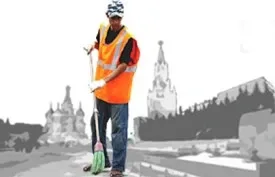
The authorities are going to rely on migrants to replenish the working-age population
As committee press secretary Yulia Vaidukova noted to a Rosbalt correspondent, "this is an ideological document," and on its basis, "city target programs" in the sphere of national policy will be adopted and adjusted, provided that the concept is approved by the Moscow government.
It should be noted that the fragments of the document that have become known to the media do not inspire much optimism. This concerns both the described situation and the proposals on how to act in it.
Will Migrants Help Moscow?
"Currently, Russians make up 84.5% of Moscow's population, and there is a trend toward changing proportions in the ethnic composition of the city," the document states. In total, 10.4 million people live in the capital, but the actual daytime population, including labor migrants, approaches 15 million.
It is noted that areas with non-indigenous populations have begun to stand out in the capital: "the processes of enclavization of Vietnamese, Chinese, people from the Transcaucasus and some other ethnic groups are proceeding quite actively, which poses a certain danger of possible acceleration of the segregation of migrants least adapted to the Moscow metropolis." In addition, as stated in the document, two-thirds of residents feel a threat of losing Moscow cultural values.
And against this background, it is stated that "in the foreseeable future, migration may become the only source of replenishing natural population decline," since "the increase in Moscow's population up to 2025 will be accompanied by a reduction in the working-age population."
So Less or More?
It is not entirely clear, however, how this message correlates with recent statements by Moscow Mayor Yuri Luzhkov. "What we have is this: we are reducing quotas, but the number of migrants is not decreasing. And they are either doing, at best, some casual odd jobs, that is, getting casual wages at casual workplaces, or they are engaged in touring, robbery, theft, anything. We do not need such a situation in the city! And we are talking about Moscow – the most attractive city for migrants to appear here," the mayor said.
By the way, at Luzhkov's initiative, a reduced quota for migrants was included in the draft tripartite agreement between the Moscow government and associations of trade unions and employers for 2010. According to the document, in 2010 the capital will employ no more than 200,000 migrants, which is 50,000 less than previously expected.
And yet the concept asserts that the authorities are still going to rely on migrants to replenish the working-age population. And for Moscow to become an "investment-attractive region" and a "city of Russia's national success in the 21st century," it is necessary to develop "interethnic harmony" and prevent "ethnopolitical tension." It is proposed to solve these problems by implementing 11 directions. However, it is difficult to guess what lies behind the set of phrases that follow.
Old Songs in a New Way
As is known, Moscow (unlike the federal center) tries to deal with migrant problems. The comprehensive program "Capital of Multinational Russia" has been implemented in the city for several years. Its goal is to create a favorable climate in relations between representatives of different nationalities. The main priorities are adaptation of migrant children, work with youth, and the media.
There is also its own know-how: the main emphasis is not on working with national minorities, but on the majority, from whose ranks, as a rule, skinheads and other extremist groups come. But, unfortunately, shows of folk dances and tastings of national dishes, which the compilers of adaptation programs rely on with surprising persistence, do not help much.
And yet, without denying progress in this direction, one cannot but admit that the city authorities, either deliberately or by a fateful coincidence, have let the situation get too far.
Last year, due to the crisis, millions of Muscovites seriously pondered the fact that there are constantly either one or two million predominantly physically strong young men in the city, hardened by hard labor and rather embittered by the treatment of employers. Men who have nothing in common with the indigenous population of Moscow – neither language, nor citizenship, nor a shared history and culture, nor appearance. The lion's share of these people worked in construction, most illegally. What would happen if they lost their jobs, perhaps no one could predict. The situation was created over years. It was voiced but not solved: construction is a very profitable business.
Another point: for many years, the capital's police (predominately Russian by nationality) oppressed everyone who could somehow be called "guests from the Caucasus and the East." Despite such close attention, Moscow is overflowing with illegal migrants. And the "fake" registrations probably cannot be sorted out either by law enforcement officers or by "well-wishers" from passport offices. And it is completely unclear how the authors of the concept intend to deal with this. Its provisions appear belated and insufficiently effective, although the goals are declared to be good.
The authorities are determined to "create conditions for socially useful integration and adaptation of migrants," proclaim the task of "reducing the shadow labor market, counteracting the emergence of enclave labor markets." And they do not intend to "allow the politicization of interethnic relations," and in schools they want to conduct "lessons of international education."
In the area of information policy, it is planned to “develop international consciousness” and produce “positive information products.” Journalists are required to “observe ethical norms in covering interethnic relations,” strengthening Moscow’s image “as a city of interreligious tolerance,” and the police are required to monitor media mentions of offenders’ ethnicity.
It is also proposed to create a monitoring system. This entails maintaining a registry that will contain and constantly update information about regional and federal national unions existing in Moscow, as well as branches and representative offices of such communities.
An intention to analyze public sentiment on the national question is outlined. The police, according to the document, will provide statistics on offenses committed for national and ethnic motives.
Unfortunately, all this resembles the proverbial tale about a white bull and only strengthens the ordinary person’s confidence that no serious national policy is being pursued. True, as Mikhail Solomentsev, chairman of the Committee for Interregional Relations and National Policy, noted, revolutionary decisions were not built into the concept. “It cannot be said that the provisions of the concept introduce something fundamentally new relative to Moscow’s current policy. But we are clarifying terminology and the powers of participants – in particular, interdepartmental groups created on the committee’s initiative – and we are also proposing criteria for evaluating the effectiveness of our policy. We tried to build a system – instead of spontaneous and not always interconnected decisions,” Solomentsev explained.
Perhaps this is a normal approach when creating any concept. But in Moscow, the problem is too acute, so the question arises: when will a set of measures appear that can truly radically change the situation?
How should relations with migrants be built?
How should the Moscow government build national policy, even if belatedly? Rosbalt correspondent posed this question to three experts representing various currents in Russian society.
“The Moscow government has much less choice than the federal one,” noted Sergei Mikheyev, vice president of the Center for Political Technologies, who belongs to the moderate right wing of Russian society. “The Russian Federation has always pursued a policy of open doors and replacing local labor with migrants under the slogan of a market economy. Moscow repeated this path.”
Sergei Mikheyev advocates attracting Russian workers from other regions, and on a national scale – for the return of compatriots – Russians, Ukrainians, and Belarusians, who have both a native language and higher qualifications. According to Mikheyev, the best way to solve the national question would be modernization – including in Moscow – the development of advanced industries in the capital’s industrial zones, which would attract educated workers.
But the political scientist sadly notes that under conditions of “primitive understood capitalism” this is hardly feasible, especially “in a crisis, when savings are again paramount.” So cheap migrants are guaranteed to us for the foreseeable future.
That national policy is primarily a matter for federal leadership was also stated by Boris Kagarlitsky, director of the Institute of Globalization and Social Movements, who has a reputation as a European socialist. He calls for studying the experience of European countries – but not those like France, where migrants burn Paris, but those like Finland, Canada, and Australia.
It is there, according to Kagarlitsky, that they know how to conduct truly successful national policy. For example, Canada accepts 250,000 immigrants per year and distributes them very competently across the country, to where there are both jobs and housing. “But this is not a matter for Moscow’s leadership alone,” Kagarlitsky emphasized.
Liberal independent political scientist Dmitry Oreshkin noted: “The main thing now is not whether the laws will be strict or liberal – there should at least be some laws!” According to the expert, all national relations in Moscow are now in the shadow sector. “Markets are ‘roofed’ not only by Azerbaijanis but also by individual officials,” Oreshkin recalled. “And any national diaspora in the city knows perfectly well how much money to collect to buy their person out of the police if they need him. If not, let him disappear.”
In Dmitry Oreshkin’s view, a permanent conference of all national diasporas in Moscow should be convened, and within its framework, a transparent, public dialogue should be conducted on all pressing issues. But for now, the political scientist notes, too many in the capital benefit from the shadow life of illegal migrants with meager wages “outside the tax sphere.” And it will be very difficult to overcome this, even with the best intentions.
One thing is indisputable – if a huge number of newcomers is a reality of Moscow life, then it is necessary to bring them into the city’s legal framework, provide them with housing that meets sanitary standards, and grant opportunities for medical care and education. Given the special attractiveness of the capital for newcomers, the city budget (without federal assistance) may certainly not be able to cope with this.
The authorities urgently need to find out how many migrants (this applies to all newcomers) are currently in the city. Diasporas should be actively involved in this process, as well as in the process of adapting newcomers to new living conditions. A simple handbook for migrants could also help, containing information about the structure of city life, legislative norms, and a necessary set of accepted behavioral norms. Mass publication of such a brochure could be provided for by the city program for assisting newcomers.
But the issue is not only about the problems of migrants adapting to a new way of life and society's attitude towards them. The fact is that today many officials and businessmen perceive Moscow solely as a source of making money. Often, not only the interests of newcomers are disregarded, but also the interests of native Muscovites. But if the new residents of the capital, initially prepared for difficulties, perceive this as one of the integral components of the new life, then Muscovites, having started to look for the cause, follow the simplest path - they discover an 'enemy', classifying as its ranks those who are unlike them. And this is the situation that needs to be changed first of all.