
BELGIUM
Belgian Symbolism, March 26 – June 27, Brussels; Gustave van de Woestijne, March 27 – June 27, Ghent. Exhibitions dedicated to the history of Belgian Symbolism are opening at the Royal Museums of Fine Arts of Belgium in Brussels and the Museum of Fine Arts in Ghent. Over 200 paintings and engravings from museum and private collections will be presented at the Brussels exhibition. These are works by artists belonging to the groups Les XX, La Libre Esthétique, and Pour l'Art, which were closely linked to Belgian Symbolist writers. The main theme of the exhibition will therefore be the connection between painting and literature of the late 19th and early 20th centuries. The exhibition will also explore the continuity of Symbolism with the traditions of medieval art, the aesthetics of German Romanticism, and Pre-Raphaelite painting. Visitors will see paintings by artists such as Léon Spilliaert, Degouve de Nuncques, Théo van Rysselberghe, Félicien Rops, and Jean Delville.
The Museum of Fine Arts in Ghent will present about 150 works by the Belgian Symbolist painter Gustave van de Woestyne. A combined ticket for both exhibitions can be purchased for €14. //www.fine-arts-museum.be
Art Brussels fair, April 23-26, Brussels. 'European platform for contemporary art' – that's how the organizers position this art fair, which has existed since 1968. 165 galleries from 20 countries and 'independent artists' will present contemporary art at the fair. 30,000 visitors will have to navigate this. Some galleries traditionally exhibit only works by promising young artists. In addition, various performances are held at Art Brussels: this year, nine international art projects 'Art in the City' will be presented at the fair. An exhibition ticket costs €15. //www.artbrussels.be
UNITED KINGDOM
Blankets 1700–2010, March 20 – July 4, London. An unusual thematic exhibition recently opened at the Victoria and Albert Museum in London. Exhibits include blankets and coverlets from the 18th to 21st centuries – from antique silk and velvet coverlets with patterns and narrative designs to works by contemporary designers. The exhibition consists of five sections, and in addition to 65 blankets, paintings and engravings will be on display, providing relevant historical and biographical context. Visitors will see coverlets whose narrative designs relate to important events in the lives of King Charles II, the Duke of Wellington, Admiral Nelson, and Queen Victoria. One section of the exhibition will feature blankets for newborns, newlyweds, and funeral coverlets. The exhibits have been provided by many British museums, the National Gallery of Australia, and private collectors. //www.vam.ac.uk
Christen Købke, until June 13, London. 'Master of Light' is the title of an exhibition that recently opened at the National Gallery in London, dedicated to the work of the foremost painter of the Danish Golden Age, Christen Købke (1810–1848). Købke's portraits, landscapes, and interior scenes are characterized by precise rendering of light, refined palette, clarity of composition, and a calm tone. After a two-year journey through Italy in 1838–1840, the artist lived in the outskirts of Copenhagen, so the main themes of his paintings become sunny views of rural gardens, the ancient Frederiksborg Castle, and portraits of family and friends. Paintings for this exhibition have been provided by Danish museums and private collectors. In the summer, the exhibition will move to the National Gallery of Scotland (July 4 – October 3). //nationalgallery.org.uk
ITALY
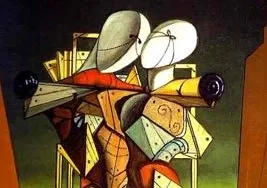
Giorgio de Chirico, March 30 – July 11, Rome. A large retrospective exhibition of Italian artist Giorgio de Chirico (1888–1978) opens at the Palazzo delle Esposizioni in Rome. Born in Greece and later moving to Munich, de Chirico's work was strongly influenced by classical antiquity and mythology, as well as German philosophy. From 1911 to 1914, he lived in Paris, where he met Apollinaire and Picasso, who introduced him to literary and artistic avant-garde circles. De Chirico became one of the founding fathers of metaphysical painting, which officially took shape in 1915. Symbolic compositions with views of wide spaces and architectural details acquire a fantastic, surreal meaning in his works of this period, and the mannequin—a key figure in metaphysical painting—appears in his works. About 100 of the artist's paintings from museums in Europe, the USA, and Japan will be on display. //english.palazzoesposizioni.it
Gladiators, March 26 – October 3, Rome. A major cultural exhibition based on the latest scientific research dedicated to gladiators and gladiatorial combat has opened at the Colosseum in Rome. Information about the world of gladiators has been gathered for the exhibition from various sources – historical documents, frescoes, mosaics, statues. Moreover, alongside poorly preserved artifacts, objects of so-called experimental archaeology – fully restored copies – are displayed. The exhibits are arranged in eight sections covering all aspects of this phenomenon of ancient Roman life: the origin and history of battles (from funeral games to public spectacles), organization and types of battles, legal and social aspects, classes and careers of gladiators, and types of weapons. //www.pierreci.it
FRANCE
Jacob Meyer de Haan, until June 20, Paris. “Unknown Artist” is the title of a new exhibition at the Musée d'Orsay in Paris. The “unknown” artist is the Dutch painter Jacob Meyer de Haan (1852-1895), known mainly from several portraits by Gauguin as his friend, student, and patron. Leaving Holland, Meyer de Haan went to Paris, met Camille Pissarro, who advised him to go to Brittany and work there with Gauguin. In the fall of 1889, de Haan settled with Gauguin and his friends in the village of Le Pouldu, where the techniques of the new “synthetic art” were being refined. It so happened that in the history of painting, Meyer de Haan, an original artist, remained in the shadow of his famous contemporary. The exhibition at the Musée d'Orsay offers a chance to rediscover the painter Meyer de Haan, with works gathered from many European museums and private collections. Concurrently with this exhibition, another is being held at the museum – “Crime and Punishment,” which we wrote about in our previous review of European exhibitions. //www.musee-orsay.fr
Fashion dolls – from Pandora to Sybarite, until September 19, Paris. Another exhibition at the Paris Museum of Dolls is devoted this time to the history of “fashion dolls” from the 17th century to the present day. The exhibition marks the fifth anniversary of the Sybarite doll series, created by the famous London couturiers Charles Fegen and Desmond Lingard. The first Sybarite model was called Clone 0101 Venus D'Royce, and it immediately caused a sensation among fashion doll enthusiasts. To this day, Sybarites remain the sales leader and a benchmark of the highest quality in this doll series. The exhibition concludes with a presentation of a new doll by the London designers, Sybarite Slipper, which can be purchased at the museum store. For fans of antique fashion dolls, it will be much more interesting to see the famous 17th-century Pandoras – they popularized Parisian fashions of that era in all the royal courts of Europe. Then among the exhibits you can see the famous Parisiennes, wax dolls by Mrs Laffitte & Désirat, decorative “boudoir dolls” from the 1920s, plastic fashion dolls from the 1950s, including the German doll Lilli – the predecessor of the famous Barbie. //www.museedelapoupeeparis.com
Read also related material: PAINTING ACCOMPANIED BY WINE TASTING
Nyuta KUKUSHKINA.
Gazeta.Ru er="0">