
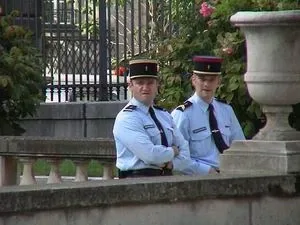
France: homeland of revolution, freedom and gendarmes
The National Gendarmerie emerged in France during the Revolution. Then, as the country expanded militarily, up to the mid-19th century, the French exported this type of militarized police to other European states. Under Emperor Napoleon, its main tasks became maintaining order in occupied territories and implementing the decrees of central authority.
The Gendarmerie survived the Napoleonic regime, remaining not only in France but also in many other European countries. True, most governments renamed this type of police to conceal its French origin. But in the Russian Empire in 1826, following the Decembrist revolt, it was precisely the gendarmerie that was established.
The French Parliament passed a law establishing the National Gendarmerie on 16 February 1791 in an attempt to restore order in a country shaken by revolutionary unrest. The pay of this mounted police was set at a quite attractive level, but the phenomenon today known as inflation very quickly reduced the guardians of the law to poverty: at that time they had to support not only their families but also pay for uniforms, equipment, and even horses. Then, in 1792, Paris declared war on the King of Bohemia and Hungary, which grew into a ten-year battle with almost all of Europe. For a long time, the main task of the mounted police became participation in combat operations.
However, at that time French gendarmes did not always successfully cope with their numerous and varied tasks. As a result, their corps was reformed, purges were carried out - overly politicized servicemen were dismissed. The Gendarmerie was fully transformed in accordance with the law of 1798: it became an elite military unit, into which people were recruited with consideration for age, combat experience, and literacy. At the same time, the Gendarmerie came under triple command - the Ministry of Justice for police missions; the defense department for matters of armament, equipment, and discipline; and the police administration for maintaining public order. Later, this security structure was reformed more than once. The First and Second World Wars became severe trials for it (during the latter, the occupiers shot 338 gendarmes for participating in the Resistance movement), but it has safely survived to this day.
Today, France's National Gendarmerie handles many tasks - from fighting terrorism and criminal crime to regulating traffic outside cities. Its representatives often participate in supporting important international missions.
Italy: hardened by the clash with the mafia
Stately carabinieri in elegant black uniforms politely greet visitors at Italian embassies and consulates all over the world. The valiant Italian gendarmes are celebrated in verse and prose, and fiction does not stray too far from the truth. Their role in stabilizing a country that became a unified state only in 1870, in which socio-economic differences between north and south are still visible, is difficult to overestimate.
This type of police originated in the Kingdom of Sardinia in 1814, when only the boldest political figures dreamed of Italian unification. The Royal Carabinieri Corps was formed there as an army unit and soon took part in the war of independence.
In 1861, after the proclamation of the Kingdom of Italy, the Carabinieri were entrusted with police duties. The main task became ensuring law and order in a country with a very fragile state system, a population prone to anarchy and also speaking many dialects. The Carabinieri were tasked with the difficult and dangerous fight against banditry, and then against the mafia and its variants - the "Camorra" and the "Ndrangheta" - which challenged local and central authorities.
Soon the Italian gendarmerie became the main defender of the "humiliated and insulted" throughout the Apennine Peninsula. In numerous works of Italian literature of that time, the Carabinieri are depicted as a powerful instrument of the law, incorruptible and ready for self-sacrifice. However, in the 20th century, especially in the books of Leonardo Sciascia, a new motif appears, also readily used by cinema: these knights without fear and reproach sometimes suffer defeat in the fight against the mafia because they are betrayed by influential politicians connected to the "godfathers"...
Today Italians turn to people in black uniforms not only for protection from criminals. In the event of a natural disaster - flood, earthquake, avalanche - they, without hesitation, call the nearest Carabinieri station. The scope of activities of this type of police even covers offenses in the electronic space (cybercrimes).
By order of the Chief of Staff of the Italian Armed Forces, the Carabinieri participate in military operations abroad, including peacekeeping and humanitarian missions. If necessary, they assist local police and army in restoring order, train colleagues. In particular, the 2nd Mobile Brigade of Carabinieri gained great experience, actively operating as part of the Multinational Specialized Unit in Bosnia and Herzegovina. This international corps serves the leadership of the European Union as a model police unit for conflict resolution abroad, investigation of especially serious crimes, including war crimes, and also for preventing terrorist acts. The unification of EU member states' legislation allows their gendarmeries to increasingly conduct joint operations to protect borders, search for criminals, combat illegal immigration and smuggling.
One piece of evidence of international recognition of the experience of the Italian Carabinieri is the assistance provided by their representatives in combating the spread of drugs in Colombia, Bolivia, Venezuela, the Dominican Republic, as well as in Morocco, Poland and Hungary. In addition, bilateral cooperation agreements with the Italians were concluded by the Romanian Gendarmerie, the Internal Troops of Ukraine, the armed forces of Qatar, and the National Gendarmerie of Argentina.
Spain: 160-Year-Old Traditions
The Civil Guard is the first state body for ensuring public order and security, which emerged during the reign of Queen Isabella II. The rampant banditry prompted the then authorities to create a nationwide agency to establish order throughout Spain. In 1844, by special decrees, this paramilitary corps was officially established to fight robbers and maintain public order, but it was independent of the then Ministry of Defense. The French Gendarmerie and a special security squadron operating in Catalonia were taken as models.
The creators of the Civil Guard believed that its main principles should be strong discipline, readiness for self-sacrifice, dignity, and loyalty to the government and the law. The effectiveness of the Spanish gendarmerie's service, the trust of the population, and its participation in humanitarian operations proved so evident that it soon became the guarantor of public order.
The "father" of the Civil Guard is considered to be the Duke of Ahumada, who developed the structure of this organization, formulated its main tasks and basic principles of activity. Initially, this paramilitary corps in peacetime was subordinate to civilian command, but in time of war or serious danger to public order it came under the leadership of the country's military command. This sometimes created conflict situations, and in 1871 the military component of the command was strengthened.
The strategic goal of the Civil Guard was proclaimed to be "ensuring the protection of people and their property in populated areas and beyond." But gradually its functions expanded, and it took on some of the tasks of the criminal, tax, traffic, and rural police. One of the innovations was the introduction of paired patrols in certain areas of territory where the gendarmes knew local residents well, that is, they began to perform the functions of district police officers.
Historians note that the victory over numerous robbers and thieves in Spain in the 19th century was ensured mainly by the civil guards. Their merits are also great in eliminating the dangerous actions of anarchists, suppressing rebellions shortly after the civil war, as well as successful measures in preventing terrorist acts which the Basque separatists currently resort to.
Today the Spanish gendarmerie numbers about 70,000 people. Several hundred of its representatives serve in Spanish embassies and participate in missions of the European Union and the UN, where they have earned a good reputation.
Throughout 160 years of its existence, this law enforcement agency has sought to preserve its best traditions, while at the same time improving its methods of operation and borrowing advanced foreign experience, primarily in the fight against domestic and international terrorism.
Portugal: A Barrier to Smuggling
A semi-military structure similar to the Spanish one for ensuring internal security operates in neighboring Portugal as well. However, the National Republican Guard is much younger: it was created on May 3, 1911. Its tasks include, among other things, conducting investigations of criminal offenses and combating offenses in the tax and customs spheres.
Since 1993, a special unit within the Portuguese gendarmerie has been monitoring the payment of taxes and customs duties. In 1996, 2000, and 2001, local guards managed to stop attempts to bring particularly large consignments of contraband cigarettes and alcoholic beverages into European Union countries through Portugal's maritime borders, which were estimated at tens of millions of euros. In 2001, in just one of the high-profile cases involving illegal alcohol imports, 167 people were arrested.
Celebrations of anniversaries of the creation of the National Republican Guard are held solemnly. For example, in May of this year, a military parade took place near the ancient Jerónimos Monastery in Lisbon, and the guards' symphony orchestra performed at a gala concert at the capital's São Carlos Theater.
The Portuguese gendarmerie regularly holds open days for children of all ages. They get the opportunity to visit its headquarters, barracks, stables, ride horses, watch motorcycle demonstrations, and learn about how their defenders carry out their difficult service.
The gendarmes of France, Italy, Spain, and Portugal often exchange experience, hold joint seminars, take courses on the problem of Islamic terrorism, and learn each other's languages. The importance of such interaction is growing, as the tasks of combating terrorism, the smuggling of goods and people, and illegal immigration are becoming increasingly complex.