
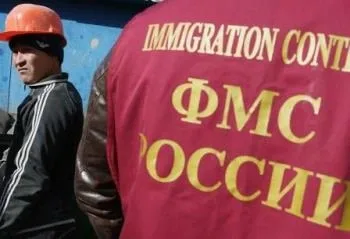
Sociologists and migration researchers analyze how the economic crisis affected migration flows to Russia
The discussion was attended by sociologists Olga Vendina, Vladimir Mukomel and Ekaterina Demintseva, migration researcher Zhanna Zayonchkovskaya and director of the Center for Migration Studies Dmitry Poletaev. The event was moderated by Alexander Verkhovsky, director of the Sova Center, and Sergei Lukashevsky, director of the Sakharov Center.
Change in information agenda
As early as 2013, during the mayoral election campaign, anti-migrant slogans were actively used by the ruling elites. On average, between 13 and 17 thousand materials on the topic of migrants were published in the media per year. Vladimir Mukomel adds that after the events at the Matveevsky Market (a brawl between market traders and police in July 2013), there was an immediate surge of attention to this topic – 33 thousand articles on the subject, and after the events in Biryulyovo (mass protests on ethnic grounds in the Moscow district of Biryulyovo Zapadnoye in October 2013) – 53 thousand materials.
However, now at the political level, rhetoric towards migrants is changing, it has almost completely subsided. According to Zhanna Zayonchkovskaya, there are currently no studies even on current migration issues, including refugees from Ukraine. This issue is not discussed in the public space either. Today's situation is completely different from when refugees from the republics appeared on the eve of the collapse of the USSR – then research was deployed quickly and widely, and the situation of refugees was known. Almost nothing is known about current refugees, and the official number of refugees from Ukraine is very arbitrary – between 800 thousand and 1.2 million people.
The discussion participants link this decline in attention to the migrant problem with the situation in Ukraine: the surge of nationalism in the neighboring state, regardless of its interpretation, caused a certain horror at the situation of intolerance in society. And this fear frightened many, including supporters of nationalist movements and pro-nationalist elites.
“From the perspective of Russian society’s attitude towards migrants, what turns out to be more important is not the state patriotism being promoted in the media, but the image of events in Ukraine that Russian media are shaping. The picture of a surge of rabid radical nationalism in a neighboring country presented to Russian TV viewers turns out to be more important than the problem of one's own national consciousness. This, in my opinion, leads to the slogan 'Russia for Russians' fading into the background,” added Sergei Lukashevsky.
In addition, the Ukrainian events collapsed the picture of the future for many people in Russia. Previously, Europe served as a certain role model, and people associated their migration aspirations with Europe or perceived European migration policy as the ideal to strive for. Today, the destruction of this ideal, according to Vendina, will have severe consequences both for Russia's migration policy and for relations between migrants themselves and between them and the host community.
Mukomel notes that xenophobia in Russian society is exclusively a product of the influence of the mass media space, and its decline last year was partly the result of deliberate action by the authorities.
“Why is this interesting for the media and the authorities? Because one of the main tasks facing the authorities is always consolidating society. But we have no positive values, so it's easier to do this based on a negative reaction. Russian society is xenophobic, so this must be exploited. And in this regard, migrants, Muslims, foreigners are an ideal enemy. But last year, a more tangible enemy appeared than some migrants. As soon as there is a relative stabilization of the situation in Ukraine, we will return to migrants,” he concludes.
Why migrants come to Russia
The reasons for migration are not only economic; they are also related to people's desire to change their own lives and their status in society. This is especially important for young migrants, for whom moving to Russia is a move to a more modernized and free country.
The change in motivation for migration, according to Vendina, is clearly seen in the example of Europe, where the labor market for migrants has been oversaturated for almost 20 years. But nevertheless, people go to European countries because there are certain channels of social mobility and social growth. And this is connected not only with the opportunity to earn money, but also with acquiring a different life experience, which raises the starting positions of migrants in different conditions.
Mukomel adds that the most common opinion in society that migrants come to the country temporarily for work is fundamentally wrong. Numerous studies show that among labor migrants, a significant part – about 30 percent or slightly less – are those who live in Russia almost permanently and do not leave the country for years. He also notes that many migrants will not leave Russia even if they lose their earnings here. “The problem is that in Russia, for better or worse, there are jobs. But in their homeland, primarily in the Central Asian republics, these jobs simply do not exist. In Tajikistan alone, more than 100 thousand people are thrown onto the labor market annually, and the government is happy if it finds a way to employ at least a few tens of thousands in the country,” says the sociologist.
Migrants in Russia are primarily Tajiks, rural residents of Uzbekistan, and to some extent citizens of Kyrgyzstan, for whom there is no alternative but Russia, emphasizes Zayonchkovskaya. For example, Tajikistan's neighbors besides Russia are Pakistan and Afghanistan, so the choice of migration direction is obvious here. Recently, Central Asian citizens have been trying to establish migration routes to Ukraine, but now they are least needed there. So they have only one choice: real poverty on the verge of hunger at home or Russia, regardless of how severe the crisis here may be.
Will migrants stay in Russia
The devaluation of the ruble has hit immigrants from Central Asia the hardest – their earnings would need to increase by about one and a half times to transfer the same amounts of money home as before.
Reports from the Federal Migration Service indicate that over the past six months, the influx of migrants has decreased by about 20 percent. However, Mukomel does not attribute these figures to the economic crisis but explains them by seasonal migration processes – in winter, there is less work for migrants, and they temporarily return home. Another part of those who left may simply be waiting for changes in the patent system to make obtaining patents easier.
Ekaterina Demintseva says that over the past few years, the standard of living of migrants in Russia has significantly increased. They have studied Russian migration legislation, established channels for handling documents, understand strategies for behavior in Russian society, and learned to use Moscow's infrastructure. The newcomers have created very strong social ties that will help them survive in the near future. Despite the fact that the crisis will now reduce their influx into the city, migrants will be able to stay in the capital for the next couple of years thanks to their social capital.
During the last crisis of 2008-2009, the number of migrants decreased. However, it was not due to an outflow of newcomers – new migrants did not enter, but many stayed in the country to ride out what they considered a critical period. 'In this crisis, I fear this period will be significantly longer, but I would not expect any serious scale of reductions in the number of migrants. Yes, 15 percent, maybe 20 – but no more,' adds Mukomel.
Zayonchkovskaya emphasizes that currently about 40 percent of migrants work illegally in Russia. Due to the economic crisis, approximately 80 percent of them will now work illegally for private individuals – through such work, by moving from a more organized labor sphere to the private sector, Central Asian migrants survived the previous crisis in Russia. Thanks to migrants' transfers, the economies of Central Asian countries also held up in 2008-2009. For example, in those years, Russia's economy fell by 7 percent, but this did not happen in Tajikistan. On the contrary, according to international estimates, the country had a 3 percent economic growth. This will also be one of the reasons why migration flows will not sharply decrease now.
The rhetoric of the authorities is also changing – if earlier it was more protective-accusatory in tone regarding migration, today it is becoming increasingly preferential. This means that the interests of the city, different population groups, and entrepreneurs are beginning to be elevated to a new level, and this rhetoric is driven by more rational and less emotional reasons.
Poletaev believes that in conditions of a shortage of qualified personnel, this niche could hypothetically be filled by migrants. However, so far this option has not been particularly developed by the authorities – only in Kurgan has a special project been launched where migrants are trained in agricultural specialties.
Toughening of Russian migration policy
The main factor that could affect the number of migrants in Russia is the activity of the Federal Migration Service. According to Zayonchkovskaya, the migration service currently has about 1.3 million refuseniks who are banned from re-entering Russia for several years. And this number is likely only to grow.
'Although such migrants can still find some loopholes to return here. This prohibitive factor will work sharply against Russia as soon as the crisis subsides a bit. Because now we are experiencing the peak of reduction in our labor force – 1-1.2 million Russians leave the labor market annually, and the youth cannot replace these pensioners,' she emphasizes.
Demintseva agrees with her – in 1979 in France, when the oil crisis triggered the closure of borders to migrants, a similar toughening of migration policy occurred. At that time, as now in Russia, borders were not closed, but many people were made inadmissible. However, then many migrants found loopholes to stay in France – they got married, went underground thanks to their social ties. The same could happen in Russia – over many years, huge migrant communities and their own diaspora networks have formed in the country, which will allow them to stay afloat.
Poletaev believes that blacklists of migrants could become a serious impetus for those who still intend to come to Russia to seek illegal routes – mass organization of illegal carriers, crossing the border with Russia through Kazakhstan, where documents are not checked, and other methods.
Another factor that may temporarily reduce the flow of migrants is the legal mechanism for obtaining patents. Initially, employers breathed a sigh of relief at this measure, as they could legally hire migrants for one-time jobs. But now the process of obtaining them is becoming overgrown with new requirements – medical certificates, exams and other documents, an increase in the price of patents to three to four thousand rubles in Moscow may deter newcomers for a while. However, in the long term, people will find a solution to these problems. 'Therefore, I do not expect a very large reduction in the migration flow, unless, of course, the migration service goes overboard with its prohibitive measures and begins to very strictly comply with all prescribed rules,' adds Zayonchkovskaya.
Migration, says Poletaev, may only decrease for a while. The last crisis proved this, when the number of Tajiks in Russia first decreased by about 30 percent, but gradually their previous numbers recovered.
Victoria KUZMENKO.
«Lenta.ru»