
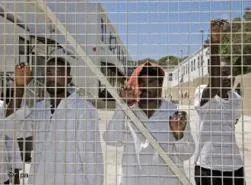
According to experts, no one dares to estimate how many people, passing through the "sieve" of European policy on combating illegal refugees, lose their health and lives
According to experts, the EU still lacks an effective policy to solve this problem. Most illegal immigrants arrive (or rather, sail) to Mediterranean countries. Spain, Italy, Malta, Cyprus are closest to Africa and are forced to deal with the problem of illegal immigration alone. These methods, observers say, are effective, but from a humanitarian standpoint, they are highly questionable.
For this, the authorities of Mediterranean countries are heavily criticized not only by human rights activists but also by their European colleagues. And yet, it remains unclear how to solve the problem of humane regulation of the flow of illegal migrants. Proposals from Mediterranean authorities to introduce quotas for the even distribution of immigrants across all EU countries do not find unanimous support in EU states. Among the opponents are Germany and Austria, which consider this not their headache but that of Southern European countries.
Politicians of Mediterranean countries hope that in October of this year the European Union will finally develop a new bill capable of resolving the problem. It is expected that the document will establish new rules for the distribution of immigrants across all 27 countries. Living conditions in African countries continue to be catastrophic and, according to many experts, will worsen in the foreseeable future. Therefore, the number of people dreaming of a prosperous life in Europe will only grow.
Malta
Last year, about six thousand refugees arrived in Malta alone. This is the highest number of asylum seekers in the EU last year, when recalculated per capita of an individual EU country. As a result, the number of refugees in Malta became ten times higher than the EU average and twenty times higher than in Germany.
The main reason is the Dublin Agreement on granting asylum in the European Union. It states that an application for legalization of the status of an illegal immigrant can be submitted in the country on whose territory the applicant entered the EU. In practice, this means that an African who sailed to Malta has the right to apply for legalization of his status only in Malta. If he illegally moves, for example, to Germany, his request will be immediately rejected and he will be deported back to Malta. Human rights activists criticize the Dublin Agreement, considering it inhumane.
Temporary reception camps for refugees in Mediterranean countries are in a catastrophic state. In Malta, one such center is located near the airport and externally resembles a place of imprisonment. The reception center is surrounded by massive metal grilles on all sides. Next to it is a "graveyard" of boats and various rusty vessels on which refugees arrived on the island in search of a better life.
Illegal immigrants in Malta are placed in the camp for 18 months. That's how long the procedure for reviewing a refugee status application takes. According to journalists who have visited the camp, hygiene standards are practically not observed there. Africans often complain about poor health, but they are not provided with proper medical care. Up to 400 people can be held in one room. It is worth noting that on the way to the "promised shores" many of them die from hunger, hypothermia, and shipwrecks.
Italy
Italy also sharply tightened laws on illegal immigration. The Italian island of Lampedusa has turned into a kind of transit point for those who regularly arrive on the island in overcrowded boats and dinghies hoping to move to Europe and start a new life there.
Special camps for illegal immigrants have been built on Lampedusa, where they are provided with medical assistance, temporary housing, food, and basic necessities. Compared to the reception centers in Malta, the conditions there are better. However, currently, the Italian camps are overcrowded, and conditions have sharply deteriorated. In January last year, hundreds of migrants escaped from the camp and held a demonstration to protest the camp conditions.
Often, illegal immigrants complain about mistreatment and humiliating remarks addressed to them by camp workers. According to independent observers, such methods are deliberately used to intimidate African refugees in order to discourage them from attempting to enter the "fortress called the EU" again. The Italian authorities' policy to reduce the flow of African refugees is sharply criticized by public and church organizations, as well as the UN. The greatest outrage is caused by the agreement on the capture and deportation of illegal refugees, which the government of Silvio Berlusconi concluded with the Libyan authorities in May of this year.
The fact is that most immigrants arrive in Italy by sea, transiting through Libya. After the signing of the new document, their flow significantly decreased. Last year, the number of migrants who moved to Italy was about 37 thousand people. The methods that Italian law enforcement agencies are now using after the agreement with Libya also cause indignation in the European Commission. The other day, EU commissioners appealed to Rome for clarification regarding a recent incident with a boat carrying illegal immigrants. The Italian coast guard expelled them back to Libya without even formally considering the issue of granting asylum to the Africans.
Spain
A few years ago, hundreds of thousands of illegal immigrants arrived in Spain annually. To combat the flow of refugees from Africa, the country's authorities introduced a computer control system for vessel traffic in the Strait of Gibraltar, strengthened the coast guard, and built wire fences separating the Spanish enclaves of Melilla and Ceuta from Morocco.
A special unit for deporting illegal immigrants from the country was also created. From the Canary Islands, Africans are often unceremoniously sent back to their homelands immediately upon arrival.
Meanwhile, in recent years, the flow of illegal refugees wishing to enter the EU via Poland, Hungary, Slovakia, and Romania has sharply declined. This is due to the aforementioned Dublin agreement and stricter border controls. Now refugees increasingly use other routes to enter the EU – Greece and the Balkan countries.
At the same time, Europe cannot be called an 'impenetrable fortress'. Annually, an average of one to two million immigrants arrive in the EU legally. And the number of asylum applications amounts to about 240,000 per year.