
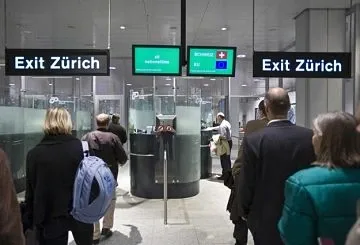
Due to immigration, Switzerland's population grew by 55,000 people last year.
The State Secretariat for Migration (SEM) stated that in the past year 2019, net immigration to Switzerland amounted to 55,000 people. As Swissinfo.ch notes, at the end of this year, the foreign population in the country was 2.1 million people, meaning almost one in four of the 8.5 million people living in the country holds a foreign passport and does not have Swiss citizenship.
Net immigration from European Union and EFTA countries (Iceland, Norway, and Liechtenstein) increased by nearly 32,000 people, largely due to citizens of Romania and Bulgaria being able to fully access the Swiss labor market starting June 2019. The largest foreign diasporas of EU citizens living in Switzerland are from Italy, Germany, France, and Portugal. The diaspora of Kosovo citizens is also large.
Recall that at the upcoming referendum on May 17, voters will decide whether Switzerland should regain unilateral control over immigration by denouncing the Swiss-EU Agreement on the Free Movement of Persons. This referendum has already been called the "Swiss Brexit" because terminating this agreement would put an end to the entire system of cooperation between Bern and Brussels, simultaneously throwing the country into the same state of complete uncertainty in its relations with the EU as the United Kingdom has been in since January 31.
The fact that such a referendum is being held reflects the noticeable public concern in Switzerland related to the influx of foreigners. On the other hand, imposing restrictions on the movement of EU citizens, and, most importantly, depriving them of the right to seek work in Switzerland, would not only destroy the established order of cooperation between Bern and Brussels based on two packages of bilateral agreements but also deprive Switzerland of access to the EU's single internal market. The European Union, recall, is Switzerland's key trade and economic partner.
For the Swiss government, countering such a prospect is currently a priority foreign policy task. Recall that Brussels seeks to conclude an institutional Framework Agreement with Switzerland that would consolidate the basic rules and norms of cooperation between Bern and Brussels. At the heart of this document is changing Switzerland's status from a country with "access" to the EU market to a country that is a "participant" in this market.
Furthermore, the document establishes a regime for the automatic implementation in Switzerland of all EU legislative norms. Switzerland would like to conduct additional negotiations on anti-dumping measures in the labor market and wages, as well as on the issue of state budget subsidies to individual sectors of the economy.
Many in Switzerland believe that such a document would effectively turn Switzerland into an EU member, with all the obligations but without the rights, that the agreement contradicts the principles of Swiss sovereignty, and that in its current form, the document will not receive parliamentary approval and will not be approved by the people in a referendum.
After the meeting in Davos between Swiss President Simonetta Sommaruga and new European Commission President Ursula von der Leyen, it became clear that no progress is being made on the Framework Agreement issue. And that it is unlikely anything will happen, at least until May 2020, that is, until the vote on the aforementioned "restrictive initiative" launched by the Swiss People's Party.