
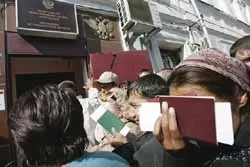
Russia has taken second place in the number of immigrants, second only to the USA
Chairman of the Investigative Committee under the Prosecutor General's Office of the Russian Federation Alexander Bastrykin reflects on this in his article published by the weekly magazine "Itogi".
At the end of the 20th and beginning of the 21st centuries, the economic and political processes taking place in the Russian state radically changed the situation: international, foreign economic, and political ties expanded and are dynamically developing; old borders opened and new ones appeared. All this led to the activation of migration processes, increasing the number of foreign citizens and stateless persons arriving in Russia. At the same time, the migration situation is becoming critical. The acuteness of the problems is largely due to the lack of an appropriate policy on the labor market, imperfections in migration laws and practices for receiving foreign labor migrants.
Illegal migration has become a particular danger, becoming one of the significant determinants of crime, its fertile breeding ground.
There is not just a quantitative increase in the number of crimes and persons committing them, but the qualitative characteristics of this phenomenon are fundamentally changing. The crime of foreign citizens is characterized by high latency; it is recorded specifically as crime by foreign citizens only when crimes are solved and perpetrators are found.
Thanks to these and other circumstances, over the past decade stable trends have emerged that complicate an already unstable economic situation. First of all, the positive internal socio-economic migration of Russia's population, necessary for production development, is decreasing. At the same time, it should be noted that the number of foreign citizens entering our country exceeds the number leaving. According to the Border Service of the FSB, the number of registered crossings of the state border last year alone amounted to 23.5 million. Moreover, in just the last three years, more than 5 million newcomers have settled in the country.
Shadow migration
The difficult economic situation in a number of foreign countries, increased competition in the labor market, and mass layoffs have led to an increase in the influx into Russia of people from former Soviet republics and far-abroad countries. At the same time, the massive uncontrolled resettlement of foreign citizens and their illegal stay favor the development of the shadow economy. By its very nature, illegal migration enters into close ties with illegal business, and consequently merges with organized crime, which, in turn, is interested in the flow of migrants as a source of income.
Legal and illegal migration is carried out with the help of firms specializing in document processing. Such companies operate quite aggressively, offering clients a wide range of services: they guarantee the processing of almost all documents necessary for arrival and legalization in Russia—invitations, single and multiple visas, company registration, immigration and registration documents for the right to reside, work and do business, and even driver's licenses.
In practice, this means that citizens of foreign countries with the appropriate financial resources can at any time come to Russia and leave it, stay on our territory and engage in entrepreneurial activity on a "legal" basis. Illegal migration through Russia, which involves millions of people, is also a major problem.
Assessing the situation related to illegal migration and discussing the reasons for the ineffectiveness of measures being taken to combat it, a number of aspects can be highlighted. These include a lack of funds, corruption of local authorities, imperfections in the system regulating the pressure of external migration, and existing demand within the country.
It is clear that restrictive barriers alone will not be so effective; a flexible system must be developed to resolve the conflict between the migration flow and the interests of the regions and the country as a whole.
At the same time, the influx of migrants into the Russian Federation will apparently continue to grow. This is due to the reduction of legal space for external migration and a labor shortage amid the demographic crisis and economic stabilization. Most foreigners, of course, come to earn money, that is, with the intention of staying in our country for a long time, but 80% of them give false reasons for coming.
Unfortunately, our migration authorities do not take into account that the growth in the number of labor migrants in conditions of the current level of unemployment can negatively affect the labor market and lead to a worsening of the crime situation, causing an aggravation of social tension.
In turn, insufficient quotas for foreign labor inevitably lead to an increase in illegal migration. A more careful study of the issue of migrant employment is required. Often, foreigners do not have not only work permits but also the necessary medical documents, which leads to the spread of infectious diseases.
Here we cannot fail to mention the problem of migrant exploitation. In fact, they are in the position of modern slaves, lacking proper working conditions, restrictions on freedom, physical violence, and often sexual exploitation. In order to obtain superprofits, employers prefer to hire illegals, saving on basic labor safety requirements, which leads to serious injuries and loss of life.
According to the Russian Federal Migration Service, in the first quarter of this year, just over half a million people were brought to administrative responsibility for various violations of immigration legislation.
Russia rose to second place in terms of number of immigrants, second only to the United States. Over 20 million people cross Russia's borders annually, but only 1.5-2 million are officially monitored. The number of illegal immigrants deported from Russia remains extremely small compared to their total number: less than 0.5%.
All this indicates a clear mismatch between the measures taken and the scale of migration violations. If concrete measures are not taken now to correct these negative trends, the situation could soon spiral out of control. This is confirmed by international experience - events in France, Germany and other European countries, where organized protests by migrants dissatisfied with working and living conditions occurred, accompanied by pogroms and public order violations.
Crime Zone
The criminal nature of illegal migration needs no special proof. Thus, it is no coincidence that in our country over the past ten years there has been a steady increase in crimes committed by foreigners and stateless persons.
The total number of such crimes has increased significantly - up to 74%, with the majority committed by citizens of CIS states – 81%. Moreover, it is citizens of neighboring countries who most often become victims of criminal attacks.
In the past year alone, the crime rate among migrants increased by more than 7.5%, with 54,000 crimes committed by them. Every third crime is committed by illegal migrants, and their attempts to legalize also lead to new crimes - the production and use of forged documents.
More than half of all crimes committed by foreign nationals were registered in the Central Federal District (30,000), and every third in Moscow (16,500).
The effectiveness of work with illegal migrants is extremely low. In fact, the vast majority of unsettled, left-to-their-own-devices people remain uncontrolled. The registration of migrants is still not properly organized. This reduces the effectiveness of law enforcement agencies in solving and investigating crimes.
The lack of necessary control over migrants who do not have normal living conditions or money for sustenance increases the wave of crimes and raises their latency level. Moreover, such criminals then freely disappear to their own countries, which subsequently do not extradite them. In May of this year, in the Moscow region, two citizens of Uzbekistan, for the sake of profit, massacred an entire family. After strangling a man, they first raped the mother and 19-year-old daughter, then killed them as well, after which they freely left the territory of Russia. In the Nizhny Novgorod region, a citizen of Uzbekistan, previously convicted in his homeland, broke into an apartment to steal, and finding the owner at home, killed him. It was later established that the criminal had been illegally in the region since 2007.
In the Kemerovo region, more than 50% of foreign nationals brought to criminal responsibility by investigative bodies had been living in Russia illegally for a long time - five years or more. Cases of violent sexual crimes by migrants against children and minors are widespread.
The range of illegal acts by migrants is wide. A special place among them is occupied by economic crimes. In the past year, there were over 15,000 such crimes, constituting a third of the total number of crimes committed by them.
In recent years, there have been more frequent instances of foreign citizens being brought into the country by their compatriots for the purpose of enslavement. Low-income citizens agree to enter Russia at the expense of those who pay for their trip, and later remain in service to those individuals. Such illegal migrants become real slaves, whom their wealthier compatriots resell to each other both for domestic services and for carrying out criminal tasks: drug trafficking, smuggling goods, and committing extortion.
Illegal migrants actively participate in the recruitment and purchase of Russian women for their further sexual exploitation in Western Europe and other countries.
Groups of criminal migrants united along ethnic lines create an uncontrolled market for goods and services, where the negative aspects of intensifying migration processes are quite clearly expressed. The activities of illegal migrants in their places of residence include the creation of an uncontrolled market for goods and services with tax evasion, conducting illegal commercial activities up to the delivery and sale of drugs and weapons, the production and sale of counterfeit alcoholic beverages, forged documents, certificates, seals, and the like.
Currently, a number of cases are under investigation regarding smuggling and illegal banking activities committed by foreigners, meaning this sector of illegal activity is also being actively developed by migrants.
The organization of illegal migration continues to flourish. In the past year, about 1,500 crimes were committed related to the organization of illegal entry into Russia by foreigners, their illegal stay, or illegal transit through the territory of our state, including for the purpose of committing crimes.
Unfortunately, even those officials who, in accordance with the law, are tasked with identifying and suppressing migration violations and crimes themselves embark on the path of committing them. Thus, in Moscow, employees of the migration service were exposed for receiving numerous bribes for illegal registration.
In the Rostov region, criminal cases are being investigated against 12 employees of the Federal Migration Service who were involved in organizing illegal entry of foreign citizens into the country and their registration. They produced the necessary package of documents for obtaining temporary residence permits for foreigners, including false certificates of registration, criminal record clearance, and other documents required for obtaining citizenship.
Under similar circumstances, a case is being investigated against a group that operated in the Moscow region in 2006-2008, organizing the illegal stay of 800 foreign citizens.
The relevance of this problem is also due to the fact that crimes committed by migrants cause a huge public outcry, provoke xenophobia, hatred on grounds of race, nationality, and religion. This issue has become particularly acute recently; a significant increase in extremism in the country is causing serious concern.
Over the past 10 years, the number of crimes committed on grounds of national hatred and enmity has increased significantly (by 68%, from 9,000 to 15,000). In the current year, these negative trends persist. Thus, in the first quarter, the number of crimes where foreign citizens were recognized as victims increased by 4% and amounted to almost 4,000. The number of murders increased by 12% (416), and intentional grievous bodily harm by 16% (788). Last year, over 2,000 robberies and 754 armed assaults were committed against them.
It is characteristic that in Moscow, St. Petersburg, and the Moscow region, there is an increase not only in crimes committed by migrants but also against them. Modern youth are increasingly susceptible to nationalist propaganda, which has led to the spread of fascist ideology among them. As a result, the majority of extremist crimes are committed precisely by minors.
The resolution of migration policy issues directly affects the country's security from terrorist threats. In the Republic of Dagestan, a case was investigated against a citizen of Tajikistan who came to the republic to his father, a field commander of Basayev's detachment, and for three years studied Arabic and military affairs. Subsequently, joining an illegal armed gang, he engaged in arms trafficking and illegally obtained a Russian passport.
The Power of Law
In the current conditions in the sphere of migration relations, it is necessary to take comprehensive measures to identify and suppress the activities of criminal groups and criminal communities formed on an ethnic basis, including migrant criminal groups. Ensure effective control over the timely identification and proof of circumstances that contributed to the commission of crimes by migrants.
Control and accounting of migration movements require legislative support and international cooperation. In some cases, it is precisely the shortcomings in this area that cause uncontrolled movements, including illegal ones. For example, the existence of a visa-free regime on certain sections of the Russian border leads to illegal migrants entering the country. In turn, the economy's need for labor resources necessitates regulation of the inflow of immigrants.
An interdepartmental meeting dedicated to the problem of combating migrant crime and improving migration policy was held on May 21 at the Investigative Committee under the Prosecutor's Office of the Russian Federation. Measures were developed to improve the legislative framework and regulatory legal support for state mechanisms regulating migration processes. A decision was made to raise issues of holding accountable those officials who, through their illegal actions or inaction, contributed to the commission of crimes. The meeting participants agreed that in the course of their own official activities, it is necessary to ensure that migration processes become a positive factor contributing to economic development, improvement of the demographic situation, and ensuring the country's security.