
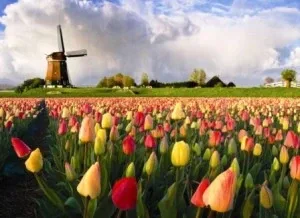
The prosperity of the Netherlands rests on tulips, windmills and... marijuana.
What is more, this nation annually reclaims several tens of square kilometers from the sea. On the drained lands - polders - reeds are planted, which over time give the first fertile layer, then several more times, and after five years this field can already be sown. On such land, a harvest is gathered that can feed up to 300 million people (the population of the Netherlands itself is only 16 million).
Interestingly, you will not find such a concept as a beach (in our understanding) here, with rare exceptions. Only in some places (for example, on the embankment of The Hague) can you splash in the sea. Usually, the sea horizon is hidden behind a multi-kilometer dam, densely dotted with pillars of wind electric mills. And only flocks of screaming seagulls chasing tractors in the fields and a piercing breeze remind you that the sea is nearby.
'Flying Dutchmen' on bicycles
The first thing you will definitely see in the land of tulips, windmills and cheese is bicycles. On their 'fiets' (bicycle in Dutch), any local can ride across the country in a few days. All conditions are created for this: special bike paths, parking, and equal rights on the roads. Everyone rides bicycles: children to school, a priest, a mother with a nursing baby in a basket, an old grandmother in a veiled hat, and members of the royal family. At the same time, the country boasts excellent roads.
Only the landscapes will not please your eyes – to the horizon, a flat as a table plain (the highest point of the country – Veluwe, is at an altitude of 106 meters above ocean level), neatly lined with a dense network of canals. In the past, they had countless shipyards. By the way, via canals from the Netherlands you can even get to Hamburg, Marseille, or Izmail (along the Rhine and Danube). It is on them that the famous Dutch windmills stand, most of which still pump water from swampy lowlands.
Anyone who decides to cycle through the Netherlands will definitely pick up another local 'attraction'. From the abundance of fertilizers in the fields, the air is thick with the stench of cow manure. Locals call it the 'smell of Holland'. Without it, the environment would resemble paradise: neat, almost doll-like houses and farms, behind a straight fence – cows, sheep, and other animals. Those who are richer keep ostriches, peacocks, roe deer, and even penguins. There are many horses, especially ponies, which are bred only for beauty.
The official head of state is the king, and at the moment – Queen Beatrix. The government, parliament, and royal residence are located in The Hague (the Dutch themselves call this city Den Haag), but the capital is considered Amsterdam – the Venice of the North, a European entertainment center. The business center, without a doubt, is Rotterdam, the largest cargo port in the world, the European boiler room (it is called Europort).
Do not envy 'migrant' money
After the fall of the Iron Curtain, our compatriots also appeared in this picturesque corner of Europe. The pioneers were car transporters. Over time, some of them found work and stayed here for a long time. Now in the Netherlands, there are officially up to 20 thousand people from the former Soviet Union. And unlike Russians who have occupied cities, most Ukrainians live in rural areas.
However, these differences are quite arbitrary. The entire territory of 'rural' Holland is covered with a dense network of towns, hamlets, and farms. Cows on the side of the highway, a farm or greenhouse, and the Gothic spire of a 'kerk' (church) towering in the distance – this is a typical landscape of a country that ranks first in Europe in population density. All available land works for the prosperity of the country. This determines the occupations of those who came here to earn money: agriculture and construction.
However, I will warn you right away, do not count on quick enrichment. It is quite difficult to get a job officially in this country. Of course, you can work illegally – as a handyman on a construction site, in a greenhouse. Locals initially treat uninvited strangers with suspicion. But if you are lucky, and after some time you find work, housing, and also establish yourself as a sociable, calm workaholic, then you will be treated like family.
The best thing is to find yourself a 'boss' – a kind of manager who can help with employment. His profit is simple: having received an order and money (at Dutch rates), he pays his subordinates at different rates. However, you need at least a minimal knowledge of the language and a specialty. And it takes time to get used to it. Therefore, people often find work after their visa has long expired. Despite some loyalty from the authorities, it is always difficult for illegals. Sometimes they even conduct raids. There have been cases where illegals were tracked from a helicopter and taken directly from the fields where they were weeding cabbage. It all ends with a couple of days in detention followed by deportation.
However, as eyewitnesses say, being in a Dutch prison is a pleasure: rooms for four people with personal televisions, individual menus. By the way, for housing, Ukrainians usually use the cheapest campsites. A room 3x4, several iron bunks, shared kitchen, toilet, showers, and a 'svitlytsya' (common room) with a table tennis table – this is the set of unpretentious migrant service. It will cost 50 euros per week. It happens that not everyone has work, and the others pawn and re-pawn passports and wedding rings to pay for housing. Therefore, never envy 'migrant' money.
Trust in your brother but don't slack yourself!
Tough conditions for survival require equally tough relations between people. If you came here not to a brother (father, godfather, matchmaker) – don't count on help. It may even happen that people you knew very well back home will unpleasantly surprise you with their indifference. The cause is ruthless competition in the labor market. Add to this the envy and arrogance inherent (let's be honest) in our people. Therefore, I have repeatedly heard from people who have already settled in well here: 'I would help him with a job. But back in the day, I was idle for three months, so let him struggle too.' So the one who lives separately, away from his compatriots, feels best.
I would advise not to trust the sincere promises of travel agencies and various intermediaries. Having paid for a visa, travel, you may find yourself alone in an open field – without housing or work. The smarter ones make their own way. Fortunately, there is a simple commuter train from Germany (from German Duisburg to the border town of Venlo – about two hours by train). The only thing is, if you have a large suitcase or bags, they will check your passport at the station. Strangely, police officers of Indian-Surinamese appearance are the most zealous in this. Probably, they have a greater sense of duty to their homeland.
Some hope to get asylum in this country. For this, for several thousand dollars, you can find a consultant (from among former compatriots) who will teach you how to behave and what to say in special institutions. Usually, they make up stories about political or criminal persecution. Preference is given to those who have evidence: records of written or telephone threats. Some try to pretend to be homosexuals. But for this, you need, for example, to describe exactly the soft spot of your 'Dutch friend'. Well, in case of failure, you can no longer hope for a Schengen visa.
'The best job for Ivan'
That is roughly the translation of a favorite saying of local drug dealers. As is known, the Netherlands remains the only country in Europe where it is permissible to use soft drugs. A little joint can be freely smoked in any coffeeshop. These establishments are easy to distinguish by the incredible number of antique pipes, mushrooms, and cannabis branches in the display windows. The regulars of these establishments are striking – phantom people with vacant stares and gray-green faces. Every European drug addict considers it a point of honor to 'let loose' in Amsterdam. The enterprising country only gets richer from this.
With a permit, cannabis can be grown legally. However, the drug is even cheaper sold under the counter on the street. It is this raw material that grows on clandestine plantations, by the way, equipped with the latest technology – with alarms and video surveillance. They are usually located in garages, basements, and attics. Naturally, the state fights unauthorized drug trafficking, but as we know – demand creates supply. Due to the risk, such work is considered the highest paid. Besides, it is not difficult – it's not like planting onions behind a tractor.
The password for recruiting labor is a characteristic finger gesture resembling scissors. Because it is with scissors that the soft buds of cannabis are cleaned. As a rule, already trusted, well-known people are recruited for such work and taken to the workplace in a covered van. Or they blindfold them – so they don't remember the way.
A newcomer has little chance of getting such a job. In case of exposure, a foreigner faces mandatory deportation (for such an activity in Germany you would be imprisoned, and in Thailand sentenced to death). The owners of such plantations are pursued by Interpol, police raid them, arrest them, fine them. But once I myself witnessed that just two days after the plantation was raided, the same 'bosses' came and recruited new workers.
Unfortunately, there are entire castes of our compatriots who do nothing else but 'marijuana work'. Despite the fact that workers are supervised, many manage to sneak out a few grams – for themselves or for sale.
The author had the luck to get into one such plantation and observe how seedlings are planted and the harvest is collected. By the way, it is harvested every 30-40 days. On one such trip, I even brought a camera and, taking advantage of the 'boss' stepping out, photographed one of these 'death factories' – my journalistic zeal got the better of me. There was risk, of course, because in case of exposure, we could face not only loss of wages. But I never took advantage of my 'right' to try the forbidden fruit for free.
Old radio for a euro, clothes for free.
The true essence of the local mentality can be understood at the annual traditional fairs – 'kermisses', which are timed to religious holidays. This is perhaps where you can see cheerful and carefree Dutch people – in everyday life they are reserved and taciturn. Preparation for the holiday begins on Friday afternoon. For the first time in my life, I saw streets and sidewalks actually washed with soap. 'Kermisses' are very popular with foreigners. The point is that here for a pittance (from 1 euro) you can buy old things: clothes, dishes, electronics, and more. Our compatriots try to get clothes directly from the bales of second-hand items that conscientious owners put out near the house for donation to charity.
And on weekdays, the Dutch are an example of efficiency and endurance. They start working very early – at six in the morning. Every two to three hours there is a mandatory break, you can eat and smoke. For them, this time is sacred, sometimes it even seems that if a fire broke out, no one would lift a finger.
Construction and repair work is done, like in our country, by 'shabashniki' (freelance workers). That is, having, for example, the qualification of a painter and knowing the local technology, you can earn up to 70-100 euros per day. To find such work, I used a very simple method. After getting used to the local greeting, I would go out to seek work. Seeing a concrete mixer in a yard, I would approach and simply offer my services. For long-term searches, it is advisable to have a bicycle. By the way, the Dutch themselves prefer old 'fietsen' – apparently they are less likely to be stolen.
In the country, there is still nostalgia for the local currency – the guilder. They say that the euro enriched the rich and ruined the poor. However, the high exchange rate of the euro currency somewhat calmed the 'Dutch' (self-name of the Dutch). In stores, everything is very cheap. In a week, I spent only 20-25 euros on food.
Open windows to the world
The Dutch decorate everything they can with live flowers: houses, fences, buses, streets and squares. And the facades of houses look like real masterpieces of landscape art: with decorative trees, fountains and waterfalls.
Contrary to popular belief, the most traditional dishes of the Dutch are not cheese, but potato sticks – 'potat' and lightly salted herring – 'heerenk'. They are eaten with a piece of condiment (onion, cucumber) from stalls right on the street, and always with hands. On the fashionable embankment of The Hague, fish eateries stand close to each other for a kilometer. And everywhere is full of people. And the famous Dutch cheese is more often used as a snack, and it is used to dress soups and salads.
Anyone who has visited Holland for the first time will definitely notice that local residents do not cover their windows. The Spanish inquisitors, who once ruled the Netherlands, taught the Dutch this habit. Fearing conspiracies, they forbade locals to close the curtains on the windows.
The Inquisition has long been forgotten, but the habit of living with open windows remains. The Dutch seem to demonstrate their openness. It's nice that now our compatriots also enjoy this hospitality. It's only a pity that for now, we are forced to study the world, for the most part, by collecting calluses on our hands.
• Today, modern IP video surveillance systems are used not only in Holland. Suffice it to recall the experience of the British capital: after the tragic subway bombings, the London authorities strengthened measures to protect the city by equipping almost all public places with a video surveillance system. Every intersection of London streets is now equipped with IP cameras that are integrated with a central video server, from which security is monitored.
Mikhail ROMANYAK.
Specially for 'Zagranitsa'.