
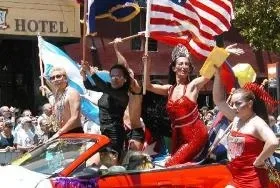
A bright show on Market Street on the day of the Parade
In the "sexual Mecca" of all America – as newspapers call San Francisco – to get acquainted with manifestations of perverse sexuality, it is absolutely not necessary to go to the Parade. Rather, special efforts are needed to not notice anything "like that." Not to go to Dolores Park, where on a warm day guys and girls hug on the grass, and the guys delicately sit farther away. To forget about the city's best repertory cinema on Castro, "in the very heart," as Soviet newspapers would have written, of the local gay community. Natural tolerance allowed me to do without this kind of sacrifice. Still, when two of my male friends decided to get married and a wedding photo shoot was already booked, I realized it was time, as party organizers used to say in Soviet films, to "decide" how I felt about "it." To find out what they are proud of there.
Because it's easy to consider oneself a liberal in Kiev, where the oddities of friendship among peoples boil down to the smell of fried herring Vietnamese-style filling the dormitories on Lomonosov Street, and sexual perversions fit on the pages of the little-demanded magazine "One of Us." Where gays are married to young ladies, and Jews to anti-Semites, and only family scandals or pogroms (touch wood!) reveal the existing misalliance. Where, finally, after the shameful trial of Paradjanov, speaking about gays with disapproval in one's voice is simply indecent.
San Francisco has one of the largest gay communities in the States. Homosexuality here is common, ordinary, it is not particularly hidden nor particularly flaunted. It was precisely this ordinariness, the necessity of everyday coexistence with the gay community, that caught me off guard. It was time to catch myself: where had my original, homespun liberalism gone? Archaeological excavations in the cultural layers of my brain found nothing but Sodom and Gomorrah incinerated by the Old Testament God. Could it be that those very embers smolder in my eyes, which had so enthusiastically read Rozanov's "People of the Moonlight"?
Oh, Reader, I am tormenting you with conjectures, but in the meantime we have already reached the city center. We were a little late, and we missed hearing the speech of Mayor Willie Brown. Not that I wanted to very much; better just imagine...
THE PARADE
"Imagine..." I wanted to say – but stopped short. Imagining Market Street on the day of the Parade is an impossible exercise for a person who grew up in a country where homosexuals were judged alongside thieves and murderers just a few years ago. Even if that person has read Boccaccio and Rabelais, even if he has secretly looked at Beardsley's "obscene" album from his mom (dad, wife). And certainly beyond the capability if that person belongs to the local gay "scene," paradoxically combining the mores of a Masonic lodge and a communal apartment. What will inevitably strike him first is the absolute openness, the obviousness of what is happening. And the universal goodwill "on both sides of the barrier." And also how much the Parade resembles some kind of pre-New Year's carnival – with the difference that no one knows who is hiding under the rabbit mask – Ivan Ivanovich, a Bengal tiger, or just another rabbit – and therefore everyone is interesting to everyone else without exception.
But still – try to imagine...
The Parade takes place on Market Street. This is a street that, with a certain degree of convention, can be considered central – it connects the skyscrapers of the financial center and the capitol-like city hall in a straight line. Market is one of the few completely flat and wide streets in the city. The procession goes along the roadway and stretches for nine blocks. People from early morning take places near the barriers lined up along the street for the entire length of the procession. There are many sympathizers and tourists in the city, so by the start of the procession, you can't push through to the front.
The benches and roofs of trolleybus stops are also occupied, hardy plane trees along the edge of the sidewalks and the tin tops of trash cans; the happiest ones stand on the subway parapets; the chosen ones sit on the guest tribune. Already leaving, I saw a broken branch of a plane tree. The body that fell with the branch was either removed or it ran away by itself.
About the spectators. Many are dressed colorfully: tropical-colored skirts, intricate hats, boas. Those who couldn't think of anything cheerier than a T-shirt with shorts put on six different-colored beaded necklaces and adorned themselves with stickers "the biggest pussy in the world," "I like to do homework at vulva university" – in this city, to praise yourself like that, you don't have to be a woman. Many of the spectators could well have taken a place on the other side of the barriers – not so much because of how tenderly they tickle each other with their mustaches, but because they are very cute – both the skirts and the fishnet stockings on carefully shaved legs, and the wigs. The composition of the spectators is replenished by those who have "participated" in the parade. Many recognize each other and kiss over the barriers.
Who are you, passerby – LGBT (the stable abbreviation from the full name of the parade, meaning lesbians, gays, bisexuals, transsexuals) or a straight onlooker? The mute question read in many eyes is doomed to remain unanswered. The parade is essentially a carnival, all around are masks. And besides, it's so easy to make a mistake in definitions... Before the parade, I tried to "study the issue" and studied an article about how transvestites differ from transsexuals. The author never explained anything clearly – possibly because his own gender, as he explained with some annoyance, is something intermediate between the two. Along the way, I learned about the existence of polysexuals and ambisexuals. Stylistically, the composition resembled Karl Marx's article "Defense of the Moselle Correspondent," which the brightest minds of the first year of the journalism faculty of the class of 1989 could not understand.
Sexual preferences are a personal matter for everyone, as my friend and I decided, tired of arguing about what gender the waiter serving us in the restaurant was. I saw the young waiter again in the bustle of the Parade: he was impeccably shaved and made up, naked to the waist and dressed in a long skirt of amazing beauty...
Somewhere at the very beginning of the procession walked a cheerful creature of indeterminate gender. From time to time it stopped, turned to the audience, and with affected grimaces began something like a cruel striptease. The audience... laughed. The fact is that the 'stripper' was a clown dressed in a robe, under which were hidden countless balloons substituting for breasts, buttocks, biceps, etc. From time to time a 'breast' rolled down to the knees, and the clown erotically retrieved it.
PARTICIPANTS
The first in the parade were children. The children were hardly gay or lesbian – simply because they were very young, about one to seven years old. The parents, who pushed children in strollers or led them by the hand, were gay and lesbian. Many carried signs – something about equal opportunities for gay families. What stuck in the memory were not them, but a couple of placards carried by the children: 'My gay dad is amazing' from a boy and 'I love my moms!' in a girl's hands.
Next – whether to start with the officials or alphabetically – we still have to start with Tony Amiano, a popular politician in the city and unsuccessful mayoral candidate, who in the last election was defeated by the universally criticized Mayor Brown (Brown is second alphabetically and first chronologically). Amiano is indeed gay, and the fact that he didn't win the election may mean that gays still do not constitute a majority of voters. However, there is also talk about the imperfections of the electoral system.
More officials (officials are easy to recognize because they ride in open limousines, most often sitting on the hood) – the director of the Golden Gate Bridge. Who doesn't know: the bridge across the bay is a symbol of San Francisco and the most photographed in the USA. Whether its director is gay, I don't know – but what a figure!
Other officials, corresponding in rank to heads of district administrations. There were many officials. I don't know if all, since participation in the parade is not mandatory for officials.
Universities – the prestigious and affordable Berkeley, where LSD and BSD were invented and where Czesław Miłosz taught, and the prestigious expensive Stanford, where the Google search engine was invented and where Nabokov taught. University people from Stanford blew brass trumpets, university people from Berkeley demonstrated the erotic properties of brass trumpets – Sigmund Freud would have had a rest.
Society of elderly gays and lesbians – old men and women in stockings and little dresses drifted in a decorated wagon and blew air kisses to the crowd.
Society of sadomasochists. The sadomasochists were strong men in leather suits, many with bare bottoms strapped with belts. Some walked with menacingly furrowed brows, others, dressed in harnesses, pulled a decorated cart on which stood dressed and stern women with whips, and howled 'Beat me! Beat me!' Further on, women painted in paint rushed about in cages guarded by 'leather' men. One 'leather' man with a simple face spanked a young lady's bare bottom, having thrown her over his knees.
Corteges of gay, lesbian and transvestite public organizations. Stage design by V. Boer.
Parents and relatives of gays and lesbians (with placards 'I am proud of my mom who is proud of her lesbian daughter', 'I am a gay's uncle', 'Hatred has no place in the family', 'I know about my son', 'I am proud of my gay son').
'Straights' fighting for gay rights.
Representatives of churches that accept and support gays (for some reason the Presbyterians and Buddhists stood out, although in fact there were about a dozen churches, no less).
Organizations fighting the spread of AIDS.
Gays – school teachers and kindergarten educators.
Gays – Vietnamese, Filipinos, Jews, Chinese, Indians (all with their own organizations). All in national costumes, like at a May Day demonstration on Red Square.
An organization promoting the fight against breast cancer in women. Semi-naked women in carnival costumes, who had undergone surgery – with disfigured breasts or none at all. From the crowd, people shouted 'Well done, lady! You are amazing!'
San Francisco Gay Men's Chorus.
Sports teams and sports clubs. Eastern martial artists split boards in half with kicks.
Rockers on BMW motorcycles.
Sexual proponents of cannabis legalization, festooned with marijuana garlands.
Fighters for the liberation of Leonard Peltier.
Fighters against the exploitation of man by man, protesting the sweatshop system at Gap factories.
Employees of Borders and Waldenbooks bookstores.
Employees of major internet companies located in Silicon Valley.
Promotional youths from the manufacturer of Altoids mints.
The workforce of a bakery that bakes bagel rolls.
'...representatives of labor collectives, public organizations, educational institutions, as well as the creative intelligentsia...' – the reader will ironically sum up from memory a quote from a report about May Day – and will be right! Because the Parade is essentially an ideological show like the Soviet 'May Day celebration.' Only here people participate voluntarily, and they write their own slogans, not receive them from the party organizer. This is what makes the Parade interesting to a person completely indifferent to the problems of sexual minorities – American ideology, generally alien to exhibitionism, appears here in all its, um... nakedness.
During the year spent in San Francisco, I have seen a May Day demonstration (100-120 people), a demonstration against electricity price hikes, a 'funeral of art' (the art community demanded curbing rent prices), a demonstration against the use of cheap labor from Southeast Asia... But LGBT hold not a demonstration, but a parade. Feel the difference. Demonstrations are held by fighters, parades by winners. Those who have nothing to prove.
Of course, it would be absurd to call the States 'the country of victorious homosexuality.' Not only because California is perhaps the most liberal state in the country; somewhere in the Midwest, being gay is much harder. Homosexuality has not triumphed, but rather has emerged from the social ghetto, established itself, and along with it something more essential has become established. Something in which not only a particular group of people is interested, but any of them – life. By recognizing the equal rights of sexual minorities, society has finally rehabilitated sexuality as a human life function, apart from its justifying connection with procreation. And that means it has rehabilitated man – as he is.
EPILOGUE
The parade went along Market Street, its participants mixed and dissolved into the crowd that filled several blocks around the city council that day. On the platforms where rock-blues-jazz concerts were held, it was impossible to move. Immediately long lines formed for beer and shashlik. A place in line is more important than sexual orientation – could be read on the faces of those crowding near the portable toilets... The event was rapidly losing its specificity. Men with genitals coquettishly covered by aprons were eating hot dogs. Dressed-up transvestites took photos with anyone who wanted (and completely free of charge). They sold beads, shirts, African wooden spoons. Dyed gays hugged undyed ones, just boys hugged just girls. In the restaurants closest to the city council, they equally ruthlessly 'fleeced' LGBT and 'straights' – prices were doubled due to the influx of customers.
The stack of 'Pride.01' magazines slowly dwindled. I grabbed one, hoping to finally find out at leisure how a transsexual differs from a polysexual, and the latter from an ambi... Probably, one can somehow, with effort, figure this out. Although for most people, this question is still idle.
Another is pressing: why did John fall in love with Raul, and not, say, Steve. And Sancho – with Isabella, and not with her girlfriend Jane. A real mystery that will forever remain outside the calls for equality and justice. Equality has nothing to do with it. And justice has nothing to do with it. And the Parade.
Angelika KHIZHNYAYA.
Special correspondent for 'Zagranitsa',
San Francisco, USA.