
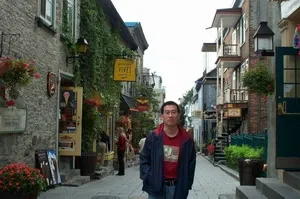
Why should statesmen spend precious time on trips and holding such events? And what is so special about this province, different from the general Canadian immigration situation, that prompted the leadership to hold such meetings? With these and other questions, the correspondent of Inostranets turned to Guy NOLIN, attaché for information policy of the immigration service of the government of the province of Quebec at the Canadian embassy in Vienna.
- I would like to start with your second question. The fact is that the Canadian constitution, so to speak, divides responsibilities between the provinces and the federal government. Several years ago, the government of Quebec signed an agreement with the federal government that Quebec would itself handle the selection of immigrants who have expressed a desire to go specifically to this province.
This was done mainly because - and this will partly answer your first question - Quebec needs immigrants. The birth rate in the province is very, very low, and the population is aging. An influx of fresh blood is necessary for our economy. However, we do not need just any immigrants, but those who speak French or are ready to learn this language. After all, due to the low birth rate in Quebec, the share of Francophones in Canada will decline over time. This prospect determines the policy of the Quebec government.
So, the mentioned agreement says that Quebec itself will develop criteria for selecting immigrants, choose locations for its immigration service offices abroad, and instruct its employees to conduct the selection of immigrants. The federal government will only have to check the candidate's reliability and health. That is, Quebec's independence in selecting immigrants is the first reason why we - separately - hold these seminars.
There is another reason. Since we need specifically French-speaking immigrants, there are not many places in the world where we could find them: France and the Maghreb - our representative office in France handles this region; we have an office in Latin America, where enclaves of Francophones still remain; and my office in Vienna works with Eastern Europe. Very few immigrants come to Quebec from Romania and Bulgaria. Now more and more applications are coming from Russia. Correspondingly, the contingent of consultant-intermediaries is increasing. And we want to be sure that people receive accurate and free information. The first thing we tell potential immigrants: if you want, you can turn to intermediaries, but you must understand that no intermediary can speed up the process of your move or influence the decision of immigration authorities. The immigration process to Quebec is extremely simple, and every literate person can handle it without outside help. And this is another reason we hold these seminars: we want to do everything in our power to ensure that interested people receive accurate information and do not fall into the hands of consultants who boast of their omnipotence.
We know that you have very many Francophones. And immigrants from Eastern Europe, as a rule, quickly integrate into a new society; they are enterprising, hardworking, and ambitious, concerned about their children's education - in short, they are exactly the kind of citizens any country needs. And Quebec as well.
- So, a person has decided to immigrate to Quebec. Where should he submit his application - to the Canadian embassy or somewhere else?
- No, no. If a person wants to immigrate to any other Canadian province, he contacts the Canadian embassy. But the one who intends to go to Quebec must contact us directly - the Quebec representation at the Canadian embassy in Vienna. The immigration process to Quebec is significantly shorter and faster: we make a decision within five to six months. Let me elaborate on this, since the entire procedure has changed quite recently.
Previously, it was a three-step process. First, a person filled out a preliminary questionnaire, in which he indicated his age, education, language proficiency, work experience, presence of relatives or friends in Quebec, information about his family - and sent it to us at the Vienna office. If our staff decided that this candidate met the accepted criteria, they sent him a more detailed questionnaire, each item of which had to be supported by an appropriate document - birth certificate, certificate, diploma, and the like. If this information also satisfied our officials, the candidate was invited for an interview, which took place about four months after filling out the second questionnaire.
However, recently we have reduced this procedure to two stages. The first questionnaire no longer exists. We have shifted this stage onto potential immigrants and onto our website. The candidate fills out a questionnaire in an interactive mode, anonymously - without indicating his name. He can fill it out endlessly, and each time the program will give a conclusion. For example: you should study French a little more. Or: you meet our criteria. And then this candidate, who is suitable on first assessment, can download the second questionnaire from the site, fill it out, attach documentary evidence, and send the package to Vienna.
What are our selection criteria? First, we do not accept applications from people who have no work experience at all. A person must have at least six months behind him.
- Do you mean work in one's specialty?
- No, any work. Second, different points are given for education: university education is valued higher than secondary education, and a candidate degree higher than just a university diploma.
Sad as it is, age also matters. A candidate under 35 receives the maximum score - 10. As they approach 45, the score decreases. This is not discrimination. You yourself understand: the younger the person, the easier it is for them to adapt to new conditions, the easier it is for them to learn a foreign language. I am already over 45, and in any country in the world it would be harder for me to find a job than for a 25-year-old. And we must be confident that all opportunities are open to new immigrants and that they will be able to take full advantage of them.
Of course, the loss of points for age can be compensated by a candidate's degree, a university diploma, or excellent command of French. But if you are over 50, your education is high school, and your French is nonexistent, you lose 30 points out of the required 40.
- Must a candidate take a language exam like the one required by the Canadian federal immigration program?
- No. If someone has some certificate of language proficiency, that's not bad, but we don't require it. We specifically conducted a SEO website audit, on which we explain what is meant by one or another level of language proficiency - there are five levels in total (debutant, elementaire, intermediaire, intermediaire avance, superieur). A person assesses themselves based on our explanations. And at the interview they must confirm that level. Lack of French can be compensated by youth, good education, and other merits. In these cases, the interview is conducted in English.
These are the main parameters. A few more questions on the questionnaire concern adaptability: the presence of relatives and friends in Canada, the presence of children, who are a very strong incentive for putting down roots in a new place.
As you can see for yourself by visiting our website, the questionnaire is very simple and yet assesses a candidate's chances quite adequately.
We are just beginning to work in Russia - in other countries, the mechanism is better honed. Say, sometimes at an interview it turns out that the candidate's self-assessment of their knowledge of French or English is somewhat inflated. But if he had studied the language a bit, chances are he would meet our requirements. In such cases, we do not close his file and we do not say, 'Sorry, you don't suit us,' but instead offer to take a language course at one of the schools we work with. And when he finishes the course and his level actually improves, the school notifies us. So the candidate doesn't need to have a second interview - we just need a professional assessment. Here we don't yet have such an arrangement with any school.
- Do you give preference to any specific professions that, accordingly, bring additional points?
- You know, we don't have a blacklist. But there are professions that are especially in demand in Quebec, in our terminology - privileged professions, for which extra points are awarded. These are engineers, physicists, chemists, mathematicians, computer specialists. However, many other specialists are also needed. The main thing is that they speak French.
Seven million people live in Quebec, six million of them speak French. No matter what field an immigrant works in, no matter where they live, without French they will not see success. Of course, in big cities - Montreal, Quebec City - you can get by with English, but in small towns, not knowing French can become a big problem.
- How many immigrants come to Quebec in a year?
- 36,000. Of these, from Eastern Europe - 6,500, from Russia - about 500 people.
- What about the quota?
- There is no quota as such. There is a three-year plan, but it is rather determined by reality - the number of suitable, worthy candidates. We never refuse people merely because the plan has been exceeded.
There is another problem. All immigrants land in Montreal. And that is where they try to settle. But we are interested in a more even distribution of arrivals across the province and we have the necessary infrastructure to receive immigrants in other places: our staff will meet the newcomers, offer rental housing options, introduce them to job vacancies, and so on. Quebec City has the same quality of life, the same services as Montreal. Not everyone understands this, thinking that the capital offers more opportunities. Although in reality Quebec City's economy is developing incredibly intensively and the need for skilled workers there is very great.
- Australia and New Zealand add points to those who agree to go to the periphery. Have you thought about doing the same?
- This is an interesting proposal. Usually Quebec is ahead in the field of immigration technologies. It is unlikely that our government has not considered such a possibility. I will find out what the pros and cons of such an approach are. Perhaps we simply haven't had time to react - this is a new problem for us. Provincial towns openly admit that they need immigrants. However, the need for an influx of new people is recognized by city authorities and entrepreneurs, but the population - not so much. And before we begin to encourage immigrants to settle in remote territories, we need to prepare local residents for the arrival of newcomers, to explain that those who are coming are not competitors who will take away their jobs, but that fresh blood is being infused, which will contribute to the creation of new jobs and the development of the economy. That is, our immigration project consists of two parts: working with the receiving side and with the received side.
In Quebec City, small communities of new immigrants have already appeared - Bulgarian, Romanian, Russian.
- Usually lower prices are accompanied by lower salaries.
- Now it's not a rule. I worked in Hong Kong and know that 20 years ago very many local entrepreneurs, these Asian investors, immigrated to Canada - to Vancouver. Then housing prices jumped sharply there - the Hong Kongers bought it up. And salaries, believe me, did not rise. I can assure you that, earning in Quebec significantly less than in Toronto, a person can lead a no less quality life. But only if he knows French. We even publish information about our program in French.
- Yes, that's amazing: you address a Russian-speaking audience - but in French. That's kind of strange...
- But such is the current policy of our government. Understand, we are not selling a product - we are not luring simple-minded ordinary people into Quebec. Our task is to convey accurate and complete information to those who are interested in it.
Perhaps over time we will abandon this practice. We are only at the beginning of the road. However, on our website all information is already available in two languages - English and French. Its address is immigration-quebec.gouv.qc.ca.