
In different countries, pirates had their own names. Tjekers were Middle Eastern pirates, Dolopians were pirates of Ancient Greece, Ushkuiniks were Novgorod river robbers. The word "filibuster" comes from Dutch and means "free taker of trophies." A filibuster was provided with a permit from the authorities of the country for which he was currently fighting. The document was called a commission. Thus, the filibuster was a kind of mercenary, whose payment consisted of the trophies he captured. Moreover, the filibuster had to sell the loot precisely in the place where he received the commission.
At the beginning of the 14th century, the Italian word "corsair" appeared. Unlike a filibuster, a corsair fought only for one country and never conducted operations on land. A "patriot" offered his services to the state and received a document confirming this. Close to corsairs are privateers or privateers - private individuals who received a license from the state to capture and destroy enemy ships during wartime.
The golden age of piracy is considered to be the period from 1690 to 1730. The setting is the West Indies. Research shows that pirate ship crews were multinational and multiracial communities operating on principles of primitive democracy. For example, between 1715 and 1725, among pirates raiding the Caribbean, 35% were English, 25% were natives of America, 20% were natives of the West Indies, 10% were Scots, 8% were Welsh, and 2% each were Swedes, Dutch, and French. The average crew size was 80 men.
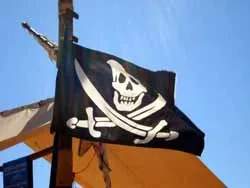
Interestingly, pirate symbolism has a mystical character. For example, the skull and crossbones on their flag is a symbol of rebirth after death. The "Jolly Roger" can be seen on many old cemeteries in the Caribbean islands, even on tombstones that are not pirate-related. Initially, the filibuster flag was bright red, in French - Joli Rouge. Hence the English transcription: Jolly Roger. In the 17th century, it was made black to be scarier. The song "Yo-ho-ho, and a bottle of rum!" reproduced by Stevenson in "Treasure Island" is most likely associated with African traditions. Fugitive slaves, who made up to a third of robber crews, worshiped their gods with the cry "Yo-ho-ho!". And rum, they say, was first invented by African Americans.