
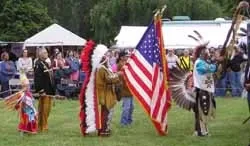
In 1992, seven American Indians appealed to the US Patent and Trademark Office, demanding a ban on the use of the word 'redskin' in the names of companies, sports teams, trademarks, etc., because only redskin Indians should have the exclusive right to use this term. In 1999, the Indians filed a lawsuit, claiming that the name of the baseball team 'Washington Redskins' offends their national feelings. In 2003, the court dismissed this lawsuit on the grounds that no evidence had been presented that the disputed term is exclusively associated with the indigenous people of the United States.
Today, there are about 150 Indian languages in the USA and Canada. Their exact number is unknown because linguists propose different classifications - for example, some consider the 'Southern Cree' language a dialect, while others consider it a separate language. For the most part, Indians have lost their native language (or rather, native languages). 72% of American Indians do not speak any language other than English. 18% speak both English and their tribal language equally well. Only 10% know English poorly or not at all, communicating constantly only in their tribal dialect. The Navajo and Pueblo Indians (living in the southern part of the USA, on the border with Mexico) have been most successful in preserving their native language.
According to the US Census Bureau, in 2000 there were approximately 1.8 million full-blooded Indians in the United States. This information, for the first time in US history, made it possible to indicate the 'mixed' origin of a country's resident. As a result, it turned out that another 2.9 million Americans consider themselves Indians to a greater or lesser extent (that is, one or more of their immediate ancestors were Indians). The largest Indian tribes today are Cherokee (about 302,500 'full-blooded' Native Americans), Navajo (276,700), Sioux (113,000), and Chippewa (almost 111,000). At the same time, the total US population in 2000 was approximately 290 million people.
The census also showed that Indians are a 'young' people (or rather, peoples). The average Indian is 29 years old, the average American is 35. 33% of Indians are under 18. For comparison, in 2000, 26% of Americans were in this age group. At the same time, Indians rarely live to old age. 5.6% of redskin residents of the USA have crossed the 65-year mark; nationally, this figure is 12.4%.
Single-parent families (where only a mother or father is present) are very numerous among Indians. On average in the US, 52.5% of households (a family or group of people living together and having a common budget) consist of complete families. Among Indians, only 45%. In some tribes, the number of single-parent families is even higher – for example, among the Athabascans (living in Alaska), only 32% of families are complete.
Despite the fact that Native Americans enjoy significant benefits when entering higher education institutions, and education is free for them, the level of education among Indians is extremely low. 72% of Indians have completed high school (nationally, this figure is 80%). 11% of Indians have a bachelor's degree (nationally, 24%). It is not surprising that the proportion of Indians holding managerial positions is significantly lower than other racial groups living in the United States. Indians most often work in construction, agriculture, and the service sector.
The average American earned $37.1 thousand in 2000, the average Indian - $28.9 thousand. Unemployment among Indians is record high for the United States - it reaches 15%, and in some reservations - 80% (the national average does not exceed 5%). 25.8% of Indians live below the poverty line, while 12% of the US population is considered 'poor'. According to current US standards, a family of four is considered poor if its total annual income does not exceed $16,895, and a single person if his income does not exceed $9,039 (data for 2000). In some tribes, the level of poverty is even higher: for example, among the Sioux Indians, 38.9% are low-income, among the Navajo - 37%.
56% of Indians own their own homes (the national average exceeds 66%). Approximately 20% of Indian homes lack running water and sewage. In 32% of cases, their homes are overcrowded - up to 25 people may live in three rooms.
According to long-term statistics from the US Department of Justice, American Indians are twice as likely as other US residents to become victims of violent crimes. Among them, there are many more people who abuse alcohol than in the country as a whole. A study conducted by the Centers for Disease Control and Prevention in 2004 showed that the most smoking in the USA is among representatives of the indigenous population - Indians, as well as Eskimos, Aleuts, etc. 40% of adult Indians are addicted to this bad habit. For comparison, 25% of black Americans and 26% of whites smoke.
The USA is a country of religious freedom. However, only with regard to Indians has a special law been passed that allows them to freely practice their religious cult (some Indians and religious scholars consider it correct to call this 'spiritual practice'). The fact is that most rituals require eagle feathers, but eagles in the USA are protected by law, and hunting them is prohibited. An exception has been made for Indians: only members of tribes can acquire eagle feathers. However, they are not allowed to sell or transfer them to non-Indians.
In 1998, when the corresponding federal law was adopted, Indian reservations received the right to create casinos. The reason for this was a 1997 ruling by the U.S. Supreme Court. The Court ruled that since Indians were pushed into infertile places lacking mineral resources and cannot engage in traditional trades that would allow them to earn a living, they have the right to engage in gambling business. This became a crucial victory for Indians, because in most U.S. states such establishments are prohibited by law. Indian casinos became islands of excitement, attracting a large number of visitors. Unlike other types of business in reservations, gambling is strictly regulated by the U.S. federal authorities.
According to the National Indian Gaming Association, in 2005 (the latest available data) gambling establishments operated in 227 of 563 reservations. In 2006, Indians earned $25.7 billion from gambling enthusiasts (in 2005 - $22.6 billion) - in terms of profitability, Indian casinos are surpassed only by the gambling houses of Las Vegas. The gambling business has created more than 670 thousand jobs. A 2005 study showed that reservation authorities (also tribal chiefs) allocate 20% of casino revenues to support educational programs, 19% to economic development, 17% each to funding law enforcement and healthcare.