
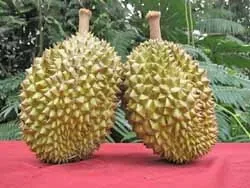
"To imagine how it smells, you need to mix equal parts of pig manure, turpentine, and onion, then season it all with sauce from unwashed last year's socks" – that is how one Western writer traveling through Southeast Asia "poetically" expressed his impression after getting acquainted with durian. Signs depicting a crossed-out durian stand at hotel entrances; the ban on taking the fruit on board an airplane is a standard rule for all airlines in Asia. In Singapore, known for the strictness of its laws, a person who brings a durian fruit onto a bus or subway risks a substantial fine.
"It tastes like heaven and smells like hell," say the residents of the city of Serian on the island of Borneo, who erected a monument to durian as the king of tropical fruits. In several countries around the world, there are clubs for fans of this, to put it mildly, foul-smelling fruit.
Durian owes its name to the Malay word duri – "spine". On slender trees up to forty-five meters tall, yellow-green, spiky "volleyballs" hang along the trunk. There can be several dozen fruits at once; as they ripen, they break off and fall down, posing a serious threat to both harvesters and random passersby. Belonging to the Bombacaceae family, the "king of fruits" grows both in rain tropical forests and on plantations in Kalimantan, Sumatra, the Malay Peninsula, Southeast Asia, and southern India. But connoisseurs and enthusiasts consider the ones grown in central Thailand to be the tastiest.
It was from Thailand that news came that could bring durian out of its "outlawed" state. As a result of 20 years of research, through endless crossbreeding of some 90 durian varieties and various genetic tests, Thai scientist Songpol Somsri developed a new variety whose smell is no worse than, say, that of a banana.
Now Thailand, the world's largest exporter of durian, will be able to supply up to 1 million fruits over the next five years – if there is demand. Sweet, with a cheese-cream consistency, durian is eaten fresh, used in confectionery, and made into drinks with the aroma of rotting onions. The strong and persistent smell is for locals merely an indicator of the product's high quality.
In Malaysia, so-called "durian parties" are becoming fashionable. Perhaps the secret of durian's popularity is that it is a strong aphrodisiac (it is sometimes called the Malay "Viagra"). A Malay proverb says: "When the durian falls from the tree, the sarong rises." For those who don't know – in Malaysia, a sarong is a long men's skirt.