
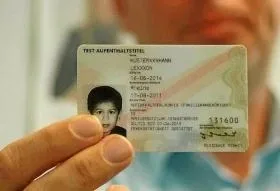
Foreigners will be required to obtain a plastic residence permit
It is designed in the form of a credit card and externally almost indistinguishable from the electronic identity card (der elektronische Personalausweis, ePA), introduced for German citizens on November 1, 2010. The chip built into the eAT stores information about the holder's date and place of birth, height and eye color, their residence status in Germany, whether or not they have a work permit, as well as a 'biometric' photo and fingerprints.
'The main advantage of the eAT is that it can almost one hundred percent guarantee the identity of a foreigner and their legal stay in the country,' says Interior Ministry spokesman Philipp Spauschus. 'Moreover, it is much more difficult to forge an electronic document than a paper sticker.'
Perhaps the new document will indeed help combat illegal entry into Germany by foreign criminals and those seeking social welfare. However, despite this, the eAT has already acquired many 'detractors'.
First of all, of course, among the temporary or permanent migrants themselves who now have to obtain it. The new rules require taking fingerprints of children aged six and older, but even infants will receive their own card – thus, Mr. Spauschus is convinced, 'the supervisory authorities can verify the actual existence of children and prevent cases of abuse of state benefits.'
So now, twice – to submit the application and to receive the final document – the entire family, including newborns and the very elderly (the latter are denied the right to issue a power of attorney to a relative for document processing), will have to appear at the foreigners' authority.
Moreover, the eAT will be quite expensive: contrary to the initially planned €28.80 (the price of the ePA for Germans), its average cost is €100. For those who have permanently moved to Germany, the expenses will not be limited to a hundred euros: the maximum validity of the eAT is 10 years; moreover, it will have to be obtained anew each time a national passport is replaced.
Human rights activists are directing serious criticism at the eAT. Despite BAMF's assurances that the biometric information on the chip will be accessible only to foreigners' authorities, the police, and customs (the latter with permission from the prosecutor's office), data protection experts warn of the risk of abuse.
'Contrary to the 2008 decision of the European Court of Justice prohibiting the storage of personal information, there are known cases of police using 'personal files' obtained electronically to investigate completely different cases unrelated to the initial request,' says Berlin commissioner Alexander Dix. 'And if demands for a central database of fingerprint registration of foreigners are repeated again and again, then eventually it will be created – one for all, both criminals and law-abiding citizens alike.'
Employees responsible for issuing documents complain: although testing of the eAT in individual localities in Germany has been carried out since November of last year, not all foreigners' authorities are sufficiently equipped with scanners for electronic processing of photos and fingerprinting. The result is long queues for clients, stress, and overtime work.
Moreover, the reliability of the document is highly questionable: computer enthusiasts from the Chaos Computer Club, who a few years ago 'read' information from the passport of then Interior Minister Wolfgang Schäuble, openly declare that copying the eAT with current computer technology is a piece of cake.
However, despite all the above arguments, the Federal Office for Migration and Refugees considers its project very successful. 'The new document will give its holder more opportunities,' says Philipp Spauschus. 'The electronic signature function, which (optionally) will also be stored in the chip's memory, will help make purchases online and conduct business correspondence with government agencies.'
The full transition to the eAT for immigrants from 'third' countries living in Germany is planned to be completed by 2021.
Yelena OBODOVSKAYA.
