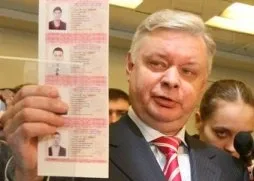
Head of the Federal Migration Service of Russia Konstantin Romodanovsky presents samples of migration cards
– Migration is constant movement, relocation. Is it possible to keep track of migration flows?
– The list of tasks that the migration service handles is extensive. It is contained in twenty regulations: 18 are already in operation and 2 are in the stage of coordination. The regulations define the services we provide to the population: registration of Russian citizens, passports, invitations, visas, temporary residence and work permits for foreign citizens on the territory of Russia, and so on.
And our second task – I think it is also the main one: managing migration flows. We began addressing many serious questions relatively recently, only over the last three years have we been creating a unified information system containing complete information about foreigners crossing the Russian border. For each foreign person we open a file, but so far less than 50% have photographs. However, the central data bank contains an 'anamnesis', the entire history of a foreign citizen's stay on Russian territory – including information on offenses, if any, and the place and time of border crossing. This knowledge helps to some extent in controlling the situation.
– How do you track migration pressure?
– We are forming a map to serve as a guide. We color regions where the number of foreign citizens exceeds 10% in a reddish-burgundy color. These are migration-stressed territories. In about two weeks we will have an electronic map where, in an online monitoring mode, one will be able to view the situation in the country.
– Information from different agencies on the number of migrants arriving in Russia and leaving it is contradictory. Whom to believe?
– If previously the service provided data based on the 'voice' of border guards or used information from the Ministry of Internal Affairs, now, thanks to the information system, we have our own information, and in my opinion, it can be considered the most accurate.
Over the past year, a total of 14.5 thousand representatives from various countries of the world crossed the Russian border (about 30% of them entered and exited multiple times), and since the beginning of 2009, 11 million 280 thousand people have entered the territory of the Russian Federation, while slightly more than 6 million have left.
Previously, vastly exaggerated figures were cited, with talk of 25-26 million annually, because repeat and subsequent border crossings were not taken into account. It got to the point of absurdity: one Estonian crossed the border 396 times in a year. Such 'travelers' create a flood of movements.
– Does the FMS have data on the number of illegal workers in the country?
– The exact number, of course, no one will give today. According to our agency's information, there are currently 5 million 200 thousand foreign citizens in Russia. We are confident that about 700 thousand of them came to work, 4.5 million are working, about 800 thousand have work permits, which means about 3 million 700 people may be working illegally, their status undefined. Many violators enter in accordance with current rules but work illegally. They build garden houses, work as watchmen, nannies, maids – that is, they do what is in demand by the middle class. It is difficult for people to hire large firms to build dachas – it is incredibly expensive. But hiring two or three citizens of Ukraine, Moldova, or Tajikistan is feasible. Such workers are necessary for Russia, and there is no point in expelling them. I think only opponents of economic development can believe that labor migrants are not needed by the country. The other thing is that they must legalize, but they do not always act legally.
– What legislative changes in migration policy are aimed at those who are within the legal framework?
– Ten laws, in one way or another concerning the status of migrants in our country, are within the walls of the State Duma. An example is the draft law on amendments to the law on the legal status of foreign citizens, which differentiates the flows of entry into Russia. The first direction is the option of 'blue cards' proposed to Europe. Let me remind you that the ministers of the twenty-seven EU member states proposed such 'cards' for highly qualified migrants. In essence, this is granting them official work permits guaranteeing high pay and equal rights with EU citizens. The second option is official employment with a law-abiding employer and under a full scheme, without tax evasion, with compliance with all obligations to employees. And finally, the third flow is the patent system. A foreign citizen purchases a patent and works for three months wherever he wishes, while the state treasury receives 1 thousand rubles for each month of the patent. We propose to launch this scheme, and I think it is reasonable – additional funds will flow into the state treasury.
– Is the proposed quota system for migrant jobs good for employers?
– To be honest, I am dissatisfied with the current mechanism. It is very cruel and inflexible. Imagine an employer who, a year and a half before being able to use foreign labor, must accurately calculate the need and submit a request through various authorities. Unthinkable, difficult, and perhaps ineffective.
At the government commission on migration policy, I proposed the following option: to calculate the permissible share of labor migrants, which would be determined by the Russian government and passed down to the regions. In turn, the regions will be able to set this norm lower, but not higher. Thus, they will have the opportunity to adjust the situation, that is, to provide workers to the sector where they are most needed, making the process flexible. For example, if a region needs builders, then the bulk of foreign labor will go according to this quota. If builders are not needed but agricultural workers are, that's fine. To manufacturing industry – please.
– Many labor migrants have a poor knowledge of Russian…
– About 14% of those arriving from CIS countries are people aged 19 to 25, a cohort that did not study in Soviet schools. This is a problem, a disaster. Speaking at the Russian Academy of Public Service, I proposed developing a pocket book – a guide for foreign citizens.
– Human rights advocates say that there are too few detention centers for foreign citizens in the country and they are located nowhere near where the largest number of foreign migrants are…
– That is true. A major problem in combating illegal migration remains the lack of detention centers for foreign citizens in the country (only 5 of them). Moreover, the worst thing is that we put them in special detention facilities (imagine what would happen if we started putting our Russian citizens – those who cross double solid lines in cars – in special detention facilities!). In this matter, the position of the regions is important. At my request, Minister Nurgaliyev addressed the regions, I wrote letters, and if the media supports us, that would also be helpful. Let a person be in isolation, but not in a bug-infested dump, but in normal conditions.
– What problems primarily hinder your agency's work?
– Undoubtedly, the service is corrupt, and to a significant extent. The migration service is a child of its time. A certain imprint is also left by the fact that mostly (over 50%) people come to us from the police. I acknowledge the need to fight corruption in the ranks of the FMS; in cases where these facts are proven, the guilty must be slapped on the wrist – but not with an axe, but with the law. In a number of cases, there have been 'sentencings' – the guilty were sent behind bars.
I think corruption can be countered only in one way: on the one hand, creating a system that prevents ignoring a person to whom we are obliged to provide a service, and on the other hand, capable of breaking the algorithm often followed by criminals: with one hand they take money, with the other they hand over a purchased document.
Interviewed by Evgenia DYLEVA.