
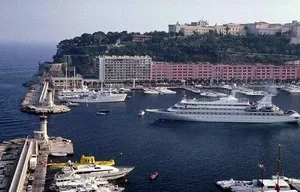
In Monaco even the sea smells of money //Photo Ukrinform
There are countries where you remember the Guinness Book of Records at every step. The Principality of Monaco, located on the Azure Coast of the Ligurian Sea, is one of them. Just think - the country occupies an area of about two square kilometers! In many of our cities, such areas are set aside for city parks. And in Monaco, four cities fused together with a population of almost 32 thousand people are located on this territory. Population density is 16,253 people per square kilometer - an absolute world record. Plus, about three million tourists visit the principality every year.
It is extremely difficult to determine where Monaco begins and where it ends. From the Italian side, the urban development stretches along the entire coast from Genoa itself, and from the French side it continues to Nice and Cannes. And only by the steep bend that the road makes descending to the sea can one determine that somewhere here, among the houses, runs the invisible border of the small state. Later it turned out that Monaco begins where mailboxes are white, not yellow, as in France.
At first, while in Monaco, you experience psychological discomfort: the urban development breaks habitual stereotypes. It is quite natural to move around the city in a horizontal plane, but here you have to do it vertically, since the cities are built on an almost vertical rock. The roads are multi-level spirals, and to get from one street to another, you have to use elevators that move in vertical tunnels cut into the rocks. There are many elevators here, many more than underground passages in our cities.
Discomfort also arises for another reason: you quickly notice that the country is literally stuffed with TV cameras, which are everywhere - in elevators, shops, restaurants, on streets and parking lots. A newcomer initially physically feels round-the-clock surveillance. This is the price for safety and for the fact that the country is crammed with money. After all, a person who has just played Texas hold'em and left the casino with a million dollars in his pocket should feel comfortable. But you don't see police anywhere.
Everything is unusual in Monaco: the streets are not only washed, but also, it seems, perfumed with expensive perfumes. There are no roofs in the usual sense - trees turn green on them, exotic flowers bloom, and turquoise water splashes in pools and artificial ponds. And everywhere there is the smell of big money. There are only about six thousand native subjects of the principality. They are called Monegasques and descend from the ancient Ligurians. In total, representatives of 121 nationalities live in Monaco. However, all of them, unlike the Monegasques, do not have any constitutional rights. Monegasques and all foreigners living in Monaco year-round do not pay taxes. In addition, only 3% of Monegasques live in their own houses, the rest are provided with housing by the state for a nominal fee.
Along the shore of the bay, packed with expensive yachts like a tin can with sprats, runs an ordinary city street. Along the road rises a long metal structure of unclear purpose. Where the street makes a sharp turn, artificial walls of car tires are built. At first, this causes bewilderment - these structures seem too alien in the body of an impressive city. And only after a while do you understand that the street is a route for Formula-1 races, tire walls are traps, and the odd structure is spectator stands. The first starting shot was fired here in 1929. You cannot envy the racers: it is incredible how at crazy speed you can fit into the sharp turns of a narrow city street that has such surprises as manhole covers and high curbs. When you drive along the track in a car, you realize that overtaking is practically impossible here. Monaco has many more fascinating things, but the most interesting is the fact that despite the complete absence of natural resources, the authorities were able to create truly heavenly conditions for the citizens of their country.