
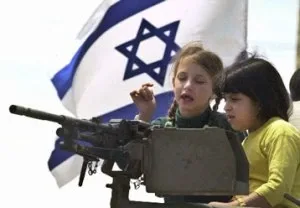
Children who are used to the sounds of war
But the war is far away, a twenty-minute drive. And in Jerusalem, everything is calm. And if you don't listen to the radio, don't watch TV, and don't read newspapers, there are no signs of war. In the stores, as always, there are plenty of goods and no customers. No one rushes to stock up on salt, soap, and matches. At the market, vendors still call out in their guttural voices. Everything that should be working is working.
"We are counting on Sharon," people say, "he has a lot of experience fighting terrorists." Now everyone understands – it cannot go on like this any longer. A big war is brewing.
Sharon is doing what needs to be done – calmly, confidently, and without unnecessary fuss. And not every report of our anti-terrorist operations appears in the media. We have such low-profile organizations as counter-terrorism units that pick off the right people from lists. You might say this is undemocratic, but the majority of Israelis are all for it. It's convenient to talk about human rights from a distance, not when your child is torn to pieces by a shell.
Yesterday, a civil defense instructor (a very pretty girl in uniform pants that hugged her bottom, clearly showing the line of her underwear) taught the residents of our courtyard how to use the shelter. The post office is persistently inviting people to pick up gas masks. Everyone understands that a big war is unavoidable, but there is no other way out. The cup of patience is overflowing.
And yet, despite the difficult situation, Russian-language cultural life in the capital is thriving. Every day, two large Russian library-clubs open their doors, hosting meetings with writers, artists, and various club activities. Soon there will be Book Week – a grand event where all the publishing houses and book-selling organizations of the country will be represented. Last year, this event was called Hebrew Book Week... But now Russian publishers and writers will be represented separately. The Israeli government and establishment have moved away from the melting pot concept, according to which all repatriates should forget their languages and cultures and switch to Hebrew. Today, state institutions also fund culture in Russian.
Almost all products have Russian labels. Even the postal service has added Russian to Hebrew, English, and Arabic. Thus, it can be said that Russian is becoming a state language.
Well, advertisers and traders can be understood – according to statistics, 20% of Israel's population is "Russian," but if you walk through any of our cities, you get the impression that "Russians" make up at least half. Maybe it's because Russians have fewer cars and use public transport more often. At any rate, in the evening in Rishon LeZion – the fourth most populous city – when I was late for my concert and asked where the hall was, I didn't meet a single Hebrew speaker. The explanation is simple – the native population is not accustomed to strolling the streets in the evenings. They sit at home, in front of their TVs, under air conditioners.
In any city, "Russian" events are held. By the way, your humble servant last year received 3,000 shekels from the President's Fund to publish a book in Russian. How I got money from Mossad is a separate story.
The system of community centers is extremely developed here – they exist in every city and town, and each has a budget for culture, including events for "Russians." This, incidentally, is how I make a living, traveling around the country with concerts. True, among my audience, people under 60 are not to be found...
Many will ask – how do we live here awaiting terrorist attacks. The answer is simple – we don't think about it. You may call it cynicism, but the probability of becoming a victim of a terrorist attack in Israel is much lower than that of being in a car accident. And if a person is plagued by obsessive thoughts that their loved ones might suffer from attacks, they should see a doctor. The psychological service in our country is well developed, and seeing a specialist is free. There is no shame in it, and no one tries to hide it. No "black mark" appears on one's employment record, and such visits are not recorded anywhere. Your humble servant, by the way, is a regular subscriber to the "emotional support service."
In Jerusalem, it's morning, plus 25, birds are singing, the sun is shining. Just now something went boom somewhere, the windows rattled. I should turn on the radio...
Maryan Belenky,
Jerusalem, Israel.
Specially for "Zagranitsa."