
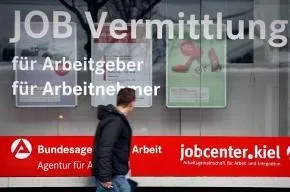
Import of workers for Germany is becoming more important than imports of gas and oil
According to experts, in 15-20 years the terrifying figure of Schröder-era unemployment could turn into its mirror image – five million vacant jobs with no one to fill them. Besides material losses, such a shortage will bring monstrously dangerous public sentiments: the eternally hungry HR departments of Brezhnev's times essentially bred the 'worker' into a 'labor man' who ultimately destroyed the Soviet economy.
Let us be frank now: Germany has no internal resources to resolve this global problem. Moreover, about 700,000 residents of Germany leave the country each year for a long time or permanently. Approximately the same number, by the way, moves to Germany from other countries. The result is a zero balance.
And experts unequivocally demand: at least 500,000 growth in the working-age population per year, otherwise the 'new economic miracle' will turn into its opposite. I am confident that in 5-10 years, the import of skilled personnel will become a much more important matter in Europe than the import of energy resources. It is for the human resource that a struggle will begin among the most developed countries. After all, a person trainable in a profession cannot be extracted from any depths or shelves. It takes at least 20 years to raise one, and that time cannot be compensated with money.
Moreover, in the next five years, the language barrier will be destroyed with the help of computer technology (a voice translator will become as mandatory a part of a mobile phone as a camera is today) – and the serfdom of language will collapse. A person will become a universal, everywhere convertible precious resource for development. With one small caveat, however: if that person is loyal to the culture of the country that intends to, so to speak, import him.
However, until quite recently, no one dared to speak openly about the loyalty of foreigners. Only Thilo Sarrazin, like Herzen to the Decembrists, woke Germany from its multicultural dream.
The country is now coming to its senses, muttering various absurdities half-asleep, and is surprised that it had been dreaming for 20 years: that any foreigner is good. If nothing is done, there is a chance the dream will simply change color, and now it will turn out that any foreigner is bad.
Both are, of course, an offensive untruth. The truth is that in Germany, artistically speaking, two poles of new citizens have formed: 4 million people from the former USSR (the vast majority of whom are ethnic Germans) and 4 million people from Islamic countries (the absolute majority of whom, let us emphasize, are not freeloaders, not potential terrorists, not criminals, but honest, hardworking, law-abiding people).
But in any case, if these two poles are brought together into one statistic, calculating the average temperature in the hospital, you get that same sweet poison of 'multi-culti' that fed public consciousness for almost 20 years. And to separate... Before Sarrazin, for some reason, no one dared.
Well, let's leave Sarrazin to the Saracens. Now Germany has a unique chance to sharply expand its, so to speak, European pole of new residents.
The German economy is growing like bamboo. The economies of the main competitors in the struggle for human resources (USA, Canada, UK) have not yet fully recovered from the crisis. So the Germans have a small time advantage. At the same time, in Central Asia (former Soviet republics), in Belarus, in the deep provinces of Ukraine and Russia, millions of able-bodied Europeans remain without decent employment. Add to that over a million Russian Germans and their family members in the same regions, halted by insurmountable language tests. And here we have before us – those very super-scarce workers, without which Germany cannot maintain its role as the locomotive of Europe.
To open the door for them, no incredible efforts are required. Only one political will is needed. And the understanding that the door will have to be opened anyway. If not to Europe, then to Asia and Africa.
As the old Moscow advertisement said, with all the wealth of choice, there is no other alternative.
Arseniy KAMATOZOV.
