
But it was not always so. Moreover, few people remember that at the dawn of the Olympic era, the Winter Games did not exist at all. It took nearly a hundred years for the snowy Olympics to become the main sporting event of winter.
Winter Week
When the International Olympic Committee was founded in 1894, no one even thought about holding Winter Olympic Games. Although even then it was proposed to include figure skating in the program of the Summer Games. And they did include it! In 1908, at the London Summer Olympics, figure skaters competed in the execution of compulsory figures. Three years later, the Italian Count Eugenio Brunetta d'Usse proposed to the IOC to finally hold a week of winter sports within the framework of the 1912 Stockholm Olympics, but the organizers did not support the idea: it was believed that the Nordic Games, which had existed since 1901 and gathered stars of winter sports, were quite self-sufficient. Was it worth competing with them? Another argument against was that winter sports competitions have no ancient origins and the word “Olympic” itself is inapplicable to them. In the end, Pierre de Coubertin solved this problem in favor of the Winter Games, and in 1924 in Chamonix, the first International Winter Sports Week was held under the auspices of the IOC - in fact, it was the first Winter Olympics.
The program of this debut week included ski jumping, figure skating, biathlon (which then appeared as a military patrol competition), speed skating, cross-country skiing, bobsleigh and ice hockey. In total, 294 athletes took part, which was recognized as a great success. Since then, these sports have remained key in the Olympic program. Naturally, they developed, new distances and movement techniques appeared (like the skating style in cross-country skiing). Women were included among the participants (they came to biathlon only in 1992, and to speed skating in 1960). In the 70s, equipment evolved rapidly, although the idea remained unchanged - we can distinguish a figure skater from a skier even when looking at photographs from the mid-20s of the last century.
After the successful debut in Chamonix, the II Games of 1928 in St. Moritz, Switzerland, were already called the Winter Olympics. Skeleton, a type of sledding sport popular in Switzerland, appeared in the program. However, at that time it did not receive permanent Olympic status (the competition was held again in 1948) and returned to the program only in 2002. It is no secret that the requirements for Olympic sports were quite simple: popularity, accessibility for a wide range of fans (watched the competition - get on the ski track yourself!), sufficient simplicity in organizing courses.
Nevertheless, there were several turning points in the history of Olympic sports. In 1936, at the Olympics in Garmisch-Partenkirchen, which was opened by Adolf Hitler, the alpine combined event - downhill and slalom - was included in the program for the first time, for both men and women. Subsequently, alpine disciplines only increased, and now ten sets of medals are awarded in this program. In 1956, figure skating moved indoors, which made this sport much more attractive to spectators - just look at the open costumes of the female figure skaters compared to the rough woolen dresses in which they courageously skated outdoors. By the way, hockey players began to compete in indoor arenas as early as 1932, at the Lake Placid Olympics. In 1960, a revolution occurred in alpine skiing equipment: the Frenchman Jean Vuarnet was the first to put on skis with metal edges instead of wooden ones and won the downhill. At the same time, in Squaw Valley, men's biathlon appeared in the program, which has now become a hit in World Cup broadcasts. True, at first men ran and shot only over a distance of 20 kilometers. Eight years later, a team race appeared - a 4x7.5 km relay. And only since 1992 have women biathletes been admitted to the Olympics: they are allowed to compete at 7.5 and 15 kilometers. The women were glad - they had long waited for an invitation to the Olympic track.
Color Pictures
The appearance of new sports in the program attracts new viewers and expands the television audience. Thus, starting from 1964, the cost of television rights for broadcasting the Winter Olympics increased more than tenfold! From $50,000 in Squaw Valley to $597,000 in Innsbruck. At the next Olympics in Grenoble in 1968, television switched to a color picture, which raises the cost of showing the Games already to $2.5 million (in Turin, this figure reached $613 million). The IOC is happily rubbing its hands: “We are on the right track.”
From this moment, perhaps, begins the commercial prosperity of the Winter Olympics. Being present at the Games as a sponsor becomes more than profitable for representatives of well-known brands - because the TV audience is constantly expanding. And sports equipment manufacturers pray to the Olympics: if earlier the classic skier's uniform was white (on a black-and-white screen it looked more elegant), now the ski track has “blossomed.” Moreover, Olympic jumpsuits are then bought up by amateur skiers like hot cakes...
In 1992, short track appeared in the program in Albertville - a sport incredibly popular in China and South Korea (indeed, many modern champions come from there). The IOC kills several birds with one stone by opening the way for speed skating on a regular hockey rink: interest in the Winter Olympics sharply increases in Japan, Korea and China, which are not distinguished by great successes in traditional sports of Scandinavian origin like cross-country skiing or biathlon. And following the audience recognition come solid investments from new sponsors in this region. By the way, since 1994, the Winter Olympics have been held two years after the Summer Games, and not in the same year, as was the case before. The IOC made this decision to separate two such significant sporting forums in time - is that not a recognition of the success of the Winter Games!
In addition to short track, an extraordinarily spectacular form of winter extreme sport appears in the program - mogul, popular in America and Canada and gathering a crowd of extreme athletes from all over the world, who roam with their snowboards to numerous competitions in Europe as well. Athletes compete on a course 225 meters long and 23.5 meters wide with a slope of 26 degrees. The task is to pass between two rows of gates located ten meters apart, down a slope dotted with artificial snow moguls. After the first and second third of the distance, the mogul skier takes off on two particularly large moguls, which become a springboard for performing aerial exercises. It is not hard to guess that athletes soaring several meters captivate the audience with their art - sometimes even more spectators gather here than for alpine skiing.
“All this, of course, was taken into account by the IOC when including this sport in the Games program,” comments Igor Kazikov, head of the Turin-2006 working group. “Now in principle there is a noticeable trend - to include what is popular among young people and looks spectacular on television. These are new speeds, unexpected twists in the sports plot, new heroes quickly turning into idols... It is not surprising that the next was snowboarding, which meets all the necessary criteria of a modern sports show.”
Time of New Heroes
Snowboarding appeared at the Nagano Games, and the very first gold medal of Canadian athlete Ross Rebagliati caused a big scandal - doping control at the Nagano Games found traces of marijuana in his samples. The medal was taken away from Ross, but what a wave of indignation arose! The IOC immediately received not only a complaint from the Canadian team, but also numerous letters from fans. The officials were popularly explained that since you included snowboarding in your program, then please play by our rules: in the snowboarder crowd, they say, it is not forbidden to indulge in grass. So please, return the medal. The most surprising thing is that these arguments had a great effect on the IOC and Rebagliati's 'gold' was returned. The incident was soon forgotten, but many still ask themselves whether it is worth 'domesticating' snow extremists, turning them into Olympians and forcing them to adhere to the strict rules of the Olympic Village for two weeks? By the way, this year, in addition to competitions in the half-pipe (translated from English - 'chute') and parallel giant slalom, snowboarders for the first time competed for another set of awards in boardercross. Men's and women's competitions take place in Bardonecchia on the same course 900 meters long with an elevation difference of 230 meters. The course is positioned so that spectators can watch the vicissitudes of the struggle from start to finish. And the participants face difficult trials - on the course they encounter an obstacle course of moguls, jumps and ditches.
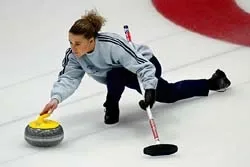
Of course, curling, included in the program in 1998, is not as spectacular as snowboarding competitions, but it is a team competition, and also with a centuries-old history. It is said that curling originated somewhere in the 16th century in Scotland, and two centuries later it was brought to North America and Canada by British army soldiers. The English word curl means 'curl', 'spiral'. This is approximately how a nearly 20-kilogram granite stone with a handle slides on the ice - the moving projectile in curling. The game is long and leisurely, but it fascinates...
In general, speaking about the program of future Winter Olympics, experts express themselves very cautiously: it is a long process to include a new sport, but you want to have high results right now. “You know that it takes years to coordinate with the IOC, it is a very long process,” explains Igor Kazikov. “Until the issue is considered at the IOC session, until it gathers enough votes... Let's better develop what we have. But if, of course, we are optimists, we would like to include bandy (ice hockey with a ball) in the program, in which we are very strong. Then the team's piggy bank would have more gold medals.”
And for now the IOC's policy is this: preserve the 'classics' like the 50-kilometer distances for men in skiing or the 10,000 meters for speed skaters, introducing small changes such as an additional set of awards for the same speed skaters (at this Olympics they had a team pursuit) or snowboarders. The 'classics' help to cultivate true sports heroes who can endure on the ski track or running track, while gradually introduced novelties keep the Games' audience from aging, attracting young people. And this policy, it must be said, justifies itself.