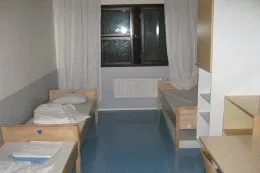
Finnish isolation center for refugees bears little resemblance to a prison
Today, of the 5.3 million population of the "land of a thousand lakes," more than 200,000 migrants have received Finnish citizenship. This figure seems impressive, but compared to other European countries (where the share of migrants sometimes exceeds 10% of the country's citizens), Finland's 4% seems insignificant. However, the number of those arriving and seeking asylum is constantly growing. The increase in the number of refugees has been especially noticeable in the last two years. For example, if in 2006, 2,324 people applied to migration services, then in 2008 it was already 4,036 people, and this year, according to forecasts, the total number of applicants will reach 6,000.
Why are more and more migrants coming to Finland? The answer is simple. According to Leena Kaisa Oberg, head of the refugee and resettlement department of the Finnish Red Cross, Finland currently offers the best conditions in Europe. All migrants without exception are provided with accommodation, free medical care, and a daily allowance of €22 per working day. This explains why in St. Petersburg and the Leningrad region over the 9 months of this year, only about three dozen people applied for refugee status, while almost 6,000 applied to the neighbors. The one-time allowance of 100 rubles from domestic migration services attracts only the most desperate migrants.
However, as personal observation showed, no one guarantees an easy life for refugees in Finland. Not everyone receives refugee status. According to statistics, only one-third of those who apply for asylum remain in the country and get a chance to become full citizens of Finland after completing an integration program. The rest are deported home.
The process of reviewing a refugee application takes a long time in Finnish institutions – from several months to three years. During this time, the "subjects" are assigned to 26 migration centers located in various parts of the country. They can live in the centers' dormitories or rent housing with state assistance. However, the most unruly and unpredictable immigrants are still deprived of liberty and placed in a special isolation facility, where they receive decent meals and the right to medical care on par with Finnish citizens. The main principle of this policy was stated by Leena Kaisa Oberg: "If refugees receive services to the same extent as Finns, they will have more opportunities and desire to integrate into Finnish society."
Not far from the center of Helsinki stands an unremarkable building, no different from other modest and practical "masterpieces" of northern Finnish architecture. Here are located the Refugee Reception Center and the Metsala Detention Center. This is not Butyrka or Kresty, but a purely civilian facility, distinguished only by the fact that on the second floor the double-glazed windows are neatly barred, and barbed wire adorns the metal mesh of the fence.
Guests from Russia are greeted by a smiling philosopher (by education and demeanor) in a simple sweater and jeans – the director of the migration center, Pekka Nuttinen. He looks nothing like a guard. Carefully avoiding the word "prison," he talks about how work with migrants is conducted.
The migration center and Metsala detention facility were built in 2005 after the European Union advised Finland to expand the number of reception points for foreigners. Until 2000, all refugees suspected of being prone to disorder and escape were sent to an ordinary prison, but the authorities decided this was inhumane. "If you apply to a European country seeking a better life for yourself and your loved ones, that does not mean you are committing a crime," explains Nuttinen. Based on this, the center's staff treat the residents not as prisoners but as people in trouble who need their basic needs met.
The structure of Metsala is as follows. On the first floor there is a regular dormitory for "reliable" migrants, and on the second floor a detention facility holding 40 people. The police decide who to place in the isolation unit. Formally, one ends up in the isolation unit as follows: a person arrives in the country and asks for asylum, but if his story about a sad fate at home or his behavior immediately raises suspicions, the police isolate him from society. The court decides on detention in the isolation unit every three months. If compelling circumstances arise indicating the "inmate's" reliability, he is released.
The isolation unit is equipped with state-of-the-art technology. The living area is separated from the administrative area by transparent glass. Administration staff monitor order using a dozen cameras. However, there is only one guard among them – the rest are social workers by profession. The detainees watch TV, go to the sauna, do fitness, play table tennis, and play dominoes.
They are fed four times a day in a spacious and bright dining room. Nuttinen engagingly told about how a certain general from the Russian migration service recently visited Metsala. Hearing about the four-meal schedule, he was very surprised and remarked, "You could feed them once every two days, and nothing would happen to them."
Refugees live in rooms with several people, and women have their own area where they can be alone away from men. The isolation unit has a laundry room and a children's room.
The budget for the entire center for 2009 is 5,373,000 euros; services provided to ordinary migrants cost the state €40 per day, while more is spent on detainees – €180 per day.
A total of 400 people pass through the migration center per day. Visitors are divided into three groups – those in the isolation unit, those living in the dormitory, and those living in apartments of relatives and acquaintances and only come to check in and use social workers' services. Over the year, the center hosts representatives of 80 nationalities – Iraqis, Nigerians, Somalis, Russians, Belarusians, Serbs, Turks.
There were also escapes in the center. Nuttinen admitted that in the first year 31 people ran away, and only then did the Finns put bars on the windows. After this innovation, only one lucky person managed to get out. The director of the detention center also told about an unsuccessful escape of a Russian: "Once we had a certain Sergei, it seemed to me that he was a Russian mafioso. He told me: if I want to escape, I will definitely escape. One day noise came from the residential sector, we ran and saw that Sergei tried to cut the suspended ceiling with a knife, but fell and hurt himself badly." Sergei's fate was unenviable — he was refused asylum and sent back. After all, Russia is on the list of prosperous countries here, where there are no hostilities and no real danger to life.
Generally, most of those who are in the detention center and migration center behave as quiet as mice, and there is a good reason for that. Violation of the law will affect the consideration of the refugee status case and increase the chances of deportation. People have something to fight for — confirmed refugee status in Finland, although it does not mean automatic granting of citizenship, opens up a huge number of opportunities. Each migrant is sent to one of the Finnish regions, and the state pays the municipality for the settlement of the newcomer. The refugee receives housing, a work permit, takes language courses and cultural integration training into Finnish society. He can also get free Finnish education and after three years participate in municipal elections.
However, not all Finns like the state's careful care of migrants. The tax level in Suomi is very high, and many citizens protest when they see their contributions going to the maintenance and service of refugees. One resident of Suomi gave an example of a typical story, in her opinion. "We often see in a grocery store how migrants and native Finns stand in line — the former pull out wallets with a hefty wad of euros, and the latter, approaching the cash register, count pennies," she said.
It is said that Finnish authorities will soon cut the cash benefit for refugees, but will organize free meals for them. This step is caused by an increase in the number of foreigners arriving in the country. "Ideally, the conditions of stay for refugees in all EU countries should be the same. This will reduce the flow of those who travel around the EU in hopes of finding a better place," said Leena Kaisa Oberg.
There are politicians in Finland who play on the feelings of the offended electorate and demand to stop the flow of migrants. However, they are hardly voted for. Finns understand that if immigrants from other countries do not do menial work, the streets of Helsinki will not be as clean as they are now.
Our northern neighbors are also worried about another fact. The demographic decline will lead to the fact that without additional labor, the Finnish economy will face collapse in 5-10 years. In these conditions, most residents prefer to endure the costly state policy, patiently "raising" future taxpayers.
Philip Mostotsky.