
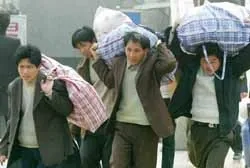
But even now, several million compatriots live in Russia who returned to their homeland in the 1990s and still find themselves in the position of uninvited guests. These people have no housing or permanent registration, which means they are denied access to education, healthcare, and do not receive pensions or benefits. Their example is unlikely to entice others to return to the Motherland.
As reported by Konstantin Zatulin, a member of the State Duma Committee on CIS Affairs and Relations with Compatriots, the program was developed in the government and the Federal Migration Service, and the presidential administration was also involved in its work. According to the new program, migrants will have their travel expenses to their place of residence fully paid, receive a one-time allowance for resettlement, and receive monthly cash benefits for six months until they acquire citizenship. A social package is also provided, including access to education and medical services, and subsidized housing.
But there are also restrictions. Migrants are offered to choose regions from three categories. “A” – strategically important border territories “characterized by population decline.” “B” – territories where large investment projects are being implemented that require mass attraction of migrants due to the lack of appropriate labor supply in the regional labor market. “C” – territories with sustainable socio-economic development, where a decline in total population and migration outflow are observed. Only in category “A” can a migrant count on full state support. However, those who decide to go to a category “B” territory will not receive unemployment benefits. “C” means that there will be no “relocation allowance” either. It is also worth noting that it is forbidden to leave the chosen region for two years. That is, you can, of course, but then you will have to return the “relocation allowance.”
In theory, the program will allow almost all natives of the USSR and Russia living abroad to come to Russia. According to the Department of the Russian Ministry of Foreign Affairs for Work with Compatriots, about 22 million compatriots currently live in the former Soviet republics. However, sociologists from VTsIOM have found that it is still unclear who exactly should be considered a compatriot. The majority of respondents (40%) consider only Russians living abroad as such. 33% include all citizens of the former USSR. And only 22% of respondents are ready to recognize all Russian-speakers connected with Russian culture (i.e., representatives of other nationalities) as compatriots.
The program itself does not have any strict restrictions regarding who is considered a compatriot. But at the same time, it notes that “people raised in the traditions of Russian culture, who speak Russian and do not wish to lose ties with Russia, are most capable of adaptation and quick inclusion in the system of positive social ties of the host community.” The Foreign Ministry suggests focusing on the law “On the State Policy of the Russian Federation towards Compatriots Abroad.” According to the document, not only Russian citizens permanently residing abroad are considered as such, but also former citizens of the USSR and those who have acquired citizenship of countries that were part of the Soviet Union, emigrants from the USSR, the RSFSR and Russia who have become citizens of other foreign states. Their descendants are also recognized as compatriots, except for descendants of “persons of titular nations of foreign states.” “And Vladimir Vladimirovich himself, and everyone put together, of course, cannot give an exact definition of a compatriot,” they said at the Department of the Ministry of Foreign Affairs for Work with Compatriots Abroad. “But what is written in the law is quite clear. This category can include three types of compatriots. It depends on self-determination and the situation.”
At the same time, experts say that the state program will not lead to an influx of people. According to Konstantin Zatulin, since the collapse of the USSR, 5-6 million people have returned to Russia. “I would not overestimate the potential of this program,” he said. “Today it is not as attractive for compatriots as it seems to those who compiled it. The fears of the first period, when people dropped everything and fled to Russia, are long gone.” Yuri Fedyaev, president of the interregional public association “Humanitarian Center for Assistance to Refugees and Internally Displaced Persons,” says the same. According to him, the main influx of Russians occurred in the 1990s, when there were ethnic unrest in these countries. Mostly people come from Tajikistan, Kyrgyzstan, Uzbekistan, and Kazakhstan.
Zhanna Zayonchkovskaya, a member of the Expert Council under the Government Commission on Affairs of Compatriots Abroad and head of the Laboratory for Analysis and Forecasting of Migration at the Institute of Economic Forecasting of the Russian Academy of Sciences, also believes that one should not pin high hopes on the program, although “better late than never.” “Now the inflow is very small, for example, in 2005 the State Statistics Committee estimated migration growth at 130,000 people, which is very little,” she says. “In my opinion, some revival is possible, but everything will depend on how much the regions get involved.”
It is unlikely that our compatriots will be tempted by the example of those who have already returned to Russia without waiting for special programs. Here the situation looks traditional, that is, deplorable. Yuri Fedyaev, president of the Humanitarian Center for Refugee Assistance, who came from Tajikistan himself, claims that there are currently 15 million compatriots living in Russia who arrived from abroad and do not know what to do with themselves. Approximately 10 million of them do not have permanent registration. “That is, they are either not accounted for or accounted for as people without a fixed place of residence.” He does not understand why officials are engaged in this program when citizens who arrived long ago have been left to their fate. “Our president has been simply set up,” he believes. “Time has been lost. We have been here since the 90s. Now we need to address the issue of those people who are in a disenfranchised position here. Russian citizens have registration at their place of stay, that is, temporary guest registration. With it, it is impossible to find a job, get a pension, or child benefits.” People have semi-citizen status. “We have citizenship, but you can only get permanent registration if you have permanent housing,” he explains. “We do not have that. It turns out to be a vicious circle.”
For the most part, the stories of migrants are very similar. Here, for example, the Efremov family from Tajikistan. They arrived, lived in a dormitory, and were allowed to register the room as property. “But they cannot apply for improved housing conditions, even though they are forced migrants,” says Yuri Fedyaev. “Officials dodge them under various pretexts. They are ready to pay, but nothing works out. Or the Snezhin family, also from Tajikistan. The head of the family died of lung cancer at age 55. A twelve-year-old child was left, no benefits, nothing was processed because he had temporary registration. The school also asked him to leave, saying: ‘Get permanent registration or we will expel you.’ Somehow the conflict was resolved; they found a place where they managed to register the boy.”
Yuri Fedyaev claims that the situation “where the problem is not resolved at all” exists in practically all regions of Russia. The reason, in his opinion, is that there is still no clear law on forced migrants or a migration concept, although the migration service has been working since 1992.
In turn, demographer Zhanna Zayonchkovskaya argues that the migration service does not collect information about how many unsettled migrants there are now, and no one can give an exact figure. “Currently, a small number of forced migrants and refugees are registered,” she says. “According to the law, five years after their arrival they should have been deregistered, but since the state did not fulfill its obligations to many, people simply did not come to re-register. And they were automatically deregistered.” According to Zayonchkovskaya, out of all those who were registered, only 10-12% were provided with any housing at all, including dormitories and non-repayable loans. The rest arranged it themselves.
Deputy Zatulin believes that with respect to those already in Russia, the broadest amnesty or legalization should be carried out. “At the initial stage, they became the main victims,” he noted. “One of the shortcomings of this program is its insularity, insufficient public involvement in discussing this problem. A council dealing with migration issues has been established in the government, but it remains formal. We still cannot come to the realization that work with compatriots abroad and work with migration flows within the country should be united.”
Maryam MAGOMEDOVA, Evgenia ZUBCHENKO.
Novye Izvestia