

American immigration policy has failed to stop illegal immigration flows. Those who try to enter the United States do so at great risk, often paying for the services of those involved in human smuggling. This leads to human rights violations and abuse of illegal immigrants. Once in the United States, these immigrants sometimes face a negative populist reaction from U.S. citizens. In some areas, immigration contributes to lower wages and reduced job numbers. Although economists agree that immigration benefits the American economy, some segments of the U.S. population may suffer serious losses. Hostile attitudes toward immigration are intensifying due to a growing sense of economic and social insecurity in many U.S. communities and rising crime in border states.
Debates on immigration to America create political blocs that do not arise with other issues. The current level of immigration is supported by businesses that profit from cheap foreign labor, ethnic lobbies seeking to strengthen their political base, and humanitarians concerned with human rights. Among those advocating reform and restriction of immigration flows are nativists who see immigrants as a threat to American culture, environmentalists worried about dangerous population growth, and those who fear that immigrants take jobs from American citizens. Immigration leads to conflict between free market advocates and cultural conservatives, and also pits human rights activists against environmentalists.
President Bush's attempt to reform immigration policy failed. How do the presidential candidates propose to solve this problem?
Hillary Clinton supports giving illegal immigrants the opportunity to apply for legal resident status. Clinton also voted for a bill to build a wall on the U.S.-Mexico border. As a senator from New York, she voted for enhanced border security but against a separate amendment to make English the official language of America.
John McCain considers a secure U.S.-Mexico border "an essential element of our national security." In his view, immigrants should learn English, American history, and civic values. McCain, along with other senators, introduced a bill requiring mandatory electronic verification for employment so that employers can check a person's legal status. McCain advocates a moderate approach to immigration, including strengthening border security, a path to citizenship for illegal immigrants, and a guest worker program. His views caused conflict between him and his fellow Republicans.
Barack Obama is the son of an immigrant from Kenya. He has voted on many immigration bills. He voted against making English the official language and supports allowing illegal immigrants who have not committed crimes to remain in the United States if they agree to pay a fine and learn English. In a recent Senate immigration reform bill, Obama proposed three amendments related to giving American citizens priority in job selection, requiring businesses to prove their workers' right to work, and improving background checks of immigrants.
Fence did not save the US from migrants 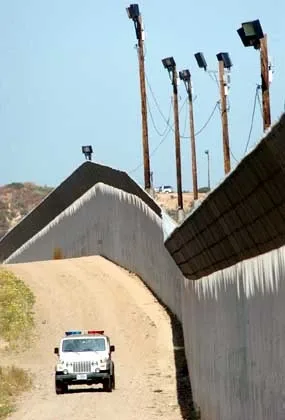
The U.S. government abandoned the use of the "virtual fence" prototype on the border with Mexico. It turned out that the Boeing development, costing $20 million, was unable in field conditions to properly alert border guards of illegal crossings of the U.S.-Mexico border.
According to Lenta.ru, the rejection of the Boeing system came exactly two months after U.S. Homeland Security Secretary Michael Chertoff announced approval of the project. The plan was that the "virtual fence" would protect a 28-mile (45 km) stretch of the U.S.-Mexico border from migrants.
The high-tech development is a system of nine 30-meter observation towers equipped with state-of-the-art equipment. In particular, Boeing specialists equipped the towers with motion sensors, radars, and highly sensitive cameras capable of recognizing objects at a distance of up to 16 km. It was also reported that a special data analysis system would allow the "virtual fence" to detect weapons and drugs on migrants.
In practice, it turned out that the Boeing development does not notify border service personnel of border violations in a timely enough manner. It is expected that Boeing will replace the system with a newer one equipped with improved cameras, radars, and transmitters.
Recall that the United States began fencing itself off from Mexico with special structures in 2006. The states bordering Mexico use various methods to protect against migrants: building regular walls, "virtual fences," or digging ditches.