
Little Emperors
The fee for a newborn's personal 'brand' ranges on average from 68 to 198 yuan. One dollar is worth a little more than eight yuan, and considering local incomes, the fee for a name looks quite substantial. Prices vary depending on the number of characters used, their rarity, and the auspiciousness of their meaning for future fate. In any case, the total will end with the digit 8. This number, according to Chinese numerology, is considered the luckiest. All other nuances of creating a 'correct' name depend on many factors, from the place and time of birth to the political situation in the country.
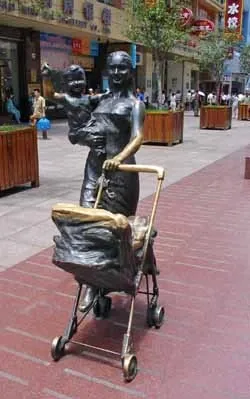
In modern China, parents choosing a name primarily try to boost their child's future self-esteem. Here originality plays the main role. Ideally, the name should be unique. Moreover, the 'one family, one child' policy has further strengthened the traditional attitude toward the child as a 'little emperor' (this term naturally refers to boys), who should bear a particularly euphonious and 'lucky' name. The state inadvertently encourages this reverent attitude of parents through the complexity of the procedure for bringing heirs into the world. This refers to the bureaucratic red tape regarding government permission for conception. To have a baby, Chinese parents must apply to the local party committee, where they will be registered and issued a certificate indicating the period - usually no more than a year - during which they can conceive a child. If they don't make it, the procedure is repeated from scratch. And since the child will be the only one anyway, they approach the choice of name seriously.
Unlike European languages, the surname comes first in Chinese. For example, the architect of Chinese reforms Deng Xiaoping had the surname Deng. And Xiaoping, meaning 'little bottle,' is his given name. By the way, after the events on Tiananmen Square, piles of broken bottle glass could be seen on Beijing streets. Foreigners did not understand such an expression of protest. But to the Chinese, everything was clear without further words. Or take the surname characters of current PRC Chairman Hu Jintao. Hu ('lake') is his surname, and Jintao ('beautiful wave') is his given name.
The tradition of placing the surname first is described in the classic 'Book of Changes' ('I Ching'). The most important thing for a resident of the Middle Kingdom is the preservation of the clan, because the clan is your place in the universe, the opportunity to live forever. That is why women in China do not take their husband's surname, since preserving the family surname means preserving their sign of fate. Europeans, on the contrary, first highlight their personal 'I' through their given name and only then indicate belonging to a clan. Thus, Chinese are convinced, the individual in the West is more important than the entire clan. From an Eastern point of view, such an approach is fundamentally wrong.
Characters of Fate
In Confucius's conversations with his disciples (the treatise 'Lun Yu'), there is a story about how one of the disciples asked the teacher a question: 'The ruler of the state of Wei is waiting for you to take up the affairs of government in his state. What will you do first?' To this Confucius replied: 'I will certainly rectify names.' This refers to the Confucian concept of 'zheng ming' - bringing things into conformity with their names. The Taoists hold the same view. 'The name that can be spoken is not the eternal name,' said Lao Tzu. Any fortune teller in China will tell you that your current name determines if not everything, then very much in your future life. They say that there are only two points that cannot be changed - the dates of birth and death. Everything in between can be corrected. So misfortunes are linked to an unsuitable name - they say, change it and then everything will go smoothly.
In ancient China, at birth a child was given a childhood name that remained with him until school. Moreover, it was believed that one should not always give only euphonious names. Children were often given 'bad' names to deceive evil spirits. When it was time for children to go to school, the father or more often the teacher would give the child an official name for registration in documents. But later, the young man or woman could receive a second name (zi) from parents and mentors, which reflected the character traits of the already formed person. This 'second self' was often the main name. An educated person often had a literary pseudonym as well, and a professional writer had two.
But in any case, name makers would first, using a complex system of divination based on the 'Book of Changes,' draw a diagram of a person's fate, and only then determine his name, which served as a talisman. If, according to the prediction, a person was to beware, for example, of fire, then the name would necessarily contain characters with the concept of 'water.' And vice versa - someone destined to drown would be given a name whose character meant 'fire,' 'blaze,' or 'matches.' Chinese names can indicate where a person is from. For example, if the name contains the character 'chuan,' denoting the abbreviated name of Sichuan Province, it means that either the bearer of the name or his parents are from those places. Newborns were often given names reflecting the wishes and aspirations of their parents. For instance, the birth of an heir was considered a much greater joy than the birth of a girl. Therefore, if there was no boy in the family, newborn daughters were given names like Laidi ('calling for a younger brother') or Pandi ('expecting a younger brother'). True, under the 'one family, one child' policy, the need for such names has disappeared.
And yet, according to entrenched customs, the names of flowers (peony, orchid, lotus) are still used in female names. Male names are often composed of characters for 'tiger,' 'dragon,' or natural phenomena ('mountain rockfall,' 'avalanche') symbolizing masculinity. True, in intellectual circles, calling oneself 'tiger,' let alone 'dragon,' is considered too deliberate. There, it is customary to choose names from classical literature.
Comrade Central Committee
Until the fall of the last imperial dynasty in 1911, the Chinese system of surnames and given names was subject to a number of taboos. For example, relatives could not call a deceased ancestor by name – as a rule, he received another, posthumous name, which was recorded on the memorial tablet. This principle applied especially strictly to emperors. Their names were generally not to be pronounced. A special motto was used to designate the monarch's reign. By the way, this custom has been preserved in Japan, where the reign of the current emperor has the motto "Heisei" - "Peace and Truth".
New times dictate new names. During the reign of Mao Zedong, it was customary to give offspring politically significant names. Names in honor of socialist construction projects came into fashion – for example, the Daqing oil fields and the Dazhai agricultural commune. Those who had several children could not limit themselves in political imagination. Some, apparently wishing to protect their offspring from the machinations of communist "evil spirits," gave the eldest the name Hong, the middle one Wei, and the youngest Bing. Together it turned out "hongweibing", or "red guard".
Today priorities are different. Favorite male names have become Jincai ("coming prosperity") and Dafu ("great wealth"). A relatively open society has led some Chinese parents to neglect tradition – their children's names mean nothing, but are merely an imitation of Western sounds. For example, Ye Linna resembles Elena, and regarding Qiongsi, Chinese believe it sounds like Jones.
However, there are still many adherents of communist ideology. Recently there was a report about a resident of southern Chinese provinces who named his twins such that when pronounced one after another, you get: "Central Committee of the Communist Party." Officials who were called upon to register the infants found themselves in a quandary: they could not refuse registration, and the phrase itself is an official brand in the PRC. But on the other hand, how will the father discipline the twins, surely not with the words: "Central Committee of the Communist Party, stop misbehaving."
However, the overwhelming majority follow the ancient tradition, choosing on the one hand a "lucky" name, and on the other an original name. The latter, however, has become a problem. The fact is that many characters cannot be entered into a computer. The software can display about 27,000 characters of Chinese writing – while there are about 80,000 characters. Officials often have to issue official documents by filling them out by hand, which creates serious inconvenience.
Recently, the authorities in Beijing have been thinking about putting things in order in this regard. An intention has been announced to create a centralized database of personal name characters. If it appears, PRC citizens will be forced to name their children based on the capabilities of this database. "Building material" for creating names not registered in it will be prohibited. However, it can already be said that the most common personal name characters, denoting, for example, "state formation" or "great wealth", will be included in the permitted list. So the choice of what euphonious name to give one's "little emperor" will remain for the Chinese in any case. As for originality, they will have to come a little closer to Western standards, according to which names are few and far between.