
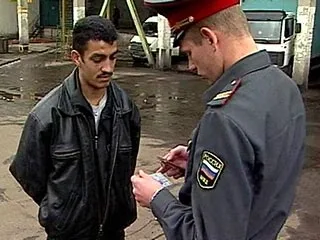
According to Novye Izvestia, this legislative initiative was approved at the end of last week by members of the Moscow City Duma commission on interethnic and interfaith relations. In their opinion, the innovation will help significantly reduce the number of illegal workers in the labor market. Meanwhile, human rights activists are convinced that the only thing the new registration rules will lead to is the complete enslavement of immigrants.
The idea for the document belongs to Pavel Konovalov, an expert at the Moscow University of the Ministry of Internal Affairs. He is convinced that the current practice, where migrants themselves obtain work permits, is untenable. For Moscow and the region, the following picture is typical: guest workers quickly part with a legal employer who pays less and find higher-paying but not always legal jobs. “At the same time, they become lawbreakers, since their stay in Russia no longer corresponds to the purpose of their visit that they stated – official employment. And migration service specialists also face difficulties in such cases, because they are obliged to find unengaged migrants and cancel their previously issued work permits,” believes Pavel Konovalov. The existing order, among other things, also negates the very idea of quota system for foreign labor. So, after obtaining a work permit, a migrant is not at all obliged to work for the organization that submitted the request to attract employees from abroad.
Pavel Konovalov proposes to solve these problems in one fell swoop by placing the responsibility for obtaining a work permit on the employer's shoulders. The newcomer thus faces a choice: either work where he was originally invited, or lose the work permit.
The idea is quite reasonable, but not entirely humane, independent experts believe. “The new scheme will completely free the hands of employers, giving them the opportunity to manipulate their employees. And guest workers will find themselves in bondage conditions,” believes Svetlana Gannushkina, chairwoman of the Civil Assistance committee. “If the employer handles the permit, then there will be no escape from him, I will be tied to him,” argues Zaur, a construction worker from Tajikistan. “And if he decides to make me work more or fine me my entire salary, or we just quarrel? What am I supposed to do, starve to death or go home to Tajikistan?!”.
The answer suggests itself: work illegally. “Thus, the shadow economy sector will only grow,” believes Nikita Mkrtchyan, senior researcher at the Institute of Demography of the Higher School of Economics. And according to Yevgeny Gontmakher, scientific director of the Center for Social Research and Innovation, the complication of the document processing procedure will generally lead to the fact that all newly arrived migrants will initially be oriented toward the illegal labor market.
Whose point of view will turn out to be closest to reality will become clear soon. If the Moscow City Duma approves this initiative at its meeting, then this draft will be submitted for consideration to the State Duma of the Russian Federation.