
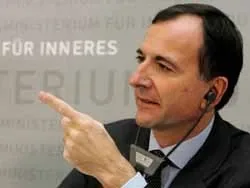
Nothing reconciles former opponents as quickly as the presence of a common external enemy. For Germany, the 'locomotive of the EU,' such an external enemy became the plan of EU Justice Commissioner Franco Frattini concerning labor migration. The social democrats and conservatives, who make up the German Grand Coalition, have been at loggerheads over this issue for almost two years now. Each party has its own vision of the problem, and no one wants to compromise on principles. But as soon as the European Commission published its plan to introduce a so-called 'blue card' (modeled on the 'green card' in the US) in the European Union for millions of potential immigrants, the SPD and CDU jointly turned their weapons against Brussels. Frattini, who voiced this plan, immediately received slaps on the wrist in Germany from both the social democrats and the conservatives.
"I don't know to what extent Mr. Frattini has managed to lose touch with reality," said Dieter Wiefelspütz, social policy expert for the SPD faction in the Bundestag, commenting on the Brussels project. "The idea of bringing so many people to Europe for nothing simply frightens me." As long as Germany has three and a half million of its own unemployed, Wiefelspütz believes, it should take care of jobs for them.
Additional migration into the country, in his opinion, will also exacerbate the problem of integrating newcomers into society: 'We must not repeat the mistakes of the sixties and seventies,' Wiefelspütz emphasized, quite transparently alluding to the mass arrival in Germany during that period, primarily of guest workers from Turkey, which led to the emergence of genuine 'parallel societies' in many large cities of the country.
Prominent representatives of the Christian Democrats use similar arguments. Thus, Federal Minister of Economics Michael Glos believes: 'Germany cannot afford mass labor migration just because we currently lack workers in some areas. This is not a faucet that you can turn on and off as you wish.' In his opinion, there are many young people in the country looking for work, and until they are employed, there is no need to look for replacements outside the EU. It is better to think about qualified specialists from the new member states.
Be that as it may, many leaders not only in Germany but also in other European countries are very dissatisfied with the European Commission's project. Moreover, the content of the document in this case is a secondary matter. What most outraged the 'captains' of European countries was the fact that Brussels is again interfering in the prerogatives of EU member states: the regulation of labor migration issues falls under the jurisdiction of national governments. In fact, in the German case, a compromise on this issue had only just been reached at a meeting in Schloss Meseberg... When suddenly another European Commission initiative appears, and the old dispute, resolved by common efforts, threatens to flare up again. According to experts, Frattini's initiative simply violates the EU constitutional treaty, which, however, has not even been adopted yet.
Thus, the document proposed by Brussels is doomed to failure from the outset, like all previous attempts by the European Commission to establish uniform rules for admitting migrants for EU member states. Germany, France and a number of other countries are ready to veto it as soon as it appears in official circulation.
Nevertheless, on October 23, Commissioner Frattini plans to propose two new European rules: the first should guarantee foreign specialists equal socio-economic rights with EU citizens, the second should create attractive conditions for their hiring in Europe. It is to this set of measures that the 'blue card' belongs: skilled foreigners should, according to the project, be given the opportunity for a two-year stay in the European Union, which can be extended. After two to three years, they will have the opportunity to move to Europe, after five years to stay, regardless of whether they have an employment contract. At the same time, the criteria for the initial contract should not be too burdensome: as Frattini stated, a salary clearly exceeding the minimum wage level for each specific country will be sufficient.
According to calculations by experts from the Financial Times, 20 million people could thus come to Europe over 20 years. However, this figure seems somewhat exaggerated to representatives of the European Commission. But it seems there is no point in arguing whether the newspaper was off by a couple of million or not – European leaders were in any case not thrilled with the European Commission's new 'bureaucratic miscarriage.' And this child, apparently, died before it was even born.
Boris ALTNER.
IA Rosbalt